Organ-on-a-chip technology tries to do something ambitious: rebuild the most important working features of human organs on small, engineered devices. Instead of growing cells in a flat dish, researchers place them inside tiny channels where fluids flow, forces act on tissues, and sensors can track what happens in real time. The review article describes how this approach has expanded from single-organ models, such as lung, liver, kidney, and heart chips, toward multi-organ systems that link several tissues together on one platform. That matters because the body does not work as isolated parts; drugs, hormones, immune signals, and waste products constantly move between organs. The field’s long-term goal is a kind of human-on-a-chip, where these interactions can be studied in a controlled lab setting. According to the review, researchers hope these systems will make biological research more realistic and reduce reliance on animal models that often fail to predict human responses. The article traces how the concept gained momentum after Donald Ingber and Daniel Huh’s 2010 lung-on-a-chip paper and shows why the technology is now viewed as a promising bridge between simple cell culture and the full complexity of the human body.
From cell dishes to miniature organs
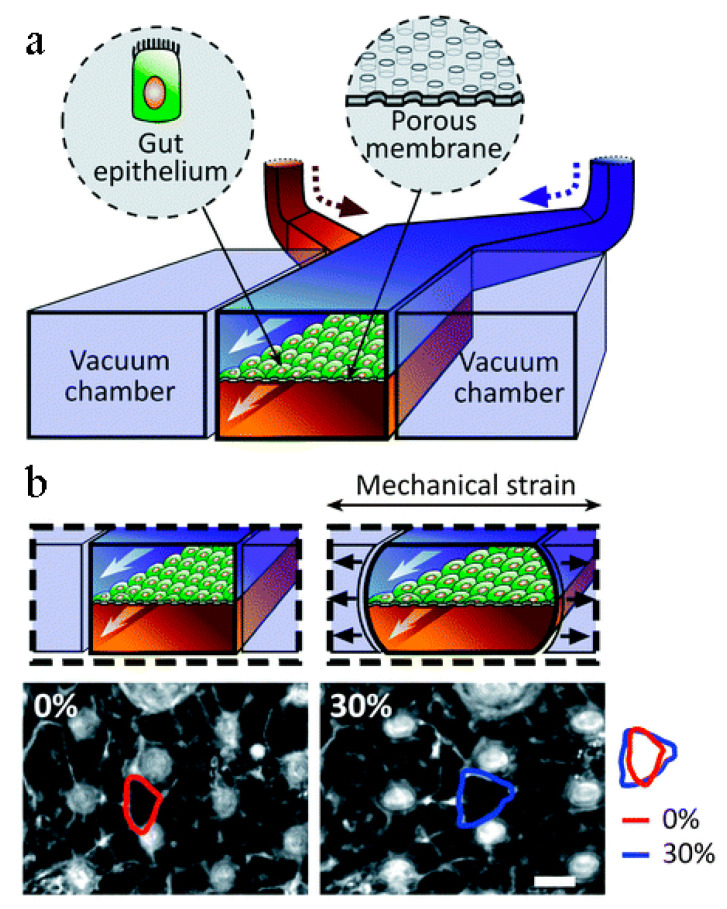
A useful way to think about an organ-on-a-chip is as a highly instrumented terrarium for cells. It gives living cells not just a place to sit, but a structured environment with moving fluid, flexible barriers, and chemical gradients that resemble the conditions inside the body.
The review explains that all organ-on-a-chip systems rely on microfluidics, meaning networks of tiny channels that control the movement of very small amounts of liquid. These chips also use biocompatible materials and built-in sensing tools, which can include imaging systems or microsensors that record how tissues behave over time.
Why single-organ chips are not enough
Single-organ models have been useful, but they only tell part of the story. A liver may process a drug, for example, but the effects of that drug also depend on what happens in the intestine, kidney, lung, or immune system afterward.
That limitation is what drives work on multi-organs-on-a-chip. The review describes these platforms as systems in which different tissues are connected by artificial, blood-like channels so scientists can study how one organ influences another, much closer to the way signals and molecules circulate in the body.
The rise of the human-on-a-chip idea
The review points to a landmark moment in 2010, when Huh and colleagues published the first lung-on-a-chip paper. That study helped define the field by showing that a microfluidic in vitro system—meaning a lab-grown model outside the body—could reproduce key physiological features of an organ’s basic functional unit.
Two years later, the idea scaled up. The review notes that a public-private partnership tasked Ingber’s lab with developing ten human organs-on-a-chip, signaling that the technology had moved beyond a clever proof of concept and into a coordinated effort to build a broader research platform.
Examples of connected organ systems
Researchers are not waiting for a full body-on-a-chip to start testing organ interactions. The article says studies have already explored two-, three-, four-, and even ten-organ chip systems, each designed to capture a more complete slice of human physiology.
One example highlighted in the review comes from Midwoud and colleagues, who combined liver and intestine tissues on a microfluidic chip to study the regulation of bile acid synthesis. That pairing makes biological sense: the intestine absorbs nutrients and signals, while the liver produces and recycles bile acids, so linking them creates a more realistic model than either organ alone.
How the chips are built and read out
Although organ-on-a-chip devices can represent different tissues, they share a common engineering logic. Cells are arranged inside miniature compartments, fluids are pumped through channels to mimic circulation, and sensors watch for changes in barrier function, metabolism, electrical activity, or cell health.
The review emphasizes the importance of these sensing components. An automated imaging system can continuously monitor tissue structure, while embedded sensors can provide direct readouts without needing to disturb the experiment, making the chip less like a static sample and more like a live dashboard.
Where the field is heading
The article notes that companies and academic labs are pushing beyond early models. In addition to lung chips, the effort associated with Ingber’s group had produced liver and intestine models and was working on next-generation systems that would include brain, kidney, and skin chips.
This expansion reflects a central promise of the field: the more organs researchers can model and connect, the better they can ask system-level questions. That includes how toxicity emerges, how a treatment changes as it moves through the body, and why a therapy that looks safe in one tissue can fail once multiple organs are involved.
Why This Matters
The attraction of organ-on-a-chip technology is not just that it is smaller or more sophisticated than standard cell culture. It is that these devices may better reproduce the human physiological environment—the physical, chemical, and biological conditions cells actually experience inside the body.
If that promise holds up, the payoff could be broad. More realistic models could improve early-stage drug testing, help researchers study disease mechanisms with greater precision, and reduce dependence on animal experiments that often do not map cleanly onto human biology.
The biggest challenge is realism at scale
At the same time, the review makes clear that the hardest problem is also the most important one: the body is deeply interconnected. A single chip that models one organ well is valuable, but it still cannot fully capture the feedback loops, timing, and cross-talk that shape real human responses.
That is why multi-organ integration remains such a major research focus. Building reliable bionic blood channels, balancing the needs of different tissue types, and keeping several organ models stable at once are difficult engineering and biological tasks, but they are essential if the field wants to move from organ mimicry to useful whole-body prediction.
What comes next
The review presents organ-on-a-chip technology as a fast-maturing field rather than a finished solution. The next phase will likely depend on how well researchers can combine more organs, improve sensing, and show that chip-based results consistently match what happens in people. If they can, these miniature systems may become one of the most practical tools for studying human biology in the lab—complex enough to matter, but controlled enough to test ideas that would be difficult or impossible to study in the body itself.