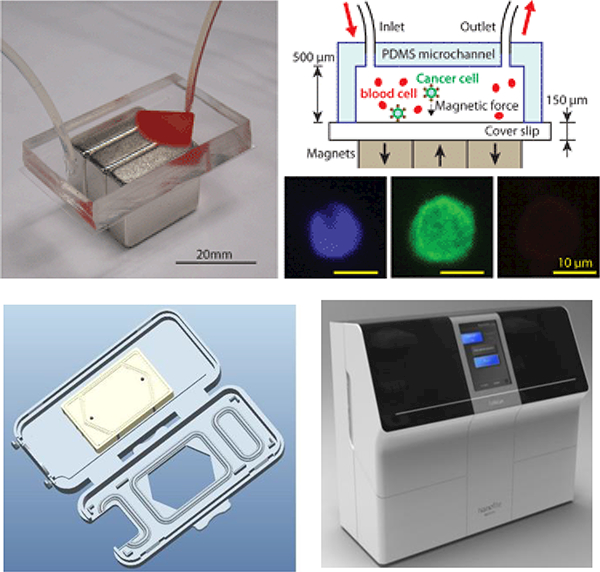
Liquid biopsy aims to read a cancer’s signals from blood instead of cutting into a tumor, and the article reviewed here argues that lab-on-chip systems are getting closer to making that idea practical at the point of care. Rather than sending samples through long, multi-step workflows in specialized labs, these miniature devices try to capture and analyze tumor-related material on a single platform. The focus is on three major classes of biomarkers: circulating tumor nucleic acids such as DNA and RNA fragments, circulating tumor cells or CTCs, and exosomes, tiny vesicles released by cells that carry molecular cargo. Each offers different clues about a patient’s cancer, from mutations to treatment response, but each also creates distinct engineering problems for chip designers. The review highlights that not every lab-on-chip strategy is equally useful outside a research setting, especially if the goal is rapid, simple testing in a clinic. In that context, choices about sample preparation, capture chemistry, detection method, and whether analysis can happen on the same device become just as important as raw sensitivity. The big message is straightforward: the field is moving toward integrated chips that can isolate rare biomarkers from blood and read them quickly, but the best systems for real-world cancer management will be the ones that balance accuracy with simplicity, speed, and usability.
What the review is really about
This source is a review of liquid biopsy on-chip technologies for cancer management, not a report on one single experiment. Its value lies in pulling together multiple approaches and asking a practical question: which ones are most likely to work in real clinical settings?
Think of a lab-on-chip device like shrinking a whole benchtop workflow into something closer to a credit-card-sized lab. The promise is that blood can go in, rare cancer-linked material can be sorted out, and a useful result can come back without the many manual steps that usually slow testing down.
The three biomarker streams
The review organizes the field around several kinds of tumor-derived material found in blood. Circulating tumor nucleic acids, often shortened to ctNA, include fragments of tumor DNA or RNA that can reveal mutations or other molecular changes linked to a cancer.
Circulating tumor cells are whole cancer cells that have broken away from a tumor and entered the bloodstream. They are rare, which makes them hard to capture, but they can offer a richer snapshot of disease because researchers may be able to study both the cells themselves and the mutations they carry.
Exosomes are tiny membrane-wrapped packages released by cells, a bit like microscopic parcels carrying messages. Because almost all cell types release them and they are abundant in serum and plasma, they have become an especially active target for on-chip liquid biopsy research.
Why chip design matters so much
The section provided from the review zeroes in on chip design considerations for point of care. That phrase matters because a device that works beautifully in a specialist lab may still fail as a bedside or clinic tool if it needs too much sample handling, too many external instruments, or too much technical expertise.
For point-of-care use, simpler is usually better. A good chip has to do more than detect a biomarker under ideal conditions; it has to process messy patient samples reliably, ideally with capture, detection, and analysis linked together in a clean workflow.
Exosomes stand out for practicality
The review describes exosome capture and analysis on-chip as an active area of development. One reason is abundance: unlike circulating tumor cells, which can be extremely scarce, exosomes are widely present in blood samples from cancer patients, giving chip designers more material to work with.
The article also notes that newer chip-based exosome methods improve on conventional isolation techniques and allow analysis to be streamlined on the same device. That is an important advantage, because combining isolation and readout reduces the need to transfer samples between tools, which can save time and lower the risk of sample loss or contamination.
Another useful point from the review is that although many of these systems were built for cancer, the strategy could extend to other diseases as exosomes are implicated more broadly. In other words, an effective chip architecture here may not be limited to oncology; it could become a more general diagnostic platform.
ctNA and CTCs offer richer detail, but add complexity
Capturing circulating tumor nucleic acids can provide direct access to cancer-linked mutations, which is one reason liquid biopsy has attracted so much attention. But nucleic-acid workflows often involve more complicated preparation and signal detection steps, making them harder to translate into quick point-of-care formats.
CTCs present a different tradeoff. They are harder to find because they are rare, but once isolated they can potentially reveal mutation status and other cellular features that a simple DNA fragment cannot show on its own.
The review mentions a case in which mutation levels were detected in captured CTCs, but with capture and analysis occurring on two separate microdevices. That detail may sound small, yet it points to a major design opportunity: if both steps already work in microscale systems, future developers may be able to merge them into a single chip and make the workflow much more usable.
Integration is the central engineering goal
Across biomarker types, the strongest theme is integration. In plain terms, the field is trying to move from a relay race, where a sample passes from one tool to another, to an all-in-one device that performs the whole sequence from enrichment to measurement.
This matters because every handoff adds friction. Each transfer can cost material, introduce error, increase operator time, and make it harder to deploy a test outside centralized labs. A point-of-care chip has to trim those steps without sacrificing the biological information clinicians care about.
The review suggests that some existing technologies are already pointing the way. When capture, detection, and analysis choices are made with the end setting in mind, on-chip systems become more than clever miniaturized experiments; they start to look like plausible clinical tools.
Why This Matters
Cancer management increasingly depends on repeat measurements rather than one-time snapshots. A blood-based test that can be run more easily could help doctors monitor treatment response, watch for recurrence, or detect emerging mutations without repeatedly relying on invasive tissue biopsies.
That is where on-chip systems could make a real difference. If a device can isolate the right biomarker quickly and analyze it on the same platform, it could shorten turnaround times and widen access to molecular testing in clinics that do not have advanced laboratory infrastructure.
The review does not claim that one biomarker or one chip format has already won. Instead, it shows that the smartest path may depend on the clinical question: exosomes may offer practical abundance, ctNA may deliver precise molecular clues, and CTCs may provide deeper cellular context.
What comes next
The next phase for this field is likely to be less about proving that these biomarkers exist and more about deciding which combinations of capture method, biomarker type, and on-chip analysis are robust enough for routine care. The technologies that succeed will probably be the ones that keep the science strong while stripping away operational complexity. If developers can integrate more of the workflow into single, reliable devices, liquid biopsy on-chip could shift from a promising research concept to a more regular part of how cancer is tracked and treated.