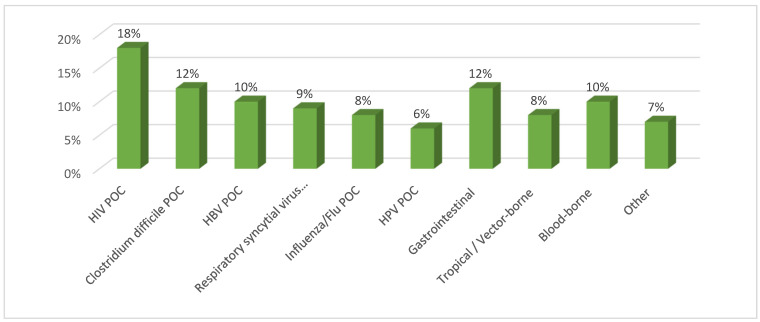
Point-of-care diagnostics for infectious diseases are moving tests out of centralized labs and closer to the patient, whether that means a clinic, a pharmacy, or a remote community setting. The core promise is simple: get an answer fast enough to guide treatment right away, instead of waiting hours or days for a lab result. According to the source review, this shift is being powered by several technologies at once, including immunoassays, molecular tests that detect genetic material, microfluidics that handle tiny volumes of fluid, biosensors, and artificial intelligence. The review also argues that speed alone is not enough. For these tools to improve public health at scale, they have to fit into real health-system workflows, connect to surveillance systems, survive supply-chain disruptions, and meet regulatory standards. That is especially important in infectious disease care, where a delayed diagnosis can mean missed treatment, wider spread, and more unnecessary antibiotic use. The picture that emerges is less about one miracle device and more about an ecosystem of engineering, clinical validation, software, policy, and financing. In that sense, the story of point-of-care testing is really a story about turning technical advances into dependable everyday care.
The technology stack is getting deeper
The review describes a field that has grown far beyond the familiar rapid strip test. Immunoassays, which work by using antibodies to recognize proteins from a pathogen, still make up the backbone of large-scale deployment because they are relatively cheap, fast, and easy to use.
But the technology frontier is shifting toward nucleic acid amplification tests, or NAATs, which detect a pathogen's genetic material. A useful analogy is photocopying a tiny fragment of viral or bacterial code until there is enough of it to see clearly. That amplification step can bring lab-like sensitivity into a compact test format.
The review also highlights newer approaches such as CRISPR-based diagnostics. CRISPR is better known as a gene-editing tool, but in diagnostics it can act more like a molecular sniffer, programmed to recognize a specific genetic sequence and trigger a detectable signal when it finds a match.
Why miniaturization matters
Another enabling technology is microfluidics, which means controlling extremely small amounts of liquid inside tiny channels. Think of it as shrinking a whole wet lab onto a chip, where fluids can be routed, mixed, and analyzed with much less reagent and often with less hands-on work.
That matters because infectious disease testing often has to happen in places with limited space, staff, or equipment. A smaller, more automated device can make sophisticated testing practical at the bedside or in lower-resource settings where a full laboratory is not available.
Biosensors add another layer. These devices convert a biological interaction, such as a viral protein binding to a capture molecule, into a readable signal, often electrical or optical. In point-of-care formats, that can support faster readouts and simpler workflows.
Artificial intelligence is entering the workflow
The review points to artificial intelligence as an increasingly important part of point-of-care diagnostics. In plain terms, AI can help a device interpret faint or complex signals, classify results more consistently, and sometimes support decision-making around what a result means in context.
This is especially useful when the test is being used outside a traditional laboratory. If a smartphone camera or portable reader can analyze an image or signal with software assistance, the system may reduce user error and improve consistency across many sites. But the review treats AI as a tool within a larger system, not as a substitute for careful test design and clinical validation.
Validation is where promising tools become reliable ones
A fast test is only useful if clinicians can trust it. The review emphasizes the need for clinical validation, meaning a test must be evaluated not just under ideal lab conditions but in the messy real world, where sample quality, operator skill, and patient populations vary.
That distinction matters because analytical performance and practical performance are not always the same thing. A device may look excellent in controlled experiments yet struggle when used in crowded clinics, during outbreaks, or in settings with temperature swings and supply interruptions.
The source also argues that success depends on more than a strong sensor or assay chemistry. Implementation science, reimbursement planning, training, and workflow integration all shape whether a point-of-care test is actually used correctly and often enough to improve outcomes.
Regulation and oversight shape adoption
The review places unusual weight on regulatory oversight, and for good reason. Infectious disease tests influence treatment choices, isolation decisions, and outbreak response, so weak evidence or unclear claims can have direct consequences for patients and communities.
Regulators are therefore not just checking a box. They help define what level of evidence is needed, how performance should be measured, and how software-driven features such as AI should be monitored over time. That is increasingly important as diagnostic platforms become connected, updateable, and more dependent on algorithms.
The article also ties regulation to market access and scale. Even a well-designed tool can stall if its approval path, reimbursement plan, or quality controls are poorly aligned with the healthcare systems expected to use it.
Why This Matters
The public-health case for point-of-care infectious disease diagnostics is straightforward: they can shorten the time from symptoms to diagnosis, and from diagnosis to treatment. In infectious disease control, that time savings can reduce transmission, improve outbreak response, and support antimicrobial stewardship, the effort to use antibiotics more carefully so resistance does not worsen.
The review also stresses equity. Decentralized diagnostics can extend access to communities that are far from major hospitals or laboratory networks, but only if the surrounding system supports them with financing, dependable supply chains, and digital connectivity for reporting and follow-up.
That last point is crucial. A test result at the bedside is helpful for one patient; a connected network of results can also strengthen surveillance by showing where infections are spreading and how quickly conditions are changing.
The next phase is about systems, not just sensors
The strongest message from the review is that point-of-care diagnostics should be understood as part of healthcare infrastructure, not as stand-alone gadgets. Their value depends on coordinated work across engineering, clinical evaluation, regulation, reimbursement, and deployment, especially in resource-limited settings.
That makes the future of the field both harder and more promising than a simple technology story. The science is advancing quickly, but the biggest gains may come from making these tools dependable, connected, and usable at scale. If that happens, point-of-care diagnostics could do more than speed up testing; they could reshape how health systems detect infection, guide treatment, and respond to the next outbreak.