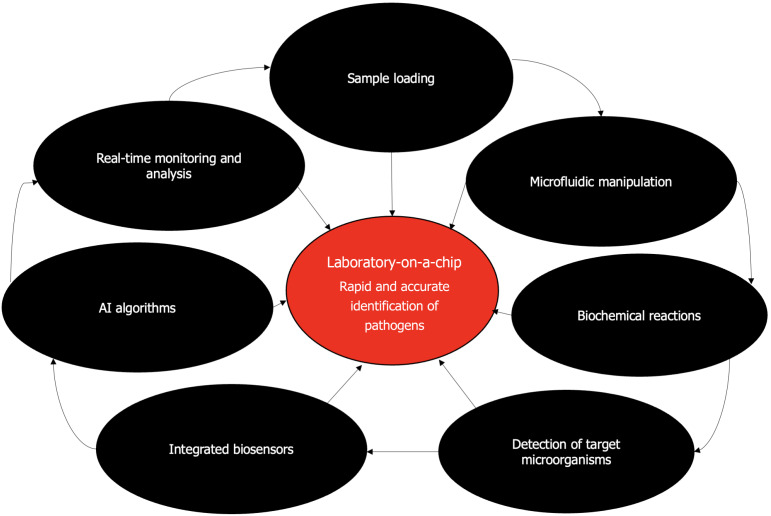
Laboratory-on-a-chip technology aims to shrink much of a medical lab onto a device small enough to fit in the palm of a hand. The core idea is simple: instead of sending a sample through several large instruments and many manual steps, a chip routes tiny amounts of fluid through microscopic channels and carries out the same tasks in sequence. In the source article, this approach is presented as a way to improve microorganism identification and diagnostics by combining sample preparation, chemical reactions, separation, and detection in one compact system. That matters because diagnosing infections often depends on speed, especially when clinicians need to decide quickly whether a patient has a bacterial, viral, or fungal threat. By reducing sample and reagent volumes, these devices can also cut cost and waste while increasing automation. The article highlights how laboratory-on-a-chip systems use microfluidics—the control of fluids in channels only tens to hundreds of micrometers wide—to perform functions that normally require a full laboratory bench. It also points to several sensing strategies, including optical, electrochemical, and magnetic detection, that can turn biological signals into readable results. Taken together, the technology promises faster, more portable testing, especially in settings where traditional lab infrastructure is hard to access.
How a lab fits on a chip
A laboratory-on-a-chip, often shortened to LOC, integrates one or more laboratory functions onto a chip measuring only millimeters to a few square centimeters. Think of it like compressing an assembly line into a tiny apartment kitchen: every tool is still there, but arranged to do more work in less space.
In practice, the chip uses etched or molded microchannels to move droplets and streams of liquid with precision. Because the channels are so small, fluids can be controlled very tightly, which helps the device handle tasks such as mixing, filtering, and delivering samples to the right testing zones.
Why microfluidics is central
Microfluidics is the enabling science behind these systems. It deals with moving and controlling tiny volumes of fluid, typically in channels far narrower than a grain of rice, allowing the chip to mimic steps that would otherwise require tubes, pumps, and benchtop instruments.
That small scale changes the economics and the speed of testing. Less sample is needed, less reagent is consumed, and reactions can occur faster because heat and molecules move efficiently over short distances. The source article argues that these advantages can support both lower-cost testing and higher-throughput analysis, meaning more samples can be processed in less time.
From raw sample to readable answer
One of the most useful features of LOC systems is that they can handle several parts of a diagnostic workflow in one place. According to the source, these devices often include modules for sample collection, filtration, concentration, and dilution so that a specimen is prepared before the actual measurement begins.
That integration matters because raw clinical samples are messy. Blood, saliva, urine, or environmental swabs can contain debris, inhibitors, and widely varying concentrations of target organisms. A chip that cleans up and standardizes the sample before analysis can improve consistency and reduce the need for trained technicians to perform each preparation step by hand.
Miniaturized reactions on the device
After preparation, the chip can host biochemical reactions that reveal whether a microorganism is present. The source specifically mentions polymerase chain reaction, or PCR, a method that amplifies genetic material so tiny amounts of microbial DNA or RNA become easier to detect.
It also points to enzyme assays and immunoassays. An enzyme assay measures the activity of specific biological catalysts, while an immunoassay uses antibodies as highly selective hooks to capture target molecules. Putting these reactions on a miniaturized chip can speed up processing and make the whole workflow more self-contained.
Separating the signal from the noise
Before detection, many tests need a way to separate useful targets from everything else in the sample. The article notes that LOC devices can use techniques such as electrophoresis, chromatography, and dielectrophoresis to sort or purify analytes based on physical or chemical properties.
An easy analogy is airport security: people and bags are funneled through different checkpoints so the right items reach the right destination. On a chip, electric fields, surface chemistry, or flow behavior can direct cells, nucleic acids, proteins, or particles into different paths, improving the chances that the detector measures the true target rather than background clutter.
Three main ways chips detect microorganisms
The source highlights three broad detection modes: optical, electrochemical, and magnetic. Each converts a biological event into a signal, but they do it in different ways, which lets designers choose the approach that best fits a pathogen, sample type, and clinical setting.
Optical detection uses light-based readouts such as fluorescence, absorbance, or chemiluminescence. Fluorescence works like invisible ink under a special lamp: a target molecule is tagged with a marker that glows when excited by light. Absorbance measures how much light a sample blocks, while chemiluminescence detects light produced by a chemical reaction.
Electrochemical detection reads electrical changes. If a biological reaction causes a shift in current, voltage, conductivity, or a redox process—a reaction involving electron transfer—the chip can translate that into evidence that a microbe or biomarker is present. These systems can be attractive for portable devices because the electronics are often compact and relatively straightforward to integrate.
Magnetic detection uses magnetic particles and sensors to find target analytes. In simple terms, magnetic beads can be coated to latch onto a microbe or molecule of interest, and then the device tracks the beads rather than the target itself. This can help pull rare targets out of complex samples and make them easier to count or confirm.
Why This Matters
The larger promise of laboratory-on-a-chip systems is not just miniaturization for its own sake. It is the possibility of moving reliable testing closer to where patients are seen, whether that is a hospital bedside, a clinic with limited infrastructure, or a field setting where shipping samples to a centralized lab is slow or impractical.
For microorganism identification, faster answers can shape treatment decisions earlier. A compact device that automates preparation, reaction, separation, and detection could shorten the time between collecting a sample and knowing what organism is involved. That, in turn, could support more targeted care and reduce unnecessary broad-spectrum treatment when the source of infection is uncertain.
What comes next
The source frames LOC technology as a platform rather than a single product, which is important because different infections and clinical environments need different designs. Some applications may favor optical readouts for sensitivity, others electrochemical systems for portability, and others magnetic workflows for pulling targets out of difficult samples.
The next phase will depend on how well these chips move from promising technical concepts into robust diagnostic tools that fit real clinical routines. If developers can pair the precision of microfluidics with dependable sample handling and easy-to-read outputs, laboratory-on-a-chip devices could make advanced microorganism testing faster, smaller, and far more accessible than conventional lab workflows allow.