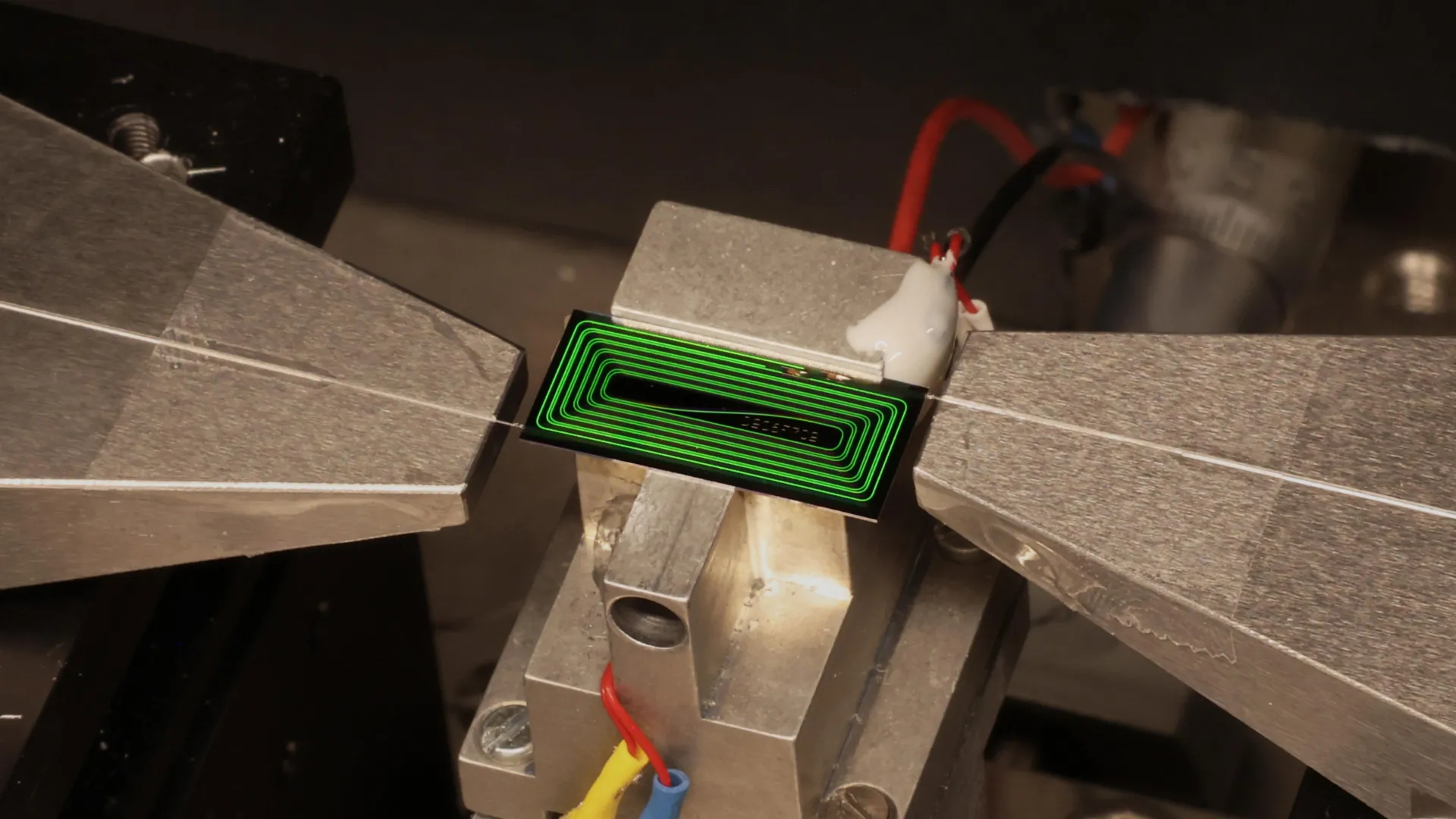
For decades, some of the most useful lasers in science have also been among the least portable. Femtosecond lasers, which emit extraordinarily short pulses lasting just one quadrillionth of a second, are central to fields such as precision measurement, advanced imaging, and high-speed communications. But these systems usually sit on optical tables and rely on bulky components that are expensive, delicate, and hard to deploy outside specialized labs. Researchers at EPFL now say they have crossed a major threshold: they have built a chip-scale ultrafast laser that performs on par with conventional tabletop femtosecond systems. The result is a long-sought step toward miniaturizing one of photonics' most powerful tools without sacrificing performance. If the approach scales, it could lower costs and make high-end laser capabilities available in many more settings. That includes medical devices, portable sensing systems, and timing tools such as atomic clocks that today depend on large, carefully maintained setups.
A long-standing photonics challenge
The phrase “shrink a laser onto a chip” can sound straightforward, but it has been a stubborn engineering problem for roughly two decades. Ultrafast lasers must generate pulses that are not only very short, but also stable, energetic, and repeatable, which usually requires a carefully balanced arrangement of mirrors, gain materials, and optical components.
When engineers try to reproduce that behavior on a chip, they run into tradeoffs. Small devices are attractive because they are compact and potentially cheap to manufacture, but miniaturization can make it harder to maintain the pulse quality and output power needed for real-world applications.
What EPFL built
The EPFL team reports a chip-scale ultrafast laser that can match the performance expected from traditional tabletop femtosecond lasers. In practical terms, that means the researchers did not simply make a tiny laser; they made one that reaches the performance level that has made larger femtosecond systems so valuable in research and industry.
That distinction matters because many previous efforts in integrated photonics have shown pieces of the puzzle without delivering a full substitute for laboratory-scale hardware. Here, the advance is framed as a genuine compression of capability: bringing high-end ultrafast laser behavior into a much smaller platform.
Why femtosecond pulses are so useful
A femtosecond is an almost unimaginably short slice of time, and pulses on that scale let scientists probe events that happen extremely quickly. They are useful for studying fast chemical reactions, making precise measurements, and generating stable optical signals that can serve as rulers for time and frequency.
Because these lasers can deliver intense bursts of light over ultrashort intervals, they are also used in imaging and diagnostic tools where precision is essential. In many cases, the value comes from combining speed, control, and consistency, qualities that are difficult to preserve when the hardware gets smaller.
Why putting it on a chip changes the equation
Moving this kind of laser onto a chip could transform how advanced photonics systems are built and used. Chip-scale devices can, in principle, be mass-produced using techniques closer to semiconductor manufacturing, which opens the door to lower-cost and more standardized components.
Smaller systems also tend to be easier to integrate into instruments. Instead of building an entire platform around a laser on an optical table, developers could potentially embed ultrafast sources inside medical tools, portable analyzers, or field-ready sensors where size, robustness, and power consumption are critical.
Possible applications
The researchers point to a broad range of uses, including medical diagnostics and atomic clocks. In diagnostics, compact ultrafast lasers could help enable more advanced optical tests in smaller, more accessible devices, potentially moving capabilities now confined to major centers into clinics or point-of-care systems.
Atomic clocks are another compelling example because they depend on exceptionally stable light sources to keep time with astonishing precision. A chip-based laser that can meet stringent performance requirements could make precision timing systems smaller and easier to deploy in communications, navigation, and scientific instruments.
Beyond size: accessibility and cost
The deeper significance of the work is not just miniaturization for its own sake. Tabletop femtosecond lasers are powerful, but their complexity and price limit who can use them and where they can go. If comparable performance can be offered in a chip-scale format, advanced photonics could become accessible to many more labs, companies, and device makers.
That kind of shift often changes an entire field. Technologies that begin as specialized scientific tools can become platforms for broader innovation once they are small enough, reliable enough, and affordable enough to be designed into products rather than treated as rare infrastructure.
Why This Matters
This development stands out because it suggests that integrated photonics is starting to capture not just simple optical functions, but some of the most demanding laser behaviors as well. Matching a tabletop femtosecond laser on a chip implies a level of control that researchers have been chasing for years, and it points to a future where high-performance optical systems are no longer tied to large, fragile laboratory setups.
For readers outside photonics, the simplest way to think about it is this: a technology that once required a bench full of precision hardware may now be heading toward a footprint closer to a microchip. When that happens, tools that were once rare often become commonplace, and new applications emerge because engineers can finally build around them.
What comes next
The next phase will be proving that the laser can be manufactured reliably, integrated with other on-chip components, and tailored for specific applications. Real impact will depend not only on performance in a research setting, but also on durability, scalability, and how easily the device can be incorporated into practical systems.
Still, after years of effort, the EPFL result looks like a meaningful turning point. If the technology continues to mature, chip-scale femtosecond lasers could help move ultrafast photonics out of elite laboratories and into the wider world, where compact, powerful light sources could support everything from better diagnostics to more precise timing and sensing.