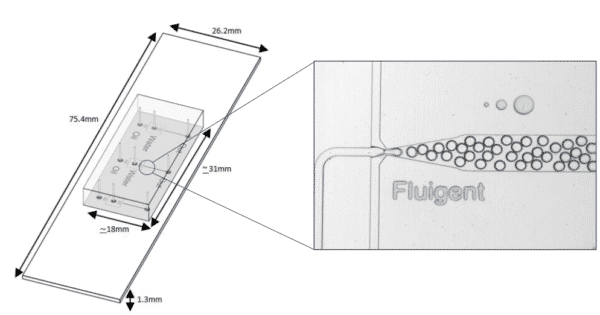
Microfluidic chip technology is finding uses far beyond simple lab plumbing. In the source material from Fluigent, the most striking examples span cancer research, wearable sensors, and the basic fluid-handling tricks that make these tiny systems useful in the first place. One highlighted device, described by Ayuso and colleagues, recreates the three-dimensional structure of a tumor spheroid while also producing a visible live “tumor slice,” giving researchers a window into how cells behave in different parts of the same miniature tumor. That matters because tumors are not uniform: cells at the center often face different oxygen, nutrient, and drug conditions than cells at the edge. Microfluidics helps model those differences in a controlled way, using channels so small they can steer minute amounts of liquid with high precision. The same control also makes the technology attractive for wearables, where only tiny samples of sweat or other body fluids may be available. Underneath these applications is a simple idea with big consequences: when fluids move through microscopic channels, they behave in predictable ways that engineers can exploit for sensing, testing, and monitoring.
What a microfluidic chip actually does
A microfluidic chip is a small device etched or molded with tiny channels that guide liquids. You can think of it like a city map for droplets: instead of cars moving through streets, fluids move through channels measured in micrometers, or millionths of a meter.
At that scale, fluid behavior changes. Flow is often laminar, which means liquids move in smooth, parallel streams rather than churning turbulently as they would in a sink or river. That predictability is one of microfluidics’ biggest advantages, because it lets researchers meter, combine, and observe very small liquid samples with fine control.
Modeling tumors in three dimensions
One application described in the source comes from Ayuso and co-authors, who presented an easy-to-use microfluidic device for studying tumors. Their chip mimics the three-dimensional architecture of multicellular spheroids, which are compact clusters of cells often used to model tumors more realistically than flat cell layers grown on a dish.
The design also creates a visible, live “tumor slice.” That gives scientists a way to watch cells in real time across different regions of the microenvironment—the immediate local surroundings that shape how cells grow, signal, and respond to stress. In practical terms, the chip lets researchers see whether cells near the outer edge behave differently from cells buried deeper inside.
Why that tumor view is useful
This kind of setup matters for drug testing. A tumor is not just a mass of identical cells; it contains gradients of oxygen, nutrients, waste products, and drug exposure. A microfluidic model that preserves those differences can reveal why a therapy appears effective in one region but less so in another.
The source emphasizes that the device allows easy monitoring of how cells respond to different drugs. That is valuable because it links structure and treatment response in the same live system. Instead of taking a single endpoint measurement after the fact, researchers can watch changes unfold as they happen.
Wearable microfluidics moves the technology onto the body
The Fluigent article also points to wearable microfluidics as an emerging application. In these devices, the microstructures do not just transport fluid; they are often the core of the sensing system itself, storing or directing tiny amounts of liquid taken from the body.
This is especially useful for bodily fluids that are difficult to collect in large volumes. Sweat is a good example. A wearable patch or similar device may only have access to trace amounts, so the ability to guide precise liquid volumes through tiny channels can improve accuracy and reliability without wasting sample.
The hidden superpower: precise fluid handling
What makes these chips so capable is not magic chemistry but careful control of movement. The source notes that microchannels can manipulate precise liquid amounts, which is essential when the available sample is limited and the measurement has to be trustworthy.
An everyday analogy is a set of measuring spoons built into a maze. Each narrow path can meter, delay, or combine liquids in a known way. In a sensing device, that means the chip can help standardize how much sample reaches a detector, which improves consistency from one test to the next.
How mixing works when fluids stay orderly
Mixing in microfluidic chips can seem counterintuitive because laminar flow keeps streams orderly. If you pour cream into coffee, turbulence does much of the mixing for you. Inside a microfluidic channel, that kind of chaotic swirling usually does not happen on its own.
Instead, passive mixing often relies on diffusion, the natural tendency of molecules to spread from an area of higher concentration to lower concentration. When two liquids flow side by side in parallel layers—a setup the source describes as lamination—molecules gradually cross the boundary between them. That gives engineers a slow but very controllable way to tune mixing.
Speeding up mixing by shaping the channel
When faster mixing is needed, chip geometry can do the work without requiring an external power source. The source describes inducing chaotic advection, which means using specially shaped channels to repeatedly split, fold, stretch, or disrupt fluid streams so molecules intermingle more quickly.
A useful analogy is kneading dough with colored streaks in it. Each fold and stretch spreads the colors into thinner layers until they blend. In a microfluidic chip, altered channel shapes create the fluid equivalent of that process, accelerating mixing while keeping the system compact and simple.
Why This Matters
Taken together, these examples show that microfluidics is not just a miniaturization trend. It is a practical way to recreate complex biology in the lab and to build sensors that work with scarce samples in the real world. The same physical principles that let a chip model a layered tumor can also help a wearable device manage sweat or another bodily fluid with high precision.
That overlap is important because it suggests a shared engineering toolkit across very different fields. Better control of tiny fluid volumes can improve disease models, drug testing, and personal monitoring technologies at the same time. In each case, the chip becomes more than a container: it actively shapes what can be measured and understood.
Where the field is headed
The source presents microfluidic technology as a platform whose value grows as designs become easier to use and more application-specific. Devices that make biology visible in real time, like the tumor-slice system, could help researchers ask sharper questions about treatment response. Wearable formats could push microfluidics out of the lab and into continuous, everyday sensing.
The common thread is control at small scale. As engineers refine channel geometry, fluid handling, and integration with sensors, microfluidic chips are likely to become less like specialized curiosities and more like standard tools for studying cells and reading signals from the body. The technology is small, but the range of problems it can tackle is getting steadily larger.