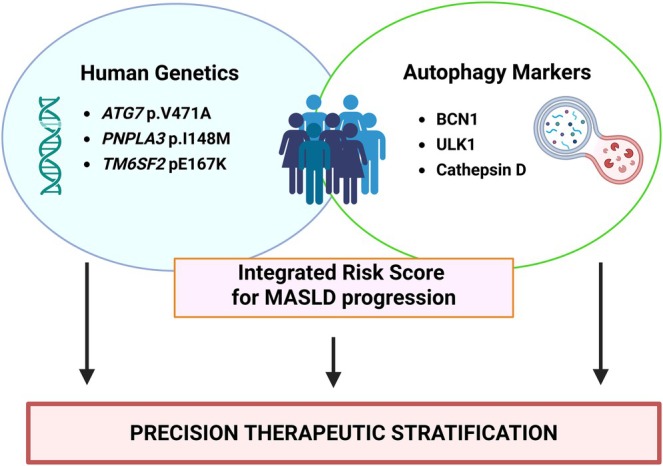
Metabolic dysfunction-associated steatotic liver disease, or MASLD, has become the most common chronic liver disease in the world, but the new review summarized here argues that fat alone is not the whole story. The authors make the case that a cell-cleanup system called autophagy is a central control point in how MASLD begins, worsens, and in some people progresses to cirrhosis or liver cancer. Autophagy is the process cells use to break down damaged parts and recycle them, a bit like a household service that hauls away broken appliances and sorts useful materials for reuse. In the liver, that system helps clear excess fat droplets and worn-out mitochondria, the structures that generate energy. When autophagy falters, the review argues, fat builds up, oxidative stress rises, liver cells become injured, and scarring can follow. The article also highlights evidence that inherited genetic variants, especially in PNPLA3 and ATG7, may weaken these protective pathways and help explain why some people develop more aggressive disease than others. Rather than treating MASLD as one uniform condition, the authors propose a precision medicine approach that matches therapies to a person's genetics and to measurable signs of autophagy function. That framing turns autophagy from a background biological detail into a practical target for future diagnosis and treatment.
Why Autophagy Matters in MASLD
MASLD is driven by metabolic stressors such as obesity and insulin resistance, but the review argues that these triggers do their worst when the liver's internal maintenance systems cannot keep up. Autophagy is one of those systems, and its job is to identify unwanted cellular material, package it, and deliver it for breakdown.
An everyday analogy helps: think of a busy city where garbage collection suddenly slows down. Trash piles up, traffic gets blocked, and basic services start to fail. In liver cells, impaired autophagy creates a similar bottleneck, allowing damaged components and excess fat to accumulate until normal function starts to break down.
The Special Roles of Lipophagy and Mitophagy
The review focuses on two forms of selective autophagy that appear especially important in MASLD. Lipophagy is the targeted breakdown of lipid droplets, the tiny fat-storage packages inside cells, while mitophagy removes damaged mitochondria before they can cause trouble.
These two pathways work like separate cleanup crews with different assignments. Lipophagy helps prevent runaway fat storage in the liver, and mitophagy protects mitochondrial health so the cell can keep making energy without spilling harmful byproducts. If either system slows, the liver becomes more vulnerable to steatosis, meaning excess fat accumulation, and to oxidative stress, a chemically damaging state caused by unstable oxygen-related molecules.
How Breakdown in Autophagy Can Drive Disease Progression
According to the review, disrupted autophagic flux is tied not just to fat buildup but to the transition toward more dangerous stages of liver disease. Autophagic flux refers to the full process of forming, transporting, and degrading unwanted cellular material; it is not enough for autophagy to start if the material never gets cleared.
When that flow is impaired, the consequences can stack up. The authors connect defective autophagy to hepatocellular ballooning, a form of liver cell injury in which cells swell and lose structural integrity, as well as to fibrogenesis, the process that lays down scar tissue. Over time, that environment may also help create the conditions for hepatocellular carcinoma, or HCC, the most common form of primary liver cancer.
What Genetics Adds to the Picture
One of the most important ideas in the article is that autophagy may help bridge metabolism and genetics. The authors point to growing evidence that inherited differences between people can change how well these cellular quality-control systems work, shaping a person's risk of severe MASLD.
The review singles out the p.I148M variant in patatin-like phospholipase domain-containing protein 3, better known as PNPLA3, as a major modifier of MASLD risk. It also highlights loss-of-function and hypomorphic variants in autophagy-related gene 7, or ATG7, a core gene required for autophagy. In plain terms, these variants may leave the liver less able to manage fat and damaged cellular machinery, predisposing some individuals to ballooning, fibrosis, and HCC.
From One-Size-Fits-All Care to Precision Medicine
The review does not present a single new drug trial; instead, it lays out a framework for how treatment could become more personalized. The authors argue that genetics and biomarkers of autophagy dynamics could be combined to sort patients into more meaningful subgroups.
That matters because MASLD can look similar on the surface while behaving very differently from person to person. Two patients may both have fatty liver, yet one might remain stable for years while another rapidly develops fibrosis or cancer risk. A precision medicine model would try to identify those differences earlier and tie them to the biology driving each case.
Therapies Aimed at Restoring Cellular Cleanup
The article also surveys emerging therapeutic strategies that aim to restore autophagic flux. The basic idea is straightforward: if impaired cleanup and recycling contribute to disease, then improving that system could reduce fat accumulation, limit lipotoxicity, and slow scarring.
Lipotoxicity means the damage caused when excess fat or fat-derived molecules become harmful to cells rather than simply being stored. By restoring the liver's ability to process lipid droplets and dispose of damaged mitochondria, future treatments might ease several linked problems at once instead of addressing only a single symptom. The review presents this as a promising direction, though still one that depends on better biomarkers and clearer patient selection.
Why This Matters
This review matters because it reframes MASLD as more than a passive consequence of eating too much or gaining weight. It suggests that the liver's ability to maintain internal order, and a person's inherited capacity to support that process, may strongly influence who develops severe disease.
That shift has practical implications. If clinicians can identify patients with impaired autophagy pathways or high-risk variants such as PNPLA3 and ATG7, they may eventually be able to intervene earlier, monitor more carefully, and choose therapies with a stronger biological rationale. For a disease that affects huge numbers of people but still lacks highly tailored treatment, that would be a meaningful step forward.
What Comes Next
The review's larger contribution is conceptual: it brings metabolism, cell biology, genetics, fibrosis, and cancer risk into one connected model. The next challenge will be turning that model into tests and treatments that work in everyday care. If future studies can reliably measure autophagy activity in patients and show which therapies restore it, MASLD care could move from broad risk categories toward truly individualized management.