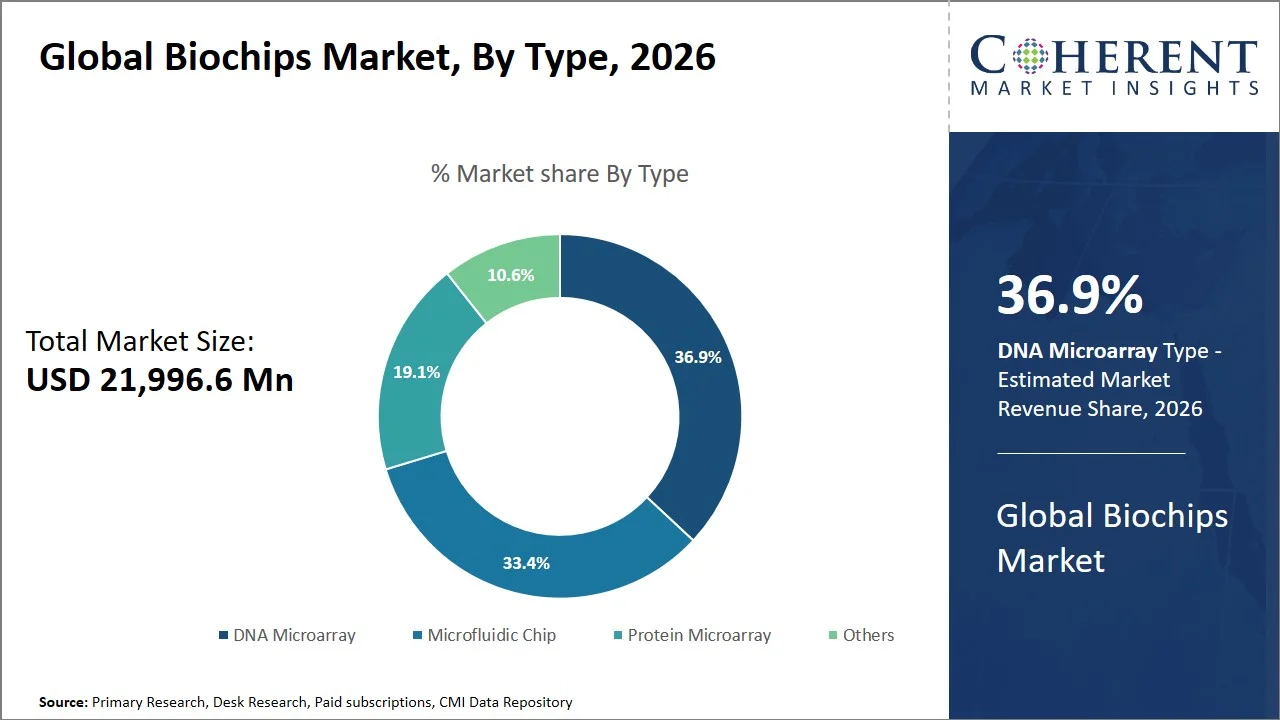
The biochips market is being pushed forward by a simple idea: put more biology onto smaller, faster, smarter devices. According to the source material, that shift is showing up most clearly in drug discovery, high-throughput screening, and advanced diagnostics, where biochips can test many biological interactions at once while using less time and fewer reagents. The category includes DNA chips, which analyze genes; protein chips, which track proteins and their behavior; and lab-on-a-chip systems, which shrink parts of a laboratory onto a compact device. The report points to growing use in target identification, toxicity testing, pharmacogenomics, and compound screening, all of which matter because they sit near the front end of how new medicines are found and validated. It also highlights a series of 2025 developments, including a partnership between Archer Materials Limited and Paragraf and a product launch from Coherent Corp., as signs that the field is moving beyond theory and into more specialized hardware. Underneath those announcements is a broader technical trend: biochips are increasingly merging biology with semiconductors, optics, microfluidics, and biosensors. That combination could make future tests more sensitive, more portable, and better suited to precision medicine, where care is tailored to the biology of an individual patient. If the report’s outlook holds, the next phase of the market will be defined less by whether biochips are useful and more by where they can deliver the most value fastest.
Why biochips are gaining traction
A biochip is a small device built to run biological tests in a highly organized format. A good everyday analogy is a parking lot with hundreds or thousands of clearly marked spaces: each spot can hold a different sample or capture a different signal, letting researchers inspect many possibilities in parallel rather than one by one.
That parallel testing is the heart of their appeal. In drug research, the source says biochips help scientists quickly assess compounds, biomarkers, and biological interactions, which can speed up assays, improve accuracy, and reduce reagent use.
Where the technology is being used
The report identifies several applications already driving demand. These include target identification, which means finding the molecular feature a drug should act on, and toxicity testing, which looks for signs that a candidate compound could be harmful.
It also points to pharmacogenomics, the study of how genes affect a person’s response to drugs, and compound screening, where large libraries of molecules are tested to find promising starting points. Biochips are attractive here because they can handle many tests at once, which is the core idea behind high-throughput screening.
Recent developments cited in the report
Among the concrete examples in the source is an American Chemical Society article published in October 2025 that highlighted progress in high-throughput screening technology. The raw material does not provide experimental details, but its inclusion signals that the market forecast is tied to ongoing technical improvement, not just financial projection.
The source also cites a May 2025 partnership between Archer Materials Limited and Paragraf. Their stated goal was to fast-track high-tech biochip systems by integrating graphene electronics, a class of ultrathin carbon-based components known for strong electrical performance, into biosensor platforms for diagnostics.
A second example comes from January 2025, when Coherent Corp. released biochips built with pin-hole arrays for high-end medical diagnostics. According to the source, the design was intended to improve optical detection and signal processing, two features that matter when devices must detect faint biological signals reliably.
The engineering shift behind the market story
What links these examples is a move toward tighter integration between biology and advanced hardware. Think of it like upgrading from a magnifying glass to a smartphone camera with image processing built in: the basic job is still to see something small, but the added electronics make the result sharper, faster, and easier to interpret.
In biochips, that means combining biosensors, which convert a biological event into a measurable signal, with semiconductors, optics, and microfluidics, the controlled movement of tiny amounts of liquid through miniature channels. The source suggests this engineering stack will help enable better sensitivity, more miniaturization, and broader medical use.
What the forecast says about the next phase
The report frames the market outlook around several converging trends: precision medicine, genomics, microfluidics, and artificial intelligence in diagnostics. Precision medicine aims to match treatment to the biology of a specific patient, while genomics focuses on the information contained in DNA; biochips are useful because they can rapidly gather and organize that kind of data.
The source also expects growth in decentralized diagnostic solutions and real-time biomarker testing. In plain terms, that means more testing closer to the patient rather than only in large central labs, and more devices that can spot useful biological signals quickly enough to influence immediate decisions.
Why This Matters
Market forecasts can sometimes sound abstract, but this one maps onto practical changes in how medicine and research are done. If biochips become smaller, more sensitive, and easier to manufacture, they could help researchers screen drug candidates faster and help clinicians run more informative tests with less sample material.
That matters especially for multi-analyte testing, where one device measures several targets at the same time. Instead of treating each marker like a separate errand, biochips can bundle them into one trip, which could support faster diagnosis and more complete biological snapshots.
What to watch next
The strongest signal in the source is not a single product launch but the direction of travel. Biochips appear to be evolving from specialized laboratory tools into more integrated platforms that connect sensing, signal processing, and data interpretation in one compact system.
The next key question is where adoption happens fastest: drug discovery, advanced hospital diagnostics, or decentralized testing outside traditional lab settings. If companies can translate semiconductor integration, graphene-based electronics, and compact lab-on-a-chip design into dependable real-world performance, biochips may become one of the quiet enabling technologies behind the next generation of diagnostics and therapeutic development.