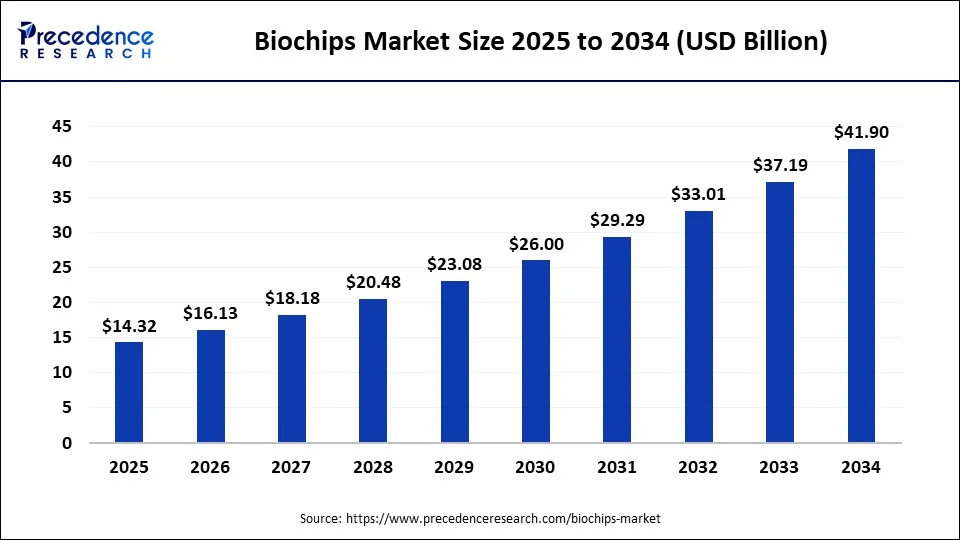
The global biochips market is projected to grow from USD 14.32 billion in 2025 to USD 41.90 billion by 2034, according to the source report, a jump that implies a 12.67% compound annual growth rate. That forecast reflects a simple idea with big consequences: laboratories and clinics want to run more tests, on smaller samples, faster and with better precision. Biochips help do that by shrinking many biological measurements onto a tiny device, much like putting an entire testing bench onto something closer to a computer chip. The report ties that demand to several trends moving at once, including targeted therapies, drug discovery, and wider use of next-generation sequencing, or NGS, a way to read DNA and RNA quickly at large scale. It also points to miniaturized diagnostic tools for real-time testing, which matters because healthcare is steadily moving away from large centralized labs for some decisions. On the industry side, large companies still dominate core hardware, while startups and niche biotechnology firms are pushing forward in microfluidics, assay chemistry, and software. Taken together, the picture is of a market growing not because of one blockbuster device, but because biochips are becoming useful across genomics, diagnostics, and research workflows at the same time.
What biochips actually do
A biochip is a small platform that can detect or analyze biological material such as DNA, RNA, proteins, or cells. Think of it like a highly organized parking lot where each space is designed to capture a specific biological target, letting researchers or clinicians test many things at once on a single surface.
That parallel testing is the key advantage. Instead of running one assay after another, a biochip can support many reactions in miniature, saving sample volume, shortening turnaround time, and often improving consistency.
Why the market is expanding
The report links growth to rising demand for targeted therapies, treatments chosen based on the biology of a patient or disease. That kind of medicine depends on tools that can sort through genetic or molecular signals quickly, which makes biochips attractive in both research and clinical settings.
It also highlights drug discovery and NGS adoption. In practice, that means pharmaceutical companies and research labs need platforms that can handle complex workflows, while sequencing-based analysis creates demand for companion tools that prepare, process, or validate biological samples.
From raw materials to finished platforms
The source breaks the market into a chain of technical steps, starting with component fabrication. This is where raw materials are turned into working elements such as DNA probes, protein capture molecules, electrodes, microfluidic channels, and the surface chemistries that help a chip bind the right target and ignore the wrong one.
Those details matter because sensitivity and specificity are not abstract engineering goals. Sensitivity is the ability to detect a signal when it is present, while specificity is the ability to avoid false alarms, and both depend heavily on how these microscopic components are designed and manufactured.
How manufacturers assemble biochips
After components are made, manufacturers combine them into complete devices using methods such as lithography, deposition, spotting, and microarray printing. A useful analogy is newspaper printing at very high precision: the pattern has to land in exactly the right place, except here the “ink” may be biological molecules that need to remain functional.
These manufacturing approaches support genomic, proteomic, and diagnostic applications. Genomics focuses on genes and genetic material, while proteomics studies proteins, and both fields benefit from the ability to place many test features in a compact, repeatable format.
The platform is bigger than the chip
The report also emphasizes instrumentation and system integration, which is a reminder that a biochip rarely works alone. It is usually paired with scanners, imaging systems, microfluidic controllers, and analytical software that together turn a tiny device into a usable workflow.
That systems view is important for buyers. A hospital lab or research center is not purchasing just a chip surface; it is buying an ecosystem that must produce readable data, fit existing procedures, and support decisions in clinical diagnostics, genomics, or basic research.
Who leads the field
According to the source, the market remains highly competitive and is led in hardware by established companies including Thermo Fisher Scientific, Illumina, Inc., Agilent Technologies, Bio-Rad Laboratories, Inc., and Abbott Laboratories. These firms are described as being especially active in genomic workflows, sequencing, and microarray-based technologies.
At the same time, startups and specialized biotechnology companies are pushing innovation in microfluidics, assay chemistry, and cloud-integrated software. Microfluidics means controlling tiny volumes of liquid in channels smaller than a grain of rice, a capability that can reduce reagent use and make portable testing systems more practical.
Why This Matters
The forecast matters because it suggests biochips are moving deeper into mainstream healthcare and life science work. When a technology grows across diagnostics, sequencing, and drug development at once, it often becomes part of the infrastructure rather than a niche tool.
The report points to three areas that could shape the next phase: decentralized point-of-care testing, artificial intelligence integration, and more scalable manufacturing. Point-of-care testing means running tests closer to the patient rather than sending samples to a distant lab, while artificial intelligence could help interpret the complex datasets these systems generate.
What to watch next
If the market follows the projected path, the next competitive battleground may be less about proving that biochips work and more about making them easier to deploy at scale. Companies that can combine reliable manufacturing, clean software, and clinically useful workflows will likely be in the strongest position as demand grows through 2034.
That does not guarantee smooth adoption. But the overall direction is clear in the report: smaller, more integrated biological testing systems are becoming a bigger part of how medicine and research are done, and biochips sit near the center of that shift.