Researchers at the University of California San Diego have built a tiny biosensor chip that can spot a subtle genetic change called a single nucleotide polymorphism, or SNP, and then send the result wirelessly to a phone or computer in real time. An SNP is a one-letter change in DNA, the kind of mutation that can help reveal disease risk, identify cancer-related markers, or guide treatment choices. What makes this device notable is not just that it works without bulky lab equipment, but that it appears to be far more sensitive than existing approaches. According to the team, the chip can detect SNPs at levels at least 1,000 times lower than current technology, a jump that could matter when genetic material is scarce or difficult to isolate. The work, published in Advanced Materials, combines a graphene-based electronic sensor with a specially engineered DNA structure that acts like molecular tweezers. Together, those parts turn a tiny binding event on the chip surface into a strong electrical signal. The broader promise is a faster, cheaper, and more portable way to test for important genetic markers outside traditional labs. If the technology scales, it could help push precision medicine toward handheld, real-time diagnostics.
How the chip reads a one-letter DNA change
SNPs are among the smallest genetic variations possible: a single “letter” in the DNA code is swapped for another. Even though that sounds minor, these changes can influence how a disease develops, how aggressive a cancer becomes, or how well a patient responds to a drug.
Detecting an SNP is hard because the sensor has to distinguish between two DNA strands that are almost identical. A useful test must reliably tell the difference between a perfect match and a strand with just one mismatched base, which is a much tougher problem than simply detecting whether DNA is present at all.
Why graphene helps
The UC San Diego device uses graphene, a one-atom-thick sheet of carbon that is exceptionally good at conducting electricity and responding to tiny changes at its surface. In biosensors, that sensitivity is valuable because biological molecules carry electrical charge, and their presence can alter graphene’s electronic behavior.
When a target DNA strand binds to the sensor, the chip converts that molecular event into an electrical signal. Because the platform is electronic from the start, the output can be transmitted directly and wirelessly to external devices such as smartphones or computers, avoiding the need for large optical readers or complex benchtop systems.
The role of the DNA “tweezers”
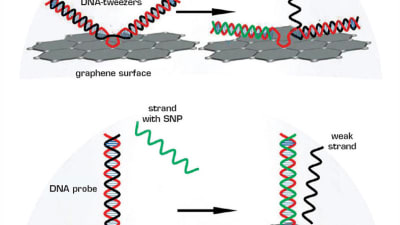
The most important design feature is a molecular structure the researchers describe as DNA-tweezers. These are engineered DNA probes attached to the graphene surface that change shape when they encounter a strand carrying the SNP the chip is designed to detect.
When the SNP-containing strand binds, the tweezers open and shift into a geometry that lies almost parallel to the graphene surface. That movement matters because it brings the DNA’s net electric charge much closer to the graphene, producing a stronger electronic response than earlier probe designs could achieve.
Why the signal is stronger than before
Older SNP-sensing chips used DNA probe structures that could recognize target strands but could not move their charge close enough to the graphene to create a large change in signal. In practice, that meant weaker readouts and lower sensitivity, especially when target molecules were present only in tiny amounts.
By contrast, the new geometry appears to amplify the effect of binding rather than merely registering it. The result, according to the researchers, is sensitivity at least 1,000 times better than current technology, which could make a major difference for early detection applications where every molecule counts.
What portable SNP testing could enable
A chip that can read SNPs quickly and wirelessly could fit into a growing class of point-of-care diagnostics, meaning tests performed near the patient rather than in a centralized laboratory. That matters because conventional genetic testing often requires expensive instrumentation, trained personnel, and processing times that can stretch from hours to days.
If a portable version of this technology reaches the clinic, it could potentially be used to screen for disease-associated genetic markers in simpler settings. The team specifically points to future applications in the early detection of markers linked to diseases such as cancer, where earlier information can improve decisions about monitoring and treatment.
Why This Matters
The significance of this work is not just higher sensitivity on paper. A practical sensor that can detect one-letter DNA mutations cheaply, quickly, and outside a specialized lab could broaden access to molecular testing and make genomic information more useful in routine care.
There is also a larger technology story here. By combining programmable DNA structures with advanced materials like graphene and wireless electronics, researchers are building diagnostic systems that behave more like smart devices than traditional medical tests. That convergence could eventually shrink complex genetic analysis into something as simple as a connected cartridge and an app.
What comes next
The current chip is an early demonstration, and the researchers say the next step is to build array-based versions that could test for up to hundreds of thousands of SNPs in a single run. That would move the system from detecting one specific mutation toward broader genetic profiling, which is far more useful in real medical and research settings.
Future studies will also need to show that the chip works reliably with messy real-world samples such as blood and other bodily fluids from animals or humans. If those tests succeed, this kind of biosensor could help turn highly sensitive genetic detection into a portable, connected tool for earlier diagnosis, more personalized treatment, and faster feedback at the point of need.