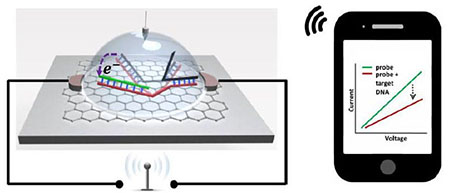
Researchers at the University of California San Diego have built a tiny wireless chip that can spot a single nucleotide polymorphism, or SNP, and send the result directly to a phone or computer. An SNP is a one-letter change in DNA, but that small difference can be medically important because some SNPs are linked to inherited disease risk, drug response, or cancer-related mutations. Detecting those changes usually requires lab-heavy workflows, including DNA amplification, specialized instruments, and multiple processing steps that can slow testing down. The new device aims to simplify that process by combining molecular recognition with electronics on a chip smaller than a fingernail. According to the team, it can detect target DNA at picomolar concentrations, meaning extremely small amounts in solution, while reaching sensitivity said to be at least 1,000 times better than current approaches. The system is also designed to work wirelessly, which could make it more useful outside traditional lab settings. At the heart of the chip is a graphene transistor paired with engineered “DNA tweezers” that physically respond when they encounter the exact mutation they were built to recognize. Together, those features point to a future where genetic testing could become faster, more portable, and easier to integrate with everyday digital devices.
How the chip works
The sensor is built around a graphene field-effect transistor, a device that uses graphene, a one-atom-thick sheet of carbon, to detect tiny electrical changes. Graphene is attractive for biosensors because it is highly conductive and very sensitive to events happening on its surface.
Attached to that surface is a specially designed piece of double-stranded DNA. The researchers shaped this DNA structure so it bends in the middle like a tiny pair of tweezers, creating a molecular switch that can open and close.
Why DNA “tweezers” matter
One side of the DNA tweezers is programmed to recognize a specific SNP sequence. If a matching DNA strand is present in the sample, it binds to that recognition region and causes the tweezers to open.
That mechanical change is important because it alters the electrical environment at the graphene surface. The transistor reads that shift as a change in current, turning a molecular binding event into a clear electronic signal.
What makes this different from standard SNP tests
Traditional SNP detection methods often struggle with sensitivity and specificity, meaning they may miss low-abundance targets or have difficulty distinguishing a true match from a near match. Many also depend on amplification, such as copying DNA many times with a method like PCR, before there is enough material to measure reliably.
This new chip is notable because it is designed to detect the target directly in solution at very low concentrations. The team says the device can sense SNP-containing DNA in the picomolar range, a level that suggests it may work with much smaller sample amounts than conventional systems require.
Wireless readout changes the user experience
Another key feature is that the signal does not stay trapped inside a benchtop machine. Once the chip detects the target DNA, it can transmit the result wirelessly in real time to a smartphone, computer, or other electronic device.
That may sound like a convenience feature, but it could be more than that. Wireless operation opens the door to portable testing systems that can be used in clinics with limited infrastructure, at the point of care, or potentially even in home-based monitoring setups if the technology matures.
Why sensitivity is such a big deal
The researchers report that the chip is at least 1,000 times more sensitive than current technology for this kind of detection. Higher sensitivity matters because many clinically relevant DNA targets appear in tiny amounts, especially early in disease or in minimally invasive samples.
If a device can reliably detect those rare signals without extensive sample preparation, it could shorten turnaround times and reduce complexity. It may also improve access by replacing bulky instruments with something much smaller and easier to deploy.
Possible medical and research uses
SNPs are important across medicine because they can help explain why people respond differently to drugs, why some individuals are predisposed to certain diseases, and how tumors evolve genetically. A compact sensor that quickly identifies a specific SNP could therefore be useful in precision medicine, where treatment decisions are tailored to a patient’s genetic profile.
Beyond the clinic, the platform could also support research labs that need fast, electronic ways to screen for known mutations. Because the recognition element is based on engineered DNA, similar designs might eventually be adapted for other genetic targets as well.
Why This Matters
This work matters because it tackles several bottlenecks in genetic testing at once: sensitivity, portability, and ease of use. Instead of relying on complex optical systems or multi-step lab workflows, the UC San Diego-led approach translates DNA recognition directly into an electrical signal that can be read wirelessly.
That combination is especially compelling for a healthcare system moving toward faster diagnostics closer to the patient. If the technology proves robust in real-world samples, it could help shift some genetic testing from centralized labs to more distributed settings where speed and simplicity are critical.
What comes next
The chip is still best understood as an emerging research technology rather than a ready-to-use consumer device. The next steps will likely involve validating it across more targets, testing it in complex biological samples, and showing that it performs consistently outside controlled lab conditions.
Still, the concept is powerful: a tiny, wireless sensor that can recognize a single-letter DNA change and instantly report it to a digital device. If that promise holds up, this kind of bioelectronic platform could become part of a new generation of connected molecular diagnostics.