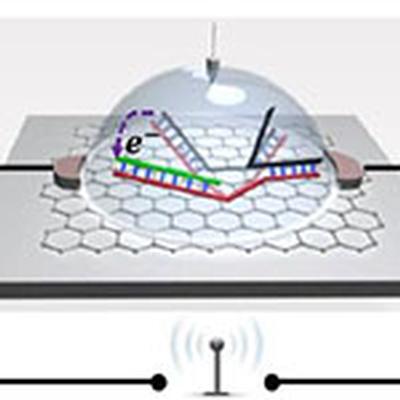
A research team led by the University of California San Diego has built a tiny wireless chip that can spot a single nucleotide polymorphism, or SNP, a one-letter change in DNA that can influence disease risk, drug response, and inherited traits. The device is notable not just because it detects these mutations, but because it does so with striking sensitivity and sends results directly to a smartphone or computer in real time. According to the university’s announcement, the chip is at least 1,000 times more sensitive than conventional SNP detection methods. That matters because many standard approaches depend on copying DNA over and over through amplification, then reading it out with large laboratory instruments. By contrast, this new sensor is smaller than a fingernail and works in solution at picomolar concentrations, meaning it can detect extremely tiny amounts of target DNA. At the heart of the system is a graphene transistor paired with specially designed DNA structures that act like molecular tweezers. Together, they create a compact biosensor that could point toward faster, simpler genetic testing outside of specialized labs.
What the chip actually detects
An SNP is one of the smallest possible genetic changes: a swap of a single DNA “letter” for another. Even though the alteration is tiny, it can have outsized biological effects, which is why SNPs are widely studied in cancer, inherited disease, and precision medicine.
Detecting one specific SNP is harder than it sounds. A sensor must distinguish between DNA strands that are nearly identical, often differing by only one chemical building block, while avoiding false signals from all the other DNA floating nearby.
Why current methods fall short
Traditional SNP detection tools are powerful, but they come with tradeoffs. The UC San Diego team notes that common methods can have limited sensitivity and specificity, meaning they may struggle to detect very low levels of a target or to cleanly separate a true match from a near miss.
Many of these methods also require amplification, the process of making many copies of DNA so there is enough material to measure. Amplification is useful, but it adds time, extra reagents, and more instrumentation, which can make testing slower and less portable.
How the biosensor works
The new device is built around a graphene field-effect transistor. A field-effect transistor is an electronic component whose current changes in response to conditions at its surface, and graphene, a single-atom-thick sheet of carbon, is especially attractive for sensing because even tiny surface events can alter its electrical behavior.
Attached to the graphene is a specially engineered double-stranded DNA structure. The researchers designed this DNA to bend near the middle, creating what they describe as DNA-tweezers, with one side programmed to recognize a particular SNP sequence.
From molecular binding to wireless signal
When a DNA strand carrying the target SNP comes close, it binds to the matching side of the DNA-tweezers. That interaction causes the tweezers to open, and this shape change shifts the local electrical environment at the graphene surface.
The transistor converts that molecular event into a measurable change in electrical current. From there, the signal can be transmitted wirelessly to a smartphone, computer, or other electronic device, allowing real-time readout without the need for a bulky benchtop setup.
Why sensitivity matters so much
The reported ability to detect SNPs at picomolar concentrations is a big part of the advance. Picomolar refers to extremely low concentrations, roughly trillionths of a mole per liter, which signals that the chip can respond to very small amounts of genetic material in solution.
Higher sensitivity can be useful in early testing scenarios, where target DNA may be scarce. It also raises the possibility of simpler workflows, because if a sensor can read tiny amounts directly, researchers may not need as much sample preparation or DNA copying beforehand.
Why wireless readout changes the picture
The wireless aspect is more than a convenience feature. It hints at a broader shift in diagnostics, where biological measurements can be captured by miniaturized sensors and sent directly to everyday electronics rather than routed through centralized lab equipment.
That could make genetic testing more flexible in clinics, field settings, or resource-limited environments. A compact chip that communicates with a phone or laptop is easier to deploy than a traditional instrument-heavy workflow, especially when rapid answers are important.
Why This Matters
This work sits at the intersection of genetics, materials science, and mobile electronics. If the approach continues to perform well beyond the lab, it could help enable faster and more accessible tests for disease-linked mutations, treatment selection, or personalized health monitoring.
It also shows why graphene remains so interesting for biosensors: its electrical properties make it unusually responsive to biological interactions happening on its surface. Pairing that responsiveness with programmable DNA structures creates a clever way to turn an almost invisible molecular event into a digital signal people can use.
What comes next
The announcement describes an early but compelling platform, and the next steps will likely involve validating the chip across more targets, more complex biological samples, and real-world testing conditions. If researchers can show the same combination of sensitivity, selectivity, and convenience outside controlled experiments, devices like this could move SNP detection closer to point-of-care use, where genetic information is gathered quickly, cheaply, and exactly where it is needed.