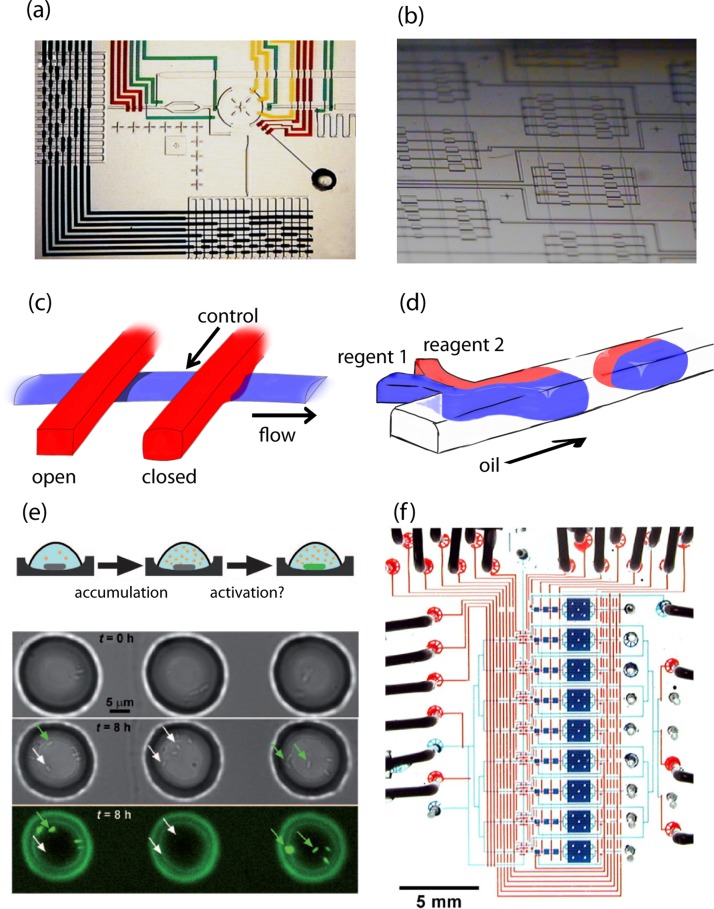
Microfluidics shrinks parts of a laboratory onto chips etched with channels thinner than a human hair, and that size change is doing more than saving space. According to the reviewed article, these miniature fluid systems have become a practical research tool because they let scientists move, mix, and measure tiny amounts of liquid with unusual precision. In life science labs, that means researchers can watch cells more closely, control chemical conditions more tightly, and run experiments that would be difficult or wasteful at normal bench scale. The piece draws a useful distinction between two branches of the field: lab-on-a-chip devices aimed at clinical testing near patients, and chip-in-a-lab systems built to help researchers answer biological questions. Its focus is the second category, where microfluidic chips are less about portability and more about making experiments cleaner, faster, and more quantitative. Because the volumes are so small, these systems can reduce reagent use, limit contamination, and automate complicated workflows that would otherwise require many manual steps. The result is a set of tools that can act like tiny plumbing networks for biology, turning the lab bench into something more programmable. Rather than replacing biology labs, the article argues, microfluidics is becoming one of the most useful ways to make those labs more exact and more insightful.
What a microfluidic chip actually does
A simple way to picture a microfluidic device is to imagine a city map for liquids. Instead of roads and intersections, the chip contains microscopic channels, valves, and chambers that guide droplets or streams of fluid to precise destinations.
Those structures usually measure tens to hundreds of micrometers across. At that scale, fluids behave differently than they do in a beaker, and researchers can exploit those differences to control timing, mixing, and exposure with much finer resolution.
Why smaller channels can improve experiments
The review emphasizes that miniaturization brings several advantages at once. Tiny channels require tiny sample volumes, which cuts the amount of expensive reagents needed and makes rare biological samples easier to study.
Small dimensions also improve measurement control. When scientists can deliver chemicals, nutrients, or cells in tightly defined amounts and sequences, they can collect cleaner quantitative data instead of relying on rougher, more manual handling at the bench.
From lab-on-a-chip to chip-in-a-lab
Microfluidics is often discussed in the context of point-of-care diagnostics, meaning tests designed to work near the patient rather than in a centralized hospital lab. Those systems aim to solve practical healthcare problems, especially where equipment, trained staff, or infrastructure may be limited.
The article focuses elsewhere: on research laboratories that already have resources but need better experimental tools. In that setting, the goal is not mainly portability. It is to create controlled micro-environments where cells, molecules, and reactions can be studied with a level of precision that standard wet-lab methods may not easily provide.
How chips help scientists study biology
In a research context, microfluidic chips can function like highly organized staging areas for biology. They can isolate cells, expose them to changing conditions, and let scientists track what happens over time without repeatedly transferring samples by hand.
That matters because biology is dynamic. Cells respond to gradients, pulses, crowding, and stress, and microfluidic systems are well suited to creating those carefully defined conditions so researchers can connect cause and effect more directly.
Automation changes the rhythm of the lab
One of the clearest practical benefits described in the article is automation. In many microfluidic bench-top systems, the user loads a sample and kit reagents, starts the run, and the instrument routes fluids through the chip, performs the assay, records the measurement, and displays the result.
That kind of workflow does not just save time. It also reduces variability introduced by repetitive manual steps, which is a major issue in biology where slight differences in pipetting, timing, or handling can change the outcome of an experiment.
Disposable cartridges and cleaner data
The review notes another understated advantage: many commercial microfluidic elements are disposable cartridges. That design helps avoid carryover contamination between experiments, a persistent problem when the same tubing or chambers are reused.
Think of it like using a fresh coffee filter each time instead of trying to rinse out the old one perfectly. In scientific terms, a clean single-use fluid path can improve confidence that one sample is not affecting the next, especially in sensitive assays.
Why microfluidics fits modern life science
Over the past decade, the article argues, microfluidics has matured from an intriguing engineering concept into a genuinely useful laboratory platform. That shift happened because the technology aligns with what modern biology increasingly needs: more measurements, smaller samples, tighter control, and more reproducible workflows.
It also bridges disciplines. Engineers can build the fluidic architecture, while biologists use it to ask questions about cells, molecules, and disease mechanisms that are difficult to probe in bulk experiments.
Why This Matters
The deeper significance of chip-in-a-lab technology is not just convenience. Better fluid control can produce better biological evidence, and better evidence is what allows researchers to separate true signals from noise.
That has long-term implications for medicine even when a chip never leaves the research lab. Tools that improve cell studies, assay design, and measurement precision can feed directly into drug discovery, disease modeling, and eventually the development of more reliable diagnostics and therapies.
What comes next
The article presents microfluidics as a field with two complementary futures: one in accessible patient-facing diagnostics and another in increasingly sophisticated research tools. For life science laboratories, the most important trend may be that chips are becoming less like specialized prototypes and more like routine instruments that slot into everyday workflows.
If that continues, the value of microfluidics will come from something deceptively simple: making biology easier to control. And when researchers can control conditions more tightly, they usually learn more from every sample they have.