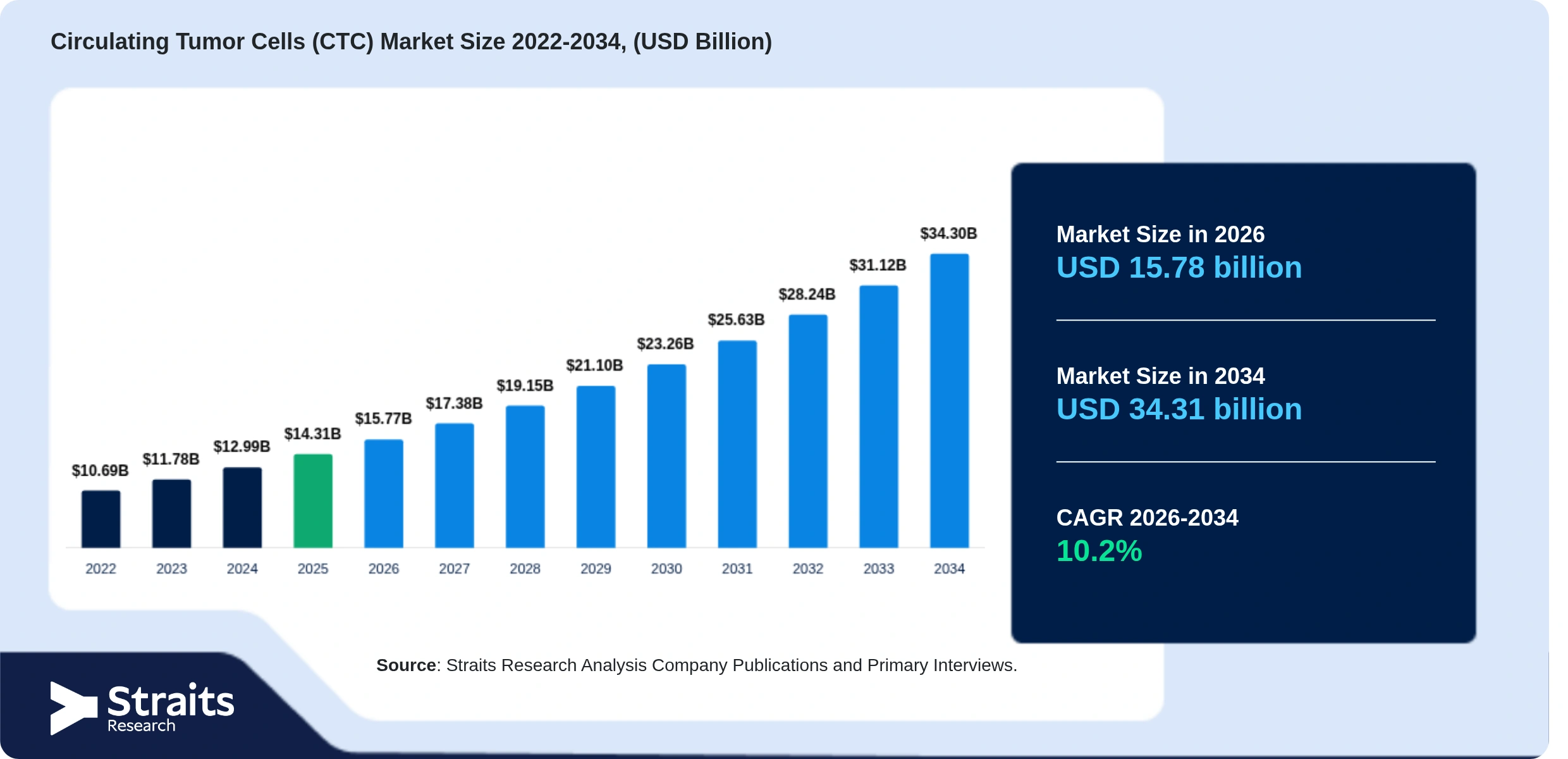
Source: Circulating Tumor Cells (CTC) Market Size, Share, Growth, 2034, by Debashree B. AI-generated summary by biochip.com, published . Not independently reviewed.
Circulating tumor cells, or CTCs, are cancer cells that break away from a tumor and drift through the blood or lymphatic system, and a new market analysis argues that better chip-based tools are helping turn those rare cells into a more useful clinical signal. The report ties market growth through 2034 to advances in devices that can isolate CTCs more accurately, especially newer cluster-chip approaches designed to capture fragile groups of tumor cells without damaging them. That matters because CTCs are extremely scarce, which makes them hard to find reliably in a tube of blood. If researchers and clinicians can isolate them well, they may be able to monitor how a cancer is changing, estimate how a patient is responding to therapy, and learn more about metastasis, the process by which cancer spreads to other organs. The source also points to rising interest in using CTC data to support more personalized cancer treatment, including preventive or tailored medicine strategies. At the center of the story is a familiar theme in bioengineering: when the hardware improves, the biology becomes easier to read. In this case, chips act like highly selective filters and sorting tools, helping scientists separate a few meaningful cells from a huge background of normal blood cells. The market outlook is therefore less about a single discovery than about a technical bottleneck easing enough to make CTC analysis more practical and more widely applied.
Why CTCs Are So Hard to Work With
Finding CTCs is a bit like trying to spot a few specific grains of sand on a crowded beach. They are rare, and they are mixed in with many more ordinary blood cells, so any test must be both sensitive and selective.
The source describes CTC isolation as laborious but highly accurate when done well. That combination explains both the promise and the challenge of the market: clinicians want the information, but the workflow has to be dependable enough to justify routine use.
What Chip Technology Adds
Chip technology, in this context, means miniaturized devices that can sort cells using carefully designed channels, surfaces, or physical traps. Think of them as tiny lab benches built into a cartridge, where the geometry of the device helps sift tumor cells from everything else in the sample.
The report says continued development of these chips has supported market expansion. Better designs improve CTC isolation, which is the critical first step before any downstream analysis can happen.
Why Cluster Chips Stand Out
One of the specific methods highlighted is cluster-chip technology. Instead of focusing only on single cells, these devices are designed to capture clusters of tumor cells, which may carry important clues about how cancer spreads.
According to the source, several researchers found the cluster-chip method more effective than a microfluidic chip that isolates CTCs with antibodies. Antibodies are proteins that bind to matching molecules on a cell surface, like a lock fitting a key, but that strategy can miss tumor cells if those surface markers vary from one cell to another.
Limits of Older Isolation Devices
The market report also lays out the practical flaws that have held back some existing devices from major companies. These include low sensitivity, trouble capturing CTCs of different shapes and sizes, high manufacturing costs, and difficulty removing captured cells for more testing afterward.
That last problem is easy to overlook but important. Capturing a cell is only useful if researchers can then examine it in the lab, study its genetics or protein markers, and compare it over time as treatment changes.
The White Blood Cell Problem
Another challenge is false identification. The source notes that white blood cells trapped alongside CTCs can be mistaken for tumor cells because their size can be similar.
This is a classic signal-versus-noise issue. If a platform cannot cleanly distinguish cancer cells from normal immune cells, the result may be less reliable monitoring and weaker confidence from clinicians who need clear answers from a blood test.
Why Non-Invasive Monitoring Matters
CTCs attract so much attention because they offer a non-invasive way to study cancer. Instead of relying only on tissue biopsies, which require taking a piece of a tumor directly, clinicians may be able to learn from a blood sample collected over time.
The source says CTCs are valuable for tracking disease progression, predicting treatment effectiveness, and helping determine prognosis. In plain terms, they could help answer three practical questions: Is the cancer changing, is the therapy working, and what does that mean for the patient's likely course?
Why This Matters
The larger significance of the market outlook is that it connects engineering progress to cancer care. As chip platforms become better at capturing rare cells without damaging them, the clinical value of CTC testing becomes easier to realize.
The report also suggests that demand will rise as researchers use CTC analysis to customize cancer therapy. Personalized medicine often sounds abstract, but here it means adjusting care based on what a patient's tumor cells are doing in real time rather than relying only on a snapshot taken earlier in the disease.
What Growth Through 2034 Really Signals
A market forecast is not proof that every CTC technology will succeed, but it does indicate where buyers and developers see unmet need. In this case, the need is clear: oncology still lacks simple, repeatable tools that can capture the biology of metastasis from a routine blood draw.
If chip-based CTC isolation keeps improving, the field could move from niche research use toward broader clinical adoption. The next phase will depend on whether these devices can consistently balance sensitivity, specificity, cost, and ease of follow-up analysis, turning a technically impressive method into a practical part of cancer management.