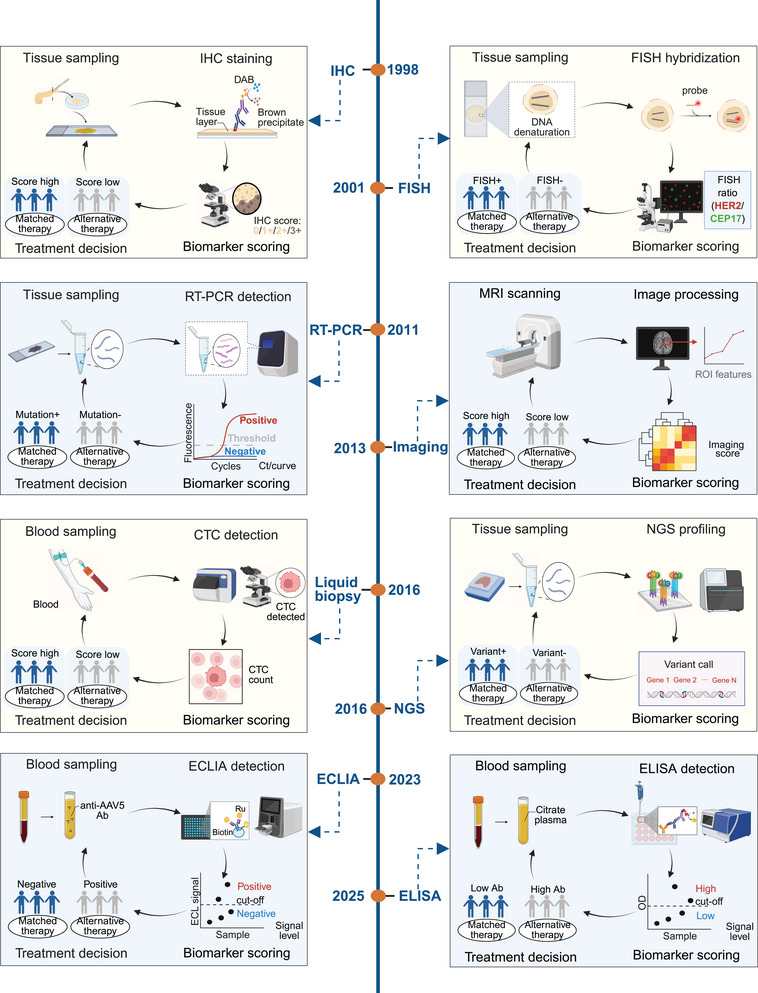
Companion diagnostics are tests designed to help doctors match the right treatment to the right patient, and the field is expanding well beyond its best-known role in cancer care. The source article, Companion Diagnostics in Clinical Therapy: Current Applications and Future Directions, describes how these tests are being paired with therapies to guide more individualized decisions at the point of care, meaning close to where a patient is actually treated. Instead of relying only on broad disease labels, companion diagnostics look for measurable signals such as biomarkers in blood, breath, or other samples that can predict whether a treatment will work, cause side effects, or need adjustment. The review highlights examples that span psychiatric drug therapy, sepsis detection, eye care, and molecular testing technologies. That breadth matters because it shows companion diagnostics are becoming a general strategy for personalized medicine rather than a niche tool for one specialty. The article also points to enabling platforms, including microfluidic chips and biosensors, that can make testing faster and more practical in clinics. Taken together, the story is less about one single device and more about a shift in medicine toward pairing therapies with targeted tests so treatment decisions are guided by the patient’s biology, not just by averages from large populations.
From one-size-fits-all to matched therapy
A simple way to think about companion diagnostics is to imagine buying prescription glasses after an eye exam instead of picking a pair off a rack. The exam does not treat your vision by itself, but it tells you which correction fits you. In the same way, a companion diagnostic does not cure disease on its own, but it helps identify which drug or product is most appropriate for a specific person.
The review says this pairing is often achieved by linking a therapeutic strategy with a test that provides individualized information at the point of care. That phrase is important. It means the value of the test depends not just on accuracy, but on whether it can deliver useful answers quickly enough to shape a real clinical decision.
Psychiatric treatment and a breath-based biomarker
One example in the article involves measuring exhaled 13CO2 in breath as a biomarker to support individualized psychiatric drug therapy. A biomarker is any measurable biological signal that can reveal something clinically useful, such as how the body processes a drug. Breath testing is especially appealing because it is noninvasive, fast, and easy to repeat over time.
For patients taking psychiatric medications, that matters because response and side effects can vary widely from person to person. A breath-based readout could act like a quick dashboard light, showing how a patient is handling therapy without requiring a blood draw. The source frames this as a way to better meet the demands of personalized psychiatric treatment, where trial-and-error prescribing can be slow and frustrating.
Sepsis detection with a multiplexed biosensor
The review also highlights a nanochannel-based electrochemical biosensor for rapid, multiplexed detection of three sepsis-related biomarkers in whole blood: procalcitonin, lipoteichoic acid, and lipopolysaccharide. Electrochemical biosensors translate biological recognition into an electrical signal, a bit like a smoke detector that turns the presence of a hidden threat into an alarm you can read. In this case, the sensor is designed to catch multiple warning signs of sepsis at once.
That multipronged approach is useful because sepsis is not a single tidy target. It is a dangerous, body-wide response to infection that can worsen quickly, so clinicians need timely information. By looking for a panel of markers rather than one signal alone, the test aims to give a richer picture from whole blood, which could improve how sepsis is detected and managed.
Why platforms matter as much as biomarkers
The source does not present companion diagnostics as only a list of biomarkers. It also points to the technologies that make those biomarkers clinically usable, including microfluidic chips and isothermal amplification methods for detecting pathogenic nucleic acids. Microfluidics means moving tiny amounts of liquid through very small channels, like building an entire lab onto something not much bigger than a credit card.
That miniaturization can speed up analysis, reduce sample volume, and support portable testing. Isothermal amplification, meanwhile, is a way to copy genetic material at a constant temperature rather than cycling through repeated heating and cooling, which can simplify equipment. Together, these platforms help explain why companion diagnostics are moving closer to bedside and clinic use rather than staying confined to large central labs.
A contact lens as a personalized test
Another example from the review is a “contact lens-on-a-chip” approach introduced by Guan and colleagues for personalized selection of compatible contact lens products. The idea may sound unusual, but it reflects a broader principle: diagnostics can help match not just drugs, but also medical products to individual biology. In eye care, compatibility can depend on subtle differences in the ocular surface and tear environment.
Think of it like trying on shoes with pressure sensors instead of relying only on size. Two products may look similar, yet one may suit the patient much better in practice. A chip-based compatibility test could help reduce guesswork and make selection more tailored from the start.
Beyond oncology
Companion diagnostics are often discussed in the context of cancer, where tumor biomarkers can determine eligibility for targeted therapies. But the review’s examples show that the concept is spreading into infectious disease, psychiatry, ophthalmology, and imaging-related applications. That expansion matters because many areas of medicine face the same underlying problem: patients with the same diagnosis may not respond the same way.
The references cited in the source reinforce that broader scope. They include work on sepsis biomarkers, intraocular biomolecules as potential markers for eye disease management, microfluidic nucleic-acid detection, and theranostics in medical imaging. Theranostics combines therapy and diagnostics in a coordinated strategy, underscoring the same basic goal of making treatment more precise and measurable.
Why This Matters
The practical promise of companion diagnostics is not just scientific elegance. It is better decision-making under real clinical pressure. If doctors can tell earlier which therapy fits, they may avoid ineffective treatments, reduce adverse effects, and move faster to options that have a better chance of helping.
That is especially important in situations like sepsis, where delays are dangerous, and in psychiatry, where treatment adjustment can take weeks or months. It also matters for healthcare systems, because a well-targeted therapy can potentially cut waste from unsuccessful treatment cycles and unnecessary exposure. The core idea is simple: better information before or during treatment can improve both care and efficiency.
What the future points toward
The review presents companion diagnostics as a field moving toward more integrated, portable, and personalized tools. Instead of a single biomarker measured in a distant lab, the future likely involves panels of biomarkers, smart biosensors, and chip-based devices that can work with small samples and deliver results quickly. As those tools mature, the most important test will be whether they fit smoothly into clinical workflows and lead to better outcomes for patients, not just better technical performance on paper.