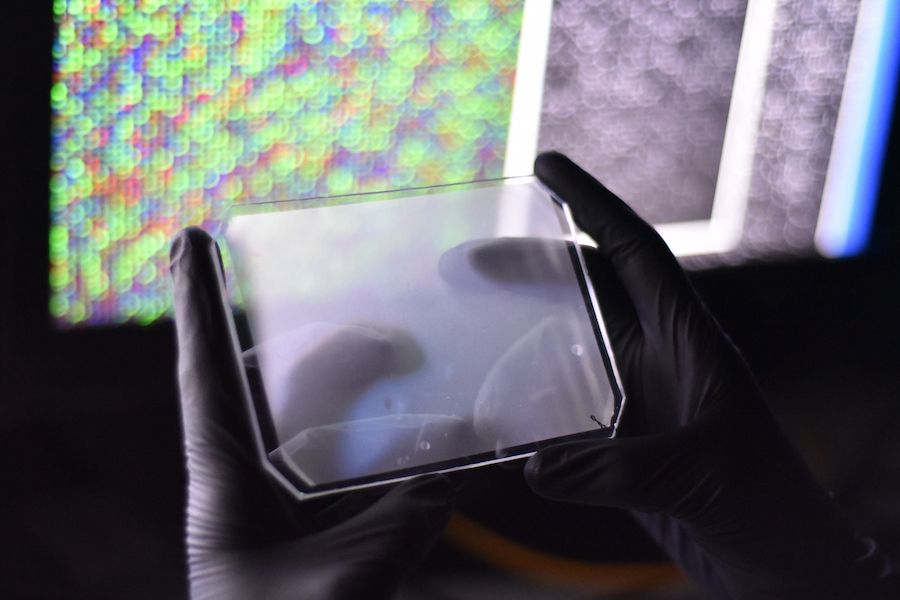
Researchers have developed a diagnostic platform that brings together CRISPR, the gene-targeting technology best known for editing DNA, with microfluidics, the science of moving tiny amounts of liquid through small channels. The result is a system called CARMEN, short for Combinatorial Arrayed Reactions for Multiplexed Evaluation of Nucleic acids, that can run more than 4,500 tests on a single chip. In practical terms, that means one device can check over 1,000 patient samples for one virus at once, or scan a handful of samples for more than 160 different viruses in parallel. The platform was validated on patient samples and is designed to deliver results the same day, making it a potentially powerful tool for outbreaks and routine surveillance. Its detection method is adapted from SHERLOCK, an earlier CRISPR-based diagnostic system developed by researchers at the Broad Institute and partner institutions. By combining SHERLOCK’s molecular precision with the scale of chip-based testing, the team says it opens up new ways to answer both clinical questions about individual patients and epidemiological questions about how infections spread. If the technology continues to mature, it could help laboratories move beyond one-test-at-a-time diagnostics toward much broader and faster screens.
How the platform works
CARMEN starts with viral genetic material, usually RNA, which is the kind of genetic code used by many viruses, including the virus that causes Covid-19. Researchers first extract that RNA from patient samples and make copies of it, a preparation step similar to what is done in RT-qPCR, the standard lab method used for many viral diagnostics.
Each prepared sample is then labeled with a unique fluorescent dye, essentially giving it a color-coded identity. The sample is split into tiny droplets, which can be mixed and routed on a microfluidic chip so that many combinations of samples and virus-detecting reactions can be tested at the same time.
What CRISPR adds
The readout relies on SHERLOCK, a CRISPR-based diagnostic first described in 2017. Unlike gene editing applications, here CRISPR is not used to rewrite genes; instead, it acts like a highly specific molecular search tool that recognizes matching genetic sequences from a virus.
When the CRISPR system finds its target, it triggers a signal that can be detected by the instrument. Because each reaction is paired with fluorescent coding, the chip can keep track of which sample met which viral target, allowing thousands of tests to run in parallel without turning into a blur of unreadable data.
Scale is the breakthrough
The most striking feature of CARMEN is its multiplexing ability, meaning it can look for many things at once. According to the researchers, a single chip can test 1,048 samples for one virus, or five samples for 169 viruses, depending on how the chip is set up.
That flexibility matters because diagnostic needs change. In one situation, a public health lab may want to screen a large population for a single known threat; in another, doctors may need to determine which of many possible viruses is causing symptoms in a much smaller number of patients.
Why this could help during outbreaks
Outbreaks create a constant tradeoff between speed, scale, and specificity. Traditional tests are often very good at answering one narrow question, but they can be harder to expand quickly when health officials need to monitor many samples or distinguish among multiple pathogens with similar symptoms.
CARMEN is designed to ease that bottleneck. Because more chips can simply be added, the system is inherently scalable; the team noted that they normally run four or five chips in a single day, suggesting the platform can be expanded without rebuilding the entire workflow from scratch.
Built for both patient care and surveillance
The technology sits at an interesting intersection between bedside diagnostics and population-level monitoring. A clinician could potentially use it to identify which virus is present in a patient sample, while researchers and public health agencies could use the same platform to track how multiple viruses are moving through communities.
That is why the researchers emphasize both clinical and epidemiological applications. Clinical use focuses on helping individual patients get the right diagnosis, while epidemiology looks at disease patterns across groups of people, which is critical for spotting emerging outbreaks and understanding transmission.
Why This Matters
Fast, flexible testing has become one of the central lessons of modern infectious disease response. A platform that can shift between high-volume screening and broad multi-virus detection could make labs more nimble when a known virus surges or when an unfamiliar pathogen begins to circulate.
There is also a cost-of-information advantage. Instead of running many separate tests one after another, a multiplexed system can gather a wider picture from the same batch of samples, saving time and potentially helping health officials make decisions sooner about isolation, treatment, and containment.
What comes next
CARMEN is still best understood as a powerful research and laboratory platform rather than a finished consumer-ready product. But its successful validation on patient samples suggests that CRISPR diagnostics are moving beyond proof-of-concept and into systems that can operate at the scale real-world public health demands. As labs continue to refine speed, automation, and ease of use, tools like this could become part of a new generation of diagnostics that are not just accurate, but massively parallel, adaptable, and ready for the next outbreak.