AI-generated summary by biochip.com, published . Not independently reviewed. Source: ACS Nano, by Nazente Atceken; Alptekin Kahya; Defne Yigci; Savas Tasoglu.
Key takeaways
- The review examines CRISPR-Cas microfluidic chips for portable, real-time biomolecule detection and point-of-care diagnostics.
- Examples include Cas12a chips for E. coli, P. aeruginosa, S. aureus, and digital CRISPR assays for SARS-CoV-2.
- The review says CRISPR-Cas integration with microfluidics for point-of-care use remains poorly understood.
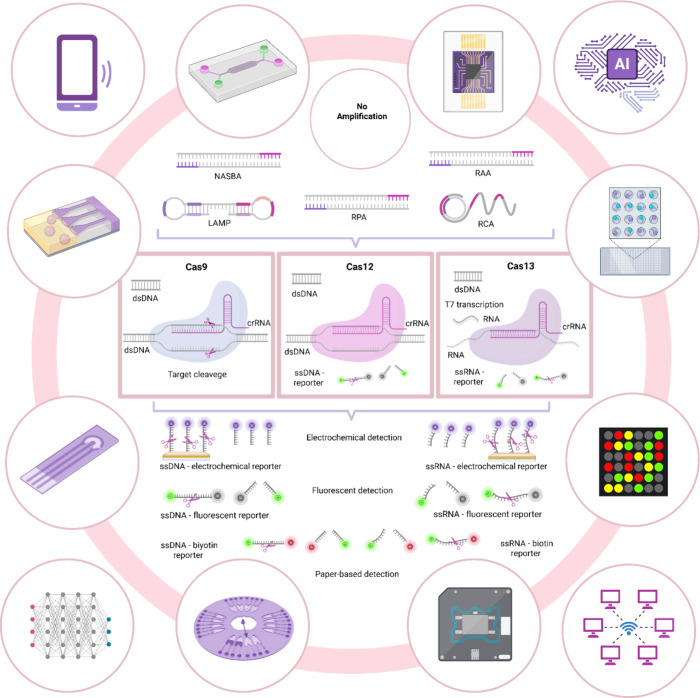
A review of CRISPR-on-chip diagnostics examines how gene-editing enzymes can be paired with miniature fluid-handling devices for point-of-care testing. The central idea is to put a powerful molecular recognition system into a small, self-contained chip that can process a sample and report a result without a full laboratory setup. CRISPR, best known for gene editing, can also be programmed to recognize a chosen DNA or RNA sequence, making it useful for detecting pathogens and other biomolecules. Microfluidics, the controlled movement of tiny liquid volumes through channels, supplies the plumbing needed to automate that detection in a compact format. The review argues that the combination could make testing faster, more portable, and more precise than many conventional diagnostic workflows. It also surveys examples aimed at infectious agents including SARS-CoV-2, Escherichia coli, Pseudomonas aeruginosa, and Staphylococcus aureus. Yet the authors stress that integrating CRISPR-Cas systems with microfluidics for point-of-care use remains poorly understood. The field has produced striking analytical results, but turning those results into robust everyday tests still requires work on chip design, reagents, sample preparation, and multiplexing.
Putting Molecular Recognition on a Chip
Think of a CRISPR-on-chip system as a tiny testing kitchen: microfluidic channels portion and move the ingredients, while the CRISPR-Cas enzyme acts like a highly selective sensor that reacts when it finds its intended molecular target. In a diagnostic setting, the target might be viral RNA or bacterial DNA in a patient or environmental sample. The enzyme is guided to that target by a designed RNA sequence, which gives the system its programmability.
Once the target is recognized, many CRISPR assays produce a measurable signal, often fluorescence. A fluorescent signal is light emitted by a dye after the molecular reaction occurs, allowing an instrument or chip reader to indicate whether the target is present. The review describes CRISPR-on-chip platforms as capable of portable, real-time biomolecule detection while reducing dependence on complex laboratory infrastructure.
Why Microfluidics Changes the Format
Microfluidic devices operate on a scale where liquid droplets and channels can be extremely small. That matters because diagnostic reactions can use less sample and fewer reagents, while the device can precisely control mixing, timing, and compartmentalization. Rather than carrying out separate preparation, amplification, and detection steps in multiple tubes, a chip can potentially bring them together.
The review highlights scalability as a key attraction. A well-designed platform could run many small reactions in parallel or be adapted to test for different targets by changing the CRISPR guide sequence. This is particularly relevant for point-of-care diagnostics, meaning tests designed to be performed close to the patient or sampling site rather than sent to a centralized laboratory.
Sensitivity and Multiplex Detection
Several properties make CRISPR-Cas systems appealing for diagnostics. The review identifies single-molecule sensitivity, the ability to detect extremely scarce molecular material, as a potential advantage of these platforms. It also points to multiplex detection, in which one test searches for multiple targets rather than returning a result for only one organism or biomarker.
That capability could be useful when symptoms overlap across infections or when a clinician needs to distinguish among several possible causes quickly. But multiplexing is not simply a matter of adding more targets. Signals must remain distinguishable, reactions must not interfere with one another, and every target needs reliable performance under the same chip conditions.
Examples Surveyed in the Review
The review includes a digital CRISPR/Cas-assisted assay reported for rapid, sensitive detection of SARS-CoV-2. Digital sensing generally divides a sample into many tiny compartments, much like distributing a crowd into separate rooms, so individual target molecules can be counted or detected with greater clarity. A cited 2021 study in Advanced Science used this general strategy for SARS-CoV-2 detection.
Another example involves a one-pot chip for gut pathogen detection using CRISPR-Cas12a, a CRISPR-associated enzyme that recognizes selected DNA targets and can generate a detectable signal. The listed bacterial targets include E. coli, P. aeruginosa, and S. aureus. The source describes fluorescent readout and recombinase polymerase amplification, or RPA, a DNA-copying method that works at a relatively constant temperature and can suit portable devices.
The reported one-pot pathogen platform had a detection value above 0.43 colony-forming units per milliliter and was described as supporting simultaneous detection and good programmability. Colony-forming units are a microbiology measure intended to estimate viable organisms capable of growing into colonies. Such figures illustrate the low concentrations these systems aim to detect, although analytical sensitivity alone does not establish clinical performance.
Different Ways to Read the Signal
Fluorescence is a recurring readout in the examples, but the review also references colorimetric and surface-enhanced Raman spectroscopy approaches. A colorimetric test creates a visible color change, which can simplify interpretation where sophisticated optics are unavailable. Surface-enhanced Raman spectroscopy, or SERS, uses specially structured surfaces to amplify a light-scattering fingerprint from molecules, potentially enabling sensitive detection.
One cited SERS chip targeted SARS-CoV-2 RNA and used catalytic hairpin assembly, a nucleic-acid reaction that can amplify a signal without conventional thermal cycling. The source lists a detection limit of 5.18 × 10² copies per milliliter for that approach, along with high specificity and multiplex potential. The review also notes that different systems carry different tradeoffs, including unfavorable reagent stability in one highly multiplexed fluorescent format and an inability to detect multiple protein targets in another approach.
Why This Matters
Fast molecular tests matter most when a result changes a near-term decision: whether to isolate a patient, begin treatment, investigate a foodborne outbreak, or monitor a local infection threat. CRISPR-on-chip systems seek to compress the capabilities of molecular laboratories into smaller devices that require less equipment and shorten processing time. If those advantages hold in real-world settings, they could expand access to sensitive testing beyond major clinical laboratories.
Still, the review is not evidence that one universal chip is ready for broad deployment. It surveys a fast-moving collection of platforms with different targets, amplification methods, readouts, and performance measures. Comparing them directly is difficult, and the source specifically identifies the connection between CRISPR-Cas chemistry and microfluidic design as an area that remains insufficiently understood.
What Comes Next
The next step for the field is not only to push detection limits lower. Developers will need to build chips that preserve reagent activity, handle realistic samples, distinguish several targets reliably, and deliver results that can be interpreted outside specialized laboratories. CRISPR-on-chip diagnostics offer a compelling technical direction, but their practical value will depend on whether the individual components can be integrated into simple, dependable point-of-care workflows.