DNA microarrays let researchers measure many genetic signals at once by fixing thousands of short DNA sequences onto a solid surface and then asking which matching molecules in a sample bind to them. Think of the array as a giant, highly organized parking lot: each space is reserved for one specific sequence, and only the right car can pull in. That simple idea made microarrays one of the most important early tools for large-scale genomics, because scientists could track gene activity, compare samples, and look for specific DNA patterns in parallel instead of one at a time. The source material explains both how these arrays work and where their boundaries lie, which is just as important as understanding their strengths. A microarray can only detect sequences it was built to recognize, so unknown genes, overlooked non-coding RNAs, or strain-specific DNA may never show up. That design constraint shapes how researchers use arrays for gene expression studies, microbial genomics, and techniques such as ChIP-chip, which maps where proteins bind DNA. Even with newer methods like quantitative polymerase chain reaction and digital polymerase chain reaction available, microarrays still matter as a clear example of how biology became high-throughput.
How a DNA microarray works
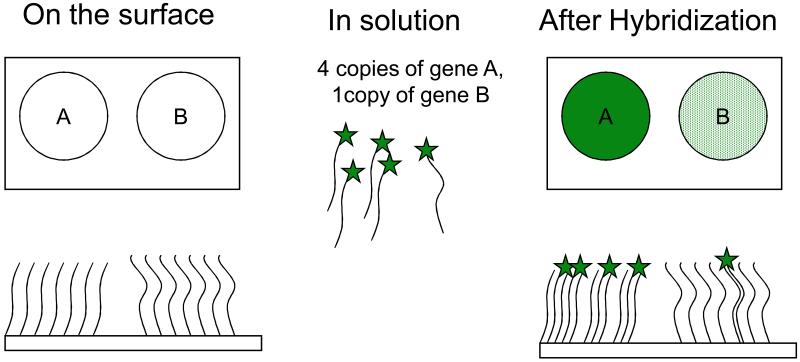
A DNA microarray starts with many distinct DNA probes arranged on a surface. These probes can be attached covalently, meaning through stable chemical bonds, or non-covalently, meaning through weaker interactions that still hold them in place during the experiment.
Researchers then add a solution containing labeled nucleic acids, usually DNA or RNA derived from a sample. If a target sequence in that mixture matches one of the probes on the array, the two bind by hybridization, the natural pairing process between complementary nucleic acid strands.
Why the array format was so useful
The power of the format comes from scale. Instead of testing one sequence at a time, scientists can place a very large number of probes on a single chip and estimate the relative abundance of many nucleic acid species in one run.
That parallel setup helped turn genomics into a measurement science. A single experiment could compare patterns across genes, tissues, or conditions and produce a broad snapshot of what was happening inside cells.
What microarrays are used for
One major use is gene expression analysis, which asks which genes are active and to what degree. In plain terms, it is like reading the production schedule of a factory: the more RNA made from a gene, the more strongly that gene is being used by the cell.
The source also highlights microarrays used with chromatin immunoprecipitation, or ChIP. In this method, transcription factors, the proteins that help control which genes are switched on or off, are first cross-linked to DNA with formaldehyde so the protein-DNA contacts are frozen in place.
How ChIP-chip maps protein-DNA interactions
After cross-linking, the DNA is broken into fragments. The transcription factor of interest, still attached to its DNA fragments, is then isolated by affinity purification using either an antibody against the factor or a molecular tag such as FLAG, HIS, myc, or HA that allows it to be pulled out of the mixture.
Once purified, the DNA is released from the transcription factor, amplified, labeled, and hybridized to the array. This workflow is known as ChIP-chip, short for chromatin immunoprecipitation on a chip, and it allows researchers to identify where a transcription factor was bound across the genome represented on the array.
The biggest limitation: arrays only see what they were designed to see
This is the central tradeoff in the technology. A microarray cannot detect RNA or DNA species unless the array includes complementary probes for them, so anything missing from the design is effectively invisible.
For gene expression studies, that means genes not yet annotated in a genome are usually absent from the array. The same goes for non-coding RNAs, RNA molecules that do not make proteins but can still regulate cell behavior, if they were not known or recognized as expressed when the array was built.
Why variable genomes create extra problems
The limitation becomes sharper in organisms with highly variable genomes, especially bacteria. Arrays are often designed from a reference strain, which is a standard genome sequence used as a template, but real isolates from the same species can carry many genes that the reference does not.
When that happens, a large fraction of genes present in the sample may simply have no matching probe on the chip. The result is not just lower sensitivity; it can also skew the biological picture by making genetic diversity look smaller than it really is.
How microarrays compare with other measurement tools
The source notes that microarrays are not the only way to quantify nucleic acid sequences. Other methods include quantitative PCR, which measures specific targets with high sensitivity, and digital PCR, which partitions samples into many tiny reactions to count molecules more directly.
Those alternatives are often better when the question is narrow and the target is already known. Microarrays, by contrast, were especially valuable when researchers wanted a broad survey across many predefined sequences at once.
Why This Matters
Microarrays helped establish a core idea that still drives modern genomics: biology can be read out at scale if you build the right measurement platform. They turned thousands of separate hybridization tests into one structured experiment and made it practical to compare large gene sets across samples.
Just as important, they taught the field a lasting lesson about technology bias. Any platform that depends on a predefined panel, whether it is an array or a targeted molecular assay, inherits the assumptions built into its design and may miss what researchers do not yet know to look for.
What the future looks like
The future of microarrays is less about replacing every newer method and more about understanding where they still fit. They remain useful as a conceptually clean, scalable way to test many known sequences in parallel, while newer sequencing-based tools can capture a wider and less biased view of genomes and transcriptomes. That makes microarrays an important bridge technology in the history of biochips: they showed how to miniaturize biology onto a surface, how to extract large amounts of information from hybridization patterns, and why assay design matters just as much as assay sensitivity. As researchers continue building faster and more precise molecular diagnostics, the basic logic behind the microarray, many measurements on one chip, still shapes the tools that come next.