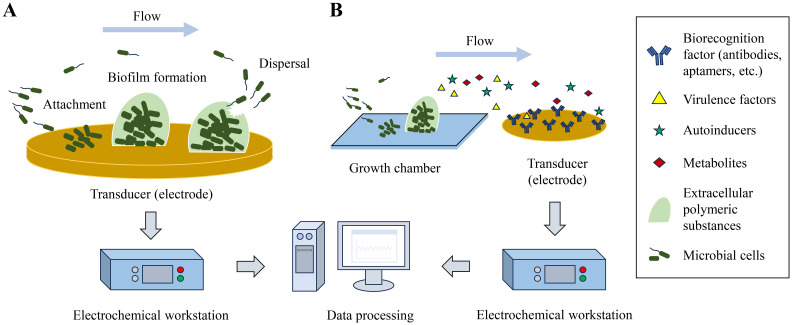
Researchers are increasingly turning to electrochemical biosensors built into microfluidic chips to watch microbial biofilms form, grow, and respond to treatment in real time. Biofilms are dense, sticky communities of microbes that attach to surfaces and protect themselves with a self-made matrix, making them far harder to kill than free-floating bacteria. The review article argues that pairing tiny fluid-handling devices with electrical sensing offers a practical way to study these stubborn microbial structures under controlled, lifelike conditions. Instead of taking occasional snapshots, scientists can continuously track changes in the biofilm by measuring electrical signals such as impedance, a property that reflects how strongly the biofilm resists current flow. That matters because biofilms play a major role in chronic infections, antibiotic resistance, and contamination in medical and industrial settings. The review highlights examples including work by Blanco-Cabra and colleagues, who monitored Pseudomonas aeruginosa and Staphylococcus aureus biofilms on a chip with integrated electrodes and controlled fluid flow. It also emphasizes the value of detecting quorum sensing molecules, the chemical messages microbes use to coordinate behavior, virulence, and resistance. Taken together, the article presents these chip-based electrochemical systems as a promising toolkit for understanding biofilm biology and eventually improving diagnosis, drug testing, and anti-biofilm therapies.
A better way to watch biofilms behave
Studying biofilms in the lab has always been tricky. Traditional methods often rely on end-point measurements, which is a bit like judging a whole movie from a single still frame: you learn something, but you miss the action in between.
Microfluidic chips help solve that problem by giving researchers a miniature, controllable environment where fluids can be delivered at precise rates. When electrochemical sensors are built directly into those chips, the system can report what is happening inside the biofilm as it develops, without constantly disturbing the sample.
How the chip-and-sensor combination works
A microfluidic chip is essentially a lab shrunk onto a small device with tiny channels and chambers. Those channels let researchers mimic the flow conditions microbes would experience in the body, in water systems, or on medical devices, while using much smaller sample volumes than conventional setups.
The electrochemical part acts like a built-in monitor. By measuring signals such as electrical impedance spectroscopy—a method that tracks how a material responds to an applied electrical current—scientists can infer changes in biofilm thickness, density, and growth over time.
An example from Pseudomonas and Staphylococcus
The review points to work by Blanco-Cabra and colleagues as a useful illustration of the approach. They used a microfluidic integrated chip with three independent growth chambers and built-in electrodes to monitor biofilms from different strains of P. aeruginosa and S. aureus.
That design let the team study growth and treatment under controlled flow conditions, while keeping the chambers separate for cleaner comparisons. According to the review, the setup supported more homogeneous biofilm formation and better reproduced physical conditions that microbes encounter outside a static petri dish.
Why electrical readouts are useful
Electrical sensing is appealing because it can be fast, continuous, and relatively gentle on the sample. Rather than staining or removing the biofilm for analysis, researchers can follow its changes indirectly through shifts in the electrical properties measured at the electrodes.
That makes the platform especially useful for observing dynamics such as proliferation, structural changes, and responses to treatment. In biofilm research, those time-dependent changes matter because resistance can emerge gradually, and a therapy that looks promising at one moment may fail over a longer period.
Listening in on microbial communication
One of the review's most important themes is quorum sensing, the chemical communication system microbes use to act as a group. A simple analogy is a group chat: individual cells release signaling molecules, and when enough of those messages build up, the population shifts behavior together.
In biological terms, those quorum sensing molecules can regulate gene expression, virulence factors, antibiotic resistance, and biofilm proliferation. The review cites Sharma and colleagues in noting that measuring these signals is key to understanding the internal logic of biofilms, not just their physical growth.
From detection to treatment testing
Because electrochemical biosensors can detect and quantify quorum sensing molecules on-chip, they offer more than a growth assay. They can potentially show when microbes are coordinating attacks, increasing virulence, or preparing defenses against antibiotics.
This creates a more dynamic platform for screening anti-biofilm agents. Instead of asking only whether a treatment reduces biomass, researchers can also ask whether it disrupts microbial communication, weakens coordinated behavior, or changes the timing of resistance-related responses.
Why This Matters
Biofilms are a major clinical and practical problem because they protect microbes from environmental stress and make infections harder to clear. On catheters, implants, wounds, and other surfaces, they can turn ordinary bacteria into persistent threats that shrug off standard treatment.
The review suggests that microfluidic electrochemical platforms could eventually support point-of-care testing, meaning diagnostic tools used near the patient rather than in a distant central lab. If such systems can reliably detect biofilm activity or quorum sensing signals quickly, they may help clinicians make earlier and more targeted treatment decisions.
The next frontier
The authors also look ahead to combining this technology with organ-on-chip systems, which are miniature devices designed to mimic the functions of human tissues or organs. That would give researchers a more realistic environment for studying how biofilms interact with host-like conditions, drugs, and changing physical stresses.
The review is careful not to present the field as finished. It notes that these systems still need further assessment to fully establish their effectiveness, but the direction is clear: better sensors, more realistic chip environments, and richer real-time data could make biofilm research far more precise in the years ahead.