AI-generated summary by biochip.com, published . Not independently reviewed. Source: Frontiers in Immunology, by Europe PMC.
Atopic dermatitis, often called eczema, is usually described as a disease of itchy, inflamed skin. But the new review behind this article argues that the condition is also a story about tiny biological messengers moving signals between cells. Those messengers are extracellular vesicles, or EVs: nanoscale packages released by skin cells, immune cells, and microbes that carry proteins, fats, and genetic material. In atopic dermatitis, these vesicles appear to help drive inflammation, weaken the skin barrier, and shape the immune system’s overreaction to harmless triggers. The review also highlights the other side of the equation: EVs may be turned into therapeutic tools that deliver drugs or calming biological signals directly to diseased skin. That makes them interesting not only as clues to how eczema develops, but also as possible biomarkers and treatment platforms. In short, the paper maps EVs as both part of the problem and part of a future solution. For a disease that affects millions and still lacks perfect long-term treatments, that dual role is what makes this research direction worth watching.
What the review is about
The source article is a scientific review focused on how extracellular vesicles contribute to atopic dermatitis pathogenesis and how they might be engineered for therapy. A review does not present one new experiment; instead, it pulls together findings from multiple studies to show where a field is heading.
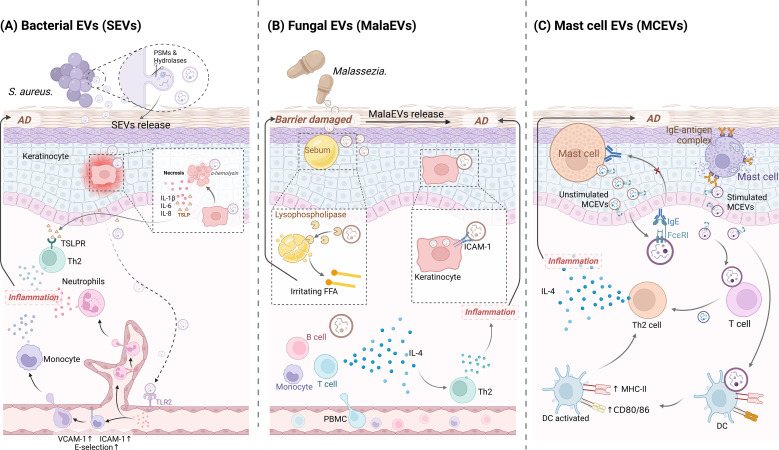
Here, the authors center EVs as communication tools in the skin ecosystem. They describe vesicles released by keratinocytes, immune cells, stem cells, and even microbes, and explain how these particles may amplify or dampen disease depending on where they come from and what cargo they carry.
Why extracellular vesicles matter in eczema
Extracellular vesicles are essentially membrane-wrapped parcels that cells send to one another. They can contain signaling proteins, lipids, messenger RNA, and microRNA, which are short RNA molecules that help control which genes are switched on or off.
In healthy skin, that kind of communication helps maintain barrier function and coordinate repair. In atopic dermatitis, the review suggests, EV signaling becomes distorted and starts reinforcing the very processes that make eczema so persistent: inflammation, itch, immune imbalance, and barrier breakdown.
How EVs may help drive disease
One of the central ideas in the review is that EVs can carry inflammatory instructions from one cell population to another. Skin cells under stress may release vesicles that encourage immune activation, while immune cells can return the favor by sending out EVs that worsen tissue inflammation.
This matters because atopic dermatitis is not caused by a single broken pathway. It is a network disease involving the skin barrier, the innate immune system, the adaptive immune system, and the skin microbiome, and EVs may serve as the connective tissue linking all of those components.
The skin barrier, immunity, and the microbiome
The skin barrier is the body’s frontline shield, and in eczema it often becomes leaky and fragile. The review describes evidence that EVs can influence barrier-related proteins and inflammatory molecules, potentially making it harder for skin to hold moisture and block irritants, allergens, and microbes.
It also points to interactions with the microbiome, the community of microorganisms living on the skin. Microbe-derived vesicles may shape inflammation directly, while host EVs may alter how microbes colonize damaged skin, adding another feedback loop to an already complex disease.
Could EVs become biomarkers?
Because EVs circulate in body fluids and reflect the state of the cells that produced them, they are attractive candidates for biomarkers. A biomarker is a measurable biological signal that can help diagnose disease, track severity, or predict response to treatment.
For atopic dermatitis, that raises the possibility of less invasive monitoring based on vesicle cargo in blood or other samples. The review suggests that specific EV-associated proteins or RNA signatures could eventually help distinguish disease stages or identify which inflammatory pathways are most active in a given patient.
Engineering EVs as treatment carriers
The most forward-looking part of the review is its discussion of therapeutic engineering. Because EVs are naturally built to move cargo between cells, researchers are exploring whether they can be repurposed to deliver anti-inflammatory drugs, small RNAs, or regenerative signals to diseased tissue.
This is especially appealing in dermatology, where local delivery matters. If EVs can be designed to reach inflamed skin efficiently and safely, they might offer a more targeted alternative to broad immune suppression, which can work well but also carries side effects and does not help every patient.
Promising sources of therapeutic vesicles
The review highlights interest in EVs derived from mesenchymal stem cells, a cell type often studied for its tissue-repair and immune-modulating properties. Vesicles from these cells may reproduce some of the parent cells’ beneficial effects while avoiding some of the practical and regulatory complications of live-cell therapy.
Researchers are also considering ways to load EVs with custom cargo or modify their surfaces so they home in on the right cells. In principle, that could allow a treatment to calm overactive immune responses, support barrier repair, and perhaps even reshape harmful skin-cell communication at the same time.
The challenges ahead
For all the excitement, the review is clear that EV science still faces major technical hurdles. Scientists need more standardized methods for isolating vesicles, defining exactly which subtype they are studying, measuring cargo consistently, and producing material at therapeutic scale.
There is also the question of mechanism. If an engineered EV improves eczema-like inflammation in a model system, researchers still need to know which molecule inside the vesicle is doing the work, which cells are receiving it, and how durable and safe that effect would be in real patients.
Why This Matters
Atopic dermatitis is common, chronic, and often underestimated. Severe cases can disrupt sleep, increase infection risk, affect mental health, and require years of careful disease management, so better tools for understanding and treating it are badly needed.
The review matters because it reframes eczema as a communication disorder as much as an inflammatory one. If EVs truly sit at the crossroads of barrier damage, immune dysregulation, and microbial imbalance, they could help researchers move beyond symptom control toward more precise ways of measuring and interrupting disease.
The bigger implication is that extracellular vesicles may become a bridge between diagnosis and therapy. The same particles that reveal what is going wrong in the skin could, with enough engineering, become delivery systems for correcting it. That is still a developing vision rather than a clinic-ready reality, but it is a compelling one. As EV biology becomes more standardized and better understood, atopic dermatitis may prove to be one of the clearest examples of how tiny cellular packages can reshape both our model of disease and our approach to treatment.