Researchers in Japan report that routine liquid-based cytology samples—the cell suspensions hospitals already prepare to diagnose cancer under a microscope—can often double as material for a sensitive lung cancer gene test called the Lung Cancer Compact Panel, or cPANEL. That matters because patients with non-small cell lung cancer increasingly need rapid molecular testing to identify drug-matching mutations and gene fusions, yet clinics do not always have extra tissue set aside for sequencing. In this study, the team asked a practical question: can the leftover fluid from standard cytology workups be used directly, without special preservation tubes or extra lab handling? Their data suggest that, in many cases, the answer is yes. DNA quality held up well across the samples they examined, while RNA quality was more fragile and more dependent on how the specimen had been fixed and how many tumor cells were present. All tested samples cleared the DNA portion of the assay, but a minority failed on the RNA side, which is important because some clinically relevant cancer drivers are detected from RNA. Overall, the results point to a workable path for expanding access to multiplex next-generation sequencing from material that is already part of routine care, while also showing exactly where the limitations still lie.
What the study set out to test
The study focused on non-small cell lung cancer, the most common broad category of lung cancer and one in which treatment decisions often depend on tumor genetics. The cPANEL test is a multiplex gene panel, meaning it checks several cancer-related genes at once using next-generation sequencing, a method that reads many fragments of genetic material in parallel.
That kind of testing can look at both DNA, the cell's long-term instruction book, and RNA, the working copy that shows which genes are actively being used. In routine pathology, however, getting enough good-quality DNA and RNA can be difficult, especially when the sample comes from a minimally invasive procedure rather than a larger surgical specimen.
Why liquid-based cytology is appealing
Liquid-based cytology, usually shortened to LBC, is already widely used in clinical practice. Instead of smearing cells directly on a glass slide, clinicians place collected cells into a preservative fluid, making the sample easier to process and standardize for microscopic review.
A simple way to think about LBC is as a jar that keeps loose puzzle pieces suspended in liquid until the lab is ready to sort them. For molecular testing, that leftover suspension could be valuable because it may still contain tumor cells, but only if the genetic material has survived the fixation and storage process well enough to be read accurately.
How the researchers evaluated the samples
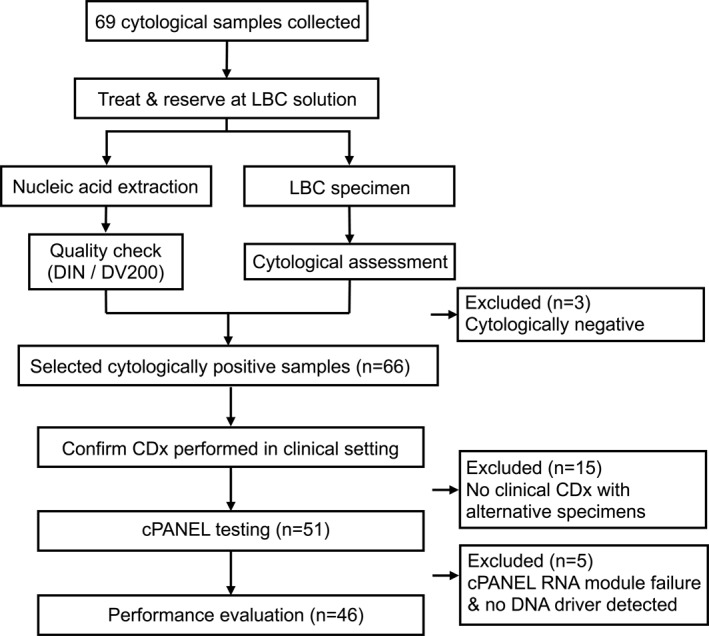
The team analyzed 69 clinical LBC specimens to measure the quality of DNA and RNA. From these, 51 samples containing non-small cell lung cancer cells and already known driver alteration status were then tested with cPANEL so the researchers could compare panel results with established companion diagnostic findings.
This design let the group answer two different questions at once. First, they could assess whether routine LBC material preserved nucleic acids well enough for sequencing; second, they could measure concordance, or how often cPANEL agreed with prior clinical test results for the same tumors.
DNA performed well, RNA was the weak spot
The clearest result was the split between DNA and RNA performance. DNA integrity was generally preserved, with a mean DNA Integrity Number of 6.2 ± 1.5, suggesting that the material remained usable for the DNA-based part of the panel.
RNA was much more variable. The study reported a mean DV200 of 16.4 ± 12.1%, a metric that reflects how much RNA remains in fragments long enough to be useful; in plain terms, low DV200 values indicate that the RNA has been chopped into pieces that are harder to analyze reliably.
That difference is not surprising biologically. DNA is often more durable in preserved samples, while RNA behaves more like a message written on fragile paper—helpful when intact, but easily damaged by fixation, time, and handling.
The choice of fixative mattered
Not all LBC preparations performed the same way. The researchers found that ThinPrep-fixed specimens had lower DNA Integrity Number and DV200 values than CytoRich Red-fixed specimens, indicating poorer preservation of both DNA and RNA in the ThinPrep group.
This is a practical point for pathology labs. The study does not claim that one fixative solves every problem, but it does show that preexisting routine choices in specimen preparation can directly shape how well a downstream sequencing assay works, especially for RNA-based detection.
How well cPANEL matched established results
On the DNA side, performance was strong: all samples successfully passed the DNA-based cPANEL assay. The trouble came in the RNA module, where six of the 51 cases, or 11.8%, failed, with low RNA yield identified as a major contributing factor.
Among the 46 specimens that were evaluable, concordance with previous clinical companion diagnostics reached 95.7%, and sensitivity was 92.3%. When the RNA module failures were counted as cPANEL-negative, sensitivity fell to 88.9%, underscoring how much assay success depends not just on the panel chemistry but on whether enough intact RNA is present to begin with.
Why This Matters
For patients, this study speaks to a common bottleneck in precision oncology: not whether a useful mutation exists, but whether there is enough suitable sample to detect it. If routine LBC specimens can be used directly for cPANEL without dedicated molecular preservation or extra preanalytical processing, more patients could potentially undergo broad molecular testing from material already collected during standard care.
For labs, the message is slightly more nuanced. Routine LBC appears to be a practical platform when the fixative is appropriate and the sample has adequate cellularity, meaning enough tumor cells are present, but RNA remains the limiting factor and may still cause false negatives or test failures in a meaningful minority of cases.
The broader significance is that pathology workflows do not always need to be rebuilt from scratch to support precision medicine. Sometimes the faster path is to validate what clinics already have on hand, identify the conditions under which it works, and be honest about the tradeoffs. This study makes that case clearly for lung cancer cytology: the approach looks feasible, especially for DNA-based testing, but success with RNA-dependent targets will depend on specimen quality, fixative selection, and careful implementation in real-world practice.