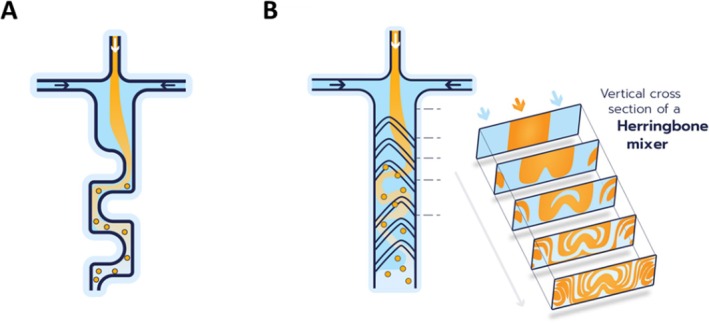
Researchers tested whether a microfluidic device could reliably make peptide-based nanoparticles for carrying genetic cargo into cells, and the answer was largely yes. The study focused on WRAP5, a short amphipathic peptide rich in tryptophan and arginine that can self-assemble with nucleic acids such as small interfering RNA and plasmid DNA. Using 72 different formulations, the team varied key manufacturing settings that often matter a great deal in nanoparticle production: the flow rate ratio, or how quickly the input streams are combined relative to each other; the total flow rate, or how fast the whole system runs; and the design of the mixing channel itself. Despite those changes, the resulting particles stayed in a tight size range of roughly 50 to 70 nanometers and remained fairly uniform, with a low polydispersity index. The particles also kept doing their biological job, whether that meant silencing the CDK4 gene in GIST-T1 cells or delivering a plasmid that drove mCHERRY expression in HeLa cells. That matters because many current lipid nanoparticles are much fussier: small tweaks in manufacturing conditions can change their size, payload loading, and performance. The new results suggest peptide-based nanoparticles may offer a sturdier, easier-to-scale route for nucleic acid delivery. They do not erase the challenges of turning a lab formulation into a medicine, but they point to a platform that may be less sensitive to production details than the lipid systems now dominating the field.
A different delivery vehicle
Most people first heard about lipid nanoparticles, or fat-based particles, during the mRNA vaccine era. They act like tiny delivery envelopes that protect fragile genetic material and help it enter cells. But they are not the only possible carrier.
Peptide-based nanoparticles use short chains of amino acids instead of lipids. In this study, the carrier was WRAP5, described as a tryptophan- and arginine-rich amphipathic peptide, meaning it has regions that interact with both water and oily environments and can bind nucleic acids while helping them cross cell membranes.
Why microfluidics was the key test
A useful analogy is a very precise kitchen faucet mixer. If you can combine ingredients at exactly the right speed and ratio every time, you are more likely to get the same final texture. That is the idea behind microfluidics, which pushes tiny streams of liquid through narrow channels to create highly controlled mixing.
For nanoparticle manufacturing, that control can be crucial. In many lipid nanoparticle systems, changing the flow rate ratio or total flow rate can alter particle size and uniformity, which then affects how well the particles work. The researchers wanted to know whether WRAP5-based particles showed the same sensitivity or whether they were more forgiving.
What the team changed, and what stayed the same
The team produced 72 formulations containing either small interfering RNA (siRNA), which can switch down a target gene, or plasmid DNA (pDNA), circular DNA commonly used to drive protein expression in cells. They then varied three process parameters: flow rate ratio, total flow rate, and the design of the mixing channel.
To check the particles, the researchers used dynamic light scattering, a standard technique that estimates particle size by measuring how particles scatter light as they move in liquid. Across all those formulations, the mean particle size remained consistently between 50 and 70 nanometers, and the polydispersity index stayed below 0.22, indicating a relatively narrow and uniform particle population.
Stability depended on the cargo
The storage results were more mixed, but still encouraging. Nanoparticles carrying siRNA showed moderate size increases when stored at 4 degrees Celsius, suggesting some physical change over time. That does not automatically mean they failed, but it does signal that siRNA-loaded versions may need closer handling and shelf-life evaluation.
By contrast, the pDNA-loaded particles were highly stable for up to 70 days. That is a useful distinction because stability is one of the practical bottlenecks in translating delivery systems from bench experiments into routine laboratory tools or future therapeutic products.
The particles still worked in cells
Physical measurements only go so far; nanoparticles must also deliver their cargo effectively. The researchers therefore tested biological activity in two cell models. In GIST-T1 cells, WRAP5:siRNA nanoparticles produced about 50% silencing of CDK4, a gene involved in cell-cycle regulation.
In HeLa cells, WRAP5:pDNA nanoparticles drove efficient expression of mCHERRY, a fluorescent reporter protein often used to show that gene delivery succeeded. Importantly, these functional results held regardless of how the particles were formulated or how long they had been stored, at least within the study conditions.
Why this looks different from lipid nanoparticles
The striking part of the study is not that the particles worked once. It is that they kept looking and behaving similarly even when the manufacturing settings changed. For researchers and manufacturers, that kind of robustness is attractive because it lowers the chance that a small production shift will create a substantially different product.
The authors explicitly contrast this behavior with many lipid nanoparticle systems, which often require tight control over flow rate ratio and total flow rate. If peptide-based nanoparticles can tolerate wider operating windows, they may be easier to scale from small lab batches to larger, more standardized production runs.
Why This Matters
Nucleic acid medicines only work if the cargo reaches the right cells in a usable form. That has made delivery one of the central engineering problems in modern biotechnology. A carrier that is active, physically consistent, and less sensitive to manufacturing tweaks could expand the toolkit for RNA interference, gene expression studies, and potentially future therapeutics.
This study does not claim that WRAP5-based nanoparticles are ready to replace lipid nanoparticles across the board. It does, however, show that a peptide-based system can be made with a microfluidic device without the usual manufacturing fragility many researchers expect. That is a meaningful result because robustness is often what separates an interesting formulation from one that can actually be developed and reproduced.
What comes next
The logical next steps are to test these particles in more complex biological settings and to examine how broadly the robustness holds across other cargos, cell types, and larger-scale manufacturing conditions. If those studies confirm the same pattern, WRAP5-based peptide nanoparticles could become a useful complement to lipid systems, especially in applications where consistency and shelf stability are as important as delivery itself.