Source: arXiv, by Xin Jin (September 10, 2026). AI-generated summary by biochip.com, published . Not independently reviewed.
Key takeaways
- University of Pittsburgh researchers propose four quantum biosensor generations defined by coherence, entanglement, and quantum-learning resources.
- The framework links neural signal bandwidths with platform response bandwidths and classifies devices by precision scaling and sensor-tissue proximity.
- The fourth generation is a proposed roadmap, not evidence of clinically validated learning-integrated quantum sensor networks.
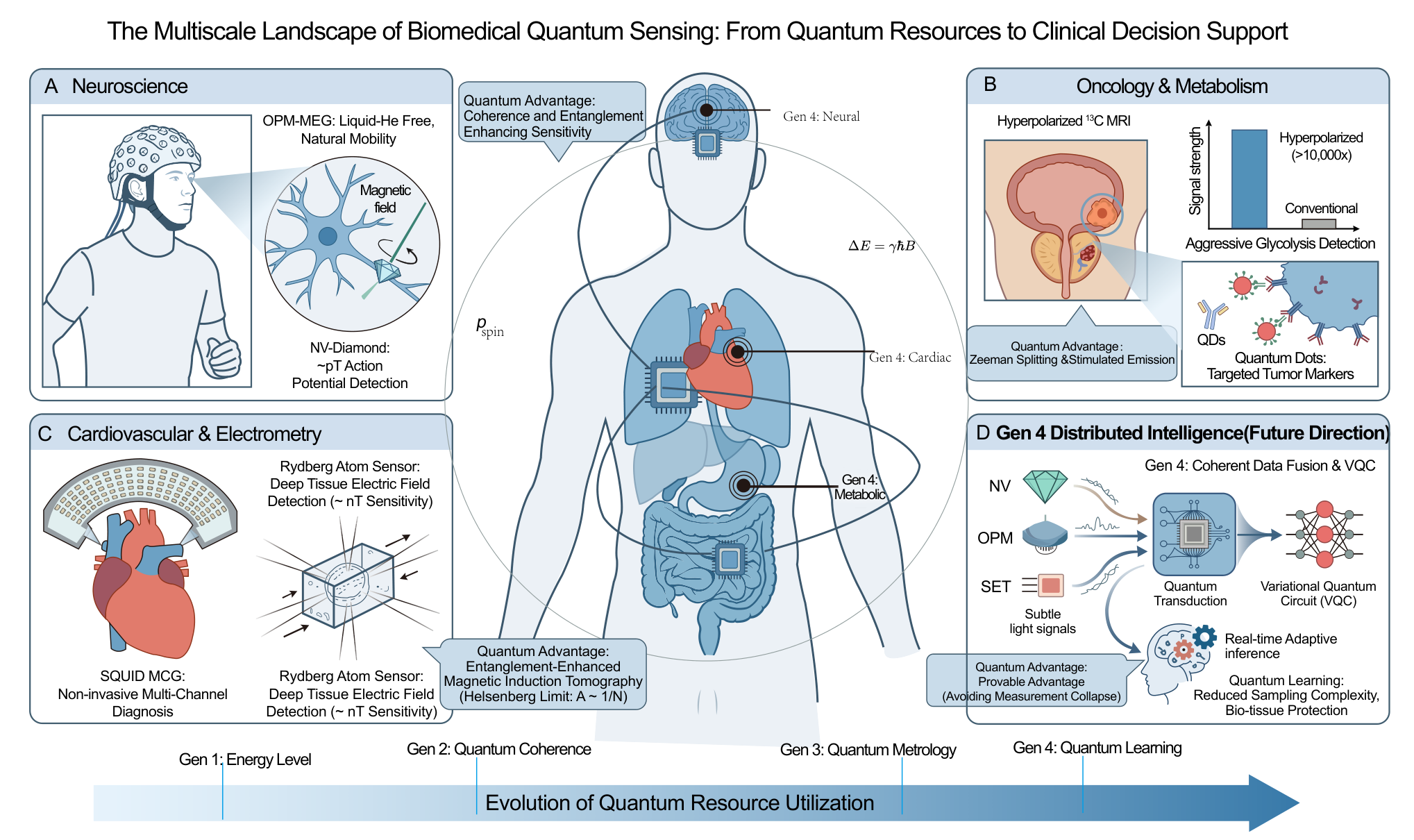
Researchers at the University of Pittsburgh have proposed a four-generation framework for understanding quantum biomedical sensors, devices designed to use carefully controlled quantum effects to measure biological signals. Their central idea is that these sensors should be compared not only by the hardware they use, such as nitrogen-vacancy centers or atomic magnetometers, but by the quantum resources that actually improve a measurement. The framework begins with devices that use discrete quantum energy levels yet retain conventional, classical precision scaling. It then moves through sensors that preserve quantum coherence, systems that use entanglement or spin squeezing, and a proposed fourth generation that combines sensing with quantum learning. This progression matters because biomedical sensing is not simply about detecting a weak field or molecule: it is about turning that measurement into useful information about living tissue. The team also proposes matching the bandwidth of each sensing platform to the timescales of neural signals, which range across different speeds and levels of biological organization. Their roadmap highlights the distance between promising laboratory physics and clinically useful sensor networks. Rather than announcing a finished medical device, the work offers a structured way to classify the field and identify what must improve before quantum sensing can support adaptive biomedical inference.
Why Quantum Resources Matter
Every electronic sensor ultimately relies on quantum physics, but that does not automatically make it a quantum sensor. Conventional biomedical instruments generally collect signals from enormous numbers of particles and are constrained by classical noise, the random fluctuations that blur a measurement even when an instrument is carefully built.
Quantum sensors take a more deliberate approach. They encode a physical quantity, such as a magnetic field, electric field, temperature change, pressure fluctuation, or chemical environment, into a controllable quantum state. A useful analogy is a tuning fork: a small change in its surroundings changes how it vibrates. In a quantum sensor, the measured signal changes the behavior of an engineered quantum state, and researchers read out that change.
First and Second Generations
The first generation uses discrete quantum energy levels for signal transduction, meaning that a biological signal is converted into a measurable change in a quantum system. These devices can offer useful sensitivity, but their precision follows classical scaling laws. Adding more independent measurements improves the result in the familiar way, rather than delivering a fundamentally different scaling advantage.
Second-generation sensors make use of quantum coherence. Coherence is the period during which a quantum state maintains a well-defined relationship among its possible states, much like keeping several clock hands synchronized long enough to compare them precisely. The longer coherence survives, the longer a sensor can accumulate information about a weak signal, extending precision up to the standard quantum limit.
The Push Beyond the Standard Quantum Limit
The standard quantum limit describes a common precision boundary for independent quantum measurements. It does not mean measurement cannot improve, but it means that reducing uncertainty typically requires many more sensing events. For weak and fast-changing biomedical signals, that requirement can be a serious practical constraint.
Third-generation architectures seek to do better by using entanglement and spin squeezing. Entanglement creates correlations between quantum objects that cannot be described as separate independent states, while spin squeezing redistributes uncertainty so that the measurement-relevant quantity becomes more precise. These approaches aim toward the Heisenberg limit, an idealized precision scaling associated with fully exploiting quantum correlations.
Hardware Is Only Part of the Story
The proposed framework spans a varied set of platforms, including superconducting circuits, nitrogen-vacancy centers, atomic magnetometers, and entanglement-enhanced metrology systems. Nitrogen-vacancy centers are atomic-scale defects in diamond whose quantum states can respond to nearby magnetic, electric, thermal, and chemical conditions. Atomic magnetometers use atoms as exquisitely sensitive field detectors, while superconducting circuits can create and manipulate quantum states in electronic structures cooled to extremely low temperatures.
Grouping these technologies only by material or device type can obscure the more consequential question: what quantum resource enters the measurement chain, and what precision scaling does it provide? The Pittsburgh team therefore proposes classifying deployed clinical devices by their precision-scaling class and by sensor-tissue proximity. That second criterion is important because a highly sensitive detector placed far from its target may face a very different biological measurement problem than a less sensitive probe positioned close to tissue.
Bandwidth Must Match Biology
Sensitivity alone does not determine whether a sensor is useful for neuroscience or medicine. A device must also respond at the right speed, or bandwidth, for the biological event it is trying to capture. A camera that takes one photo per minute cannot record a hummingbird's wingbeat, even if every picture is exceptionally sharp.
The team applies that logic to a hierarchy of neural signals and the response bandwidths of quantum platforms. Matching a sensor's operating range to the timing of relevant biological activity could help distinguish systems suited to slow physiological variations from those capable of tracking rapid neural dynamics. This analysis places engineering choices, such as sensor design and tissue proximity, alongside fundamental questions of quantum precision.
A Proposed Fourth Generation
The fourth generation is an emerging concept rather than an established class of clinical instruments. It would integrate quantum sensing end to end with quantum learning and variational circuits, which are adjustable quantum circuits optimized for a particular task. Instead of collecting raw physical measurements and sending all interpretation to a conventional computer, such a system could perform adaptive inference within the quantum domain.
That distinction shifts the goal from measuring an observable to extracting structured biological information. A sensor network might not merely register a magnetic change, for example, but adapt its measurement strategy to help distinguish meaningful patterns from irrelevant variation. The proposed roadmap organizes this transition around physical milestones toward learning-integrated networks.
Why This Matters
Biomedical quantum sensing often attracts attention because it could detect extraordinarily weak signals, but sensitivity is only one link in a longer chain. A clinically useful system must preserve its quantum advantage in a real environment, operate at the needed biological timescale, reach the relevant tissue, and convert measurements into interpretable information. The four-generation model makes those dependencies more visible by connecting quantum resources with device function and eventual inference.
The framework does not establish that fourth-generation systems have achieved clinical performance, nor does it claim that entanglement-enhanced or learning-integrated sensing has solved the practical barriers of biomedical deployment. Its value is as a map for comparing very different sensor architectures on shared terms. Future progress will depend on whether researchers can pair durable quantum states with appropriate bandwidth, biological access, and adaptive analysis, moving quantum biosensors from precise physical probes toward tools that can reveal useful patterns in living systems.