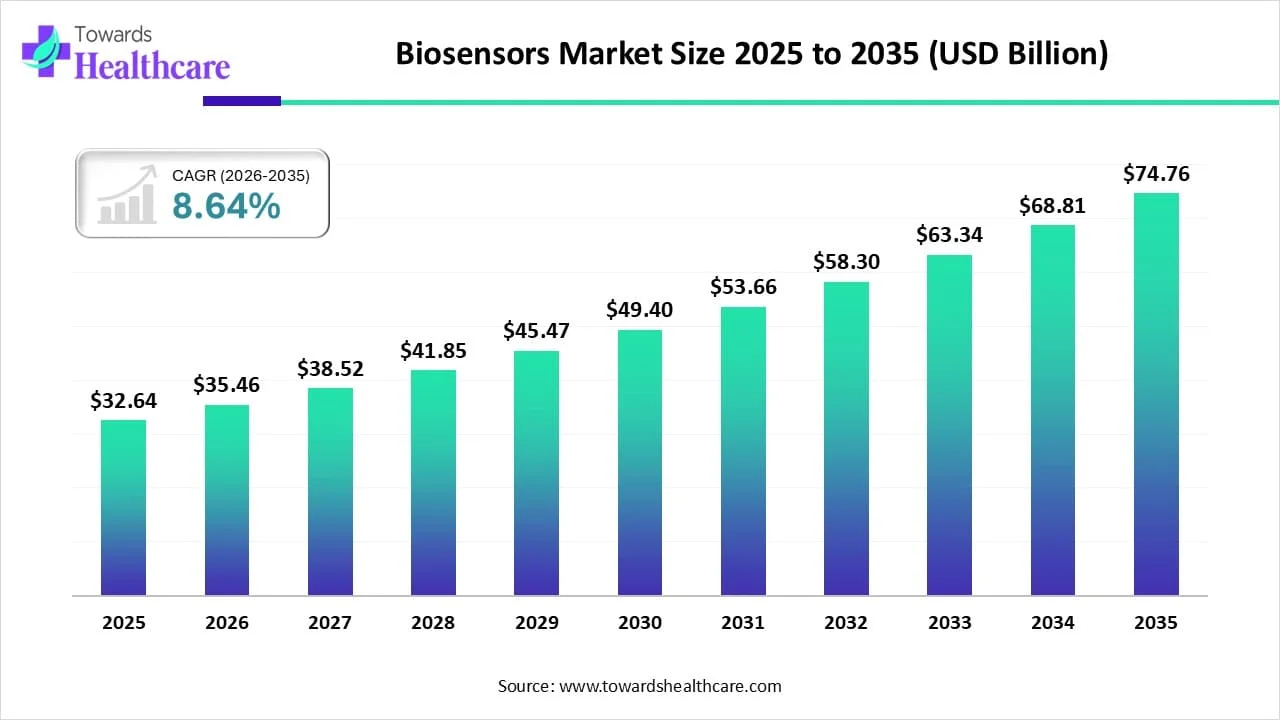
Source: OpenPR, by Towards Healthcare Research and Consulting, https://www.towardshealthcare.com/. AI-generated summary by biochip.com, published . Not independently reviewed.
The global biosensors market is being pushed forward by a simple idea: measure biology quickly, continuously, and in places far beyond a central lab. The source material points to a market that could reach USD 68.72 billion by 2035, driven by demand in wearables, diagnostics, and digital health platforms. One major theme is the rise of compact sensor chips that can track body signals while using very little power, making them practical for devices people wear all day. Another is the expansion of pathogen detection tools, including a photonic chip-based spectrometric biosensor technology transferred in India in July 2024 to UNINO Healthcare Pvt. Ltd. for faster infectious-disease testing. Europe is also highlighted as a region where growing health awareness is helping demand for biosensor-enabled products. Taken together, these signals suggest that the market is not growing because of one killer app, but because several sectors are maturing at once. Semiconductor suppliers, diagnostics companies, clinical service firms, and digital health platforms are all part of the same stack, and each layer makes the others more useful. That interconnected structure helps explain why biosensors are moving from niche medical tools into everyday health monitoring and broader disease surveillance.
What Is Driving the Market
A biosensor is a device that detects a biological signal and turns it into data people or machines can use. A helpful analogy is a smoke detector: it senses something invisible, converts that signal into an alert, and lets you act quickly. In a biosensor, the “something” might be glucose, a pathogen, or a body movement pattern rather than smoke.
The source frames market growth around health awareness and convenience. People increasingly expect to track heart rate, activity, and related body signals in real time, often from the wrist or another wearable device. That expectation creates demand not just for consumer gadgets, but also for the chips, algorithms, and validation services needed to make the measurements reliable.
Wearables Push Sensor Design Forward
STMicroelectronics is one of the companies cited in the source, and Simone Ferri, the company’s APMS Group VP and MEMS Sub-Group General Manager, ties biosensor momentum directly to wearable electronics. He describes wearables as a critical enabling technology for the rise in personal health awareness and fitness. That matters because wearables are where engineering limits become obvious: the device has to be small, light, and able to run for long periods on a tiny battery.
Ferri says STMicroelectronics recently launched a biosensor chip designed to combine motion and body-signal sensing in an ultra-compact package with a frugal power budget. In plain terms, that means packing several sensing functions into a chip small enough for tight spaces while keeping electricity use low. For users, low power is not a technical footnote; it is the difference between a device that feels seamless and one that is annoying to charge.
Why Low-Power Chips Matter
Low-power design is easy to underestimate, but it often determines whether a biosensor is practical. Think of it like fuel efficiency in a car: if the engine works well but burns through gas too fast, the product becomes harder to live with. In wearables, power-hungry sensing can shorten battery life, increase heat, and force design compromises.
That is why semiconductor firms such as STMicroelectronics, Analog Devices, Texas Instruments, and ams-OSRAM sit at the foundation of the market ecosystem described in the source. They supply sensing chips, microelectromechanical systems or MEMS - tiny moving structures built into chips - and signal-processing technologies that help devices capture and interpret subtle biological signals. Better chips do not just improve performance; they widen the range of products that can include biosensing at all.
India’s Pathogen Detection Development
The source also highlights a specific event in India: in July 2024, an indigenously developed photonic chip-based spectrometric biosensor technology was transferred to UNINO Healthcare Pvt. Ltd. The stated goal is quick and accurate pathogen detection to help prevent infectious diseases. Unlike fitness wearables, this is a diagnostic and public-health use case, showing how broad the biosensor category has become.
The phrase photonic chip means the system uses light rather than only electrical signals to detect what is in a sample. Spectrometric refers to measuring how light interacts with matter, a bit like using a fingerprint made of wavelengths. In practice, that approach can help identify pathogens quickly by spotting distinctive optical patterns, potentially making testing faster and more accessible than traditional lab workflows in some settings.
The Market Is an Ecosystem, Not a Single Product
One of the most useful parts of the source is its breakdown of the market into roles. Product manufacturers such as Abbott, DexCom, Roche Diagnostics, Siemens Healthineers, and Nova Biomedical turn sensor technology into commercial diagnostic and monitoring devices. They sit between component suppliers and the clinicians or consumers who actually use the tools.
Then there are service providers including IQVIA, ICON plc, and Labcorp, which support clinical validation, healthcare services, commercialization, and regulatory studies. That work is less visible than a new device launch, but it is essential. A sensor is only valuable if companies can prove it works consistently, fits care pathways, and meets regulatory expectations.
Platform providers such as Oura Health, Philips, and Medtronic add yet another layer by integrating biosensor data into patient monitoring systems and broader digital health ecosystems. This is where raw measurements become a service. A heart-rate reading on its own is just a number; embedded in software, trends, and alerts, it can become part of preventive care or remote monitoring.
Why This Matters
The most important shift here is that biosensors are moving from occasional testing toward continuous and distributed measurement. Instead of waiting for a clinic visit, users can gather data during daily life, and healthcare systems can sometimes detect changes earlier. That could support faster responses to infection risk, chronic disease management, and more personalized health tracking.
It also changes who participates in healthcare technology. Chipmakers, device firms, contract research organizations, and software platforms are now tightly linked, which means progress in one layer can accelerate the others. If smaller, lower-power chips become easier to build, device makers can design new formats; if validation and data platforms improve, those devices become easier to trust and adopt.
What to Watch Next
If the market does climb toward the level projected in the source, the next phase will likely depend on execution more than hype. Companies will need to show that sensors are not only clever, but accurate, durable, power-efficient, and easy to integrate into care and consumer routines. The latest signals from wearables and pathogen detection suggest the field is heading that way, with innovation happening at both the chip level and the application level.
The broader story is that biosensors are becoming infrastructure. They are turning biology into usable data in real time, whether the goal is counting steps, monitoring body signals, or detecting infectious agents quickly. As more organizations across the ecosystem refine those tools, biosensing is likely to become a more ordinary part of medicine and daily life - and that may be the clearest sign of the market’s maturation.