Liquid biopsy refers to a set of tests that look for cancer-related material in blood or other body fluids instead of removing a piece of tissue with a needle or surgery. The source describes these tools as a minimally invasive and accessible way to detect cancer earlier and to keep track of how a patient is responding over time. Rather than relying only on a single snapshot from a tumor sample, liquid biopsy can capture signs of disease from a simple blood draw, and in some cases from urine or plasma. The key idea is straightforward: tumors shed biological clues into the body, and sensitive tests can read those clues. According to the source, those clues include genetic mutations and circulating biomarkers such as circulating tumor DNA, cell-free DNA, and extracellular vesicles. That makes liquid biopsy useful not just for finding cancer, but also for monitoring it, especially when repeat tissue biopsies would be difficult or risky. The source places particular emphasis on patients with advanced cancer, where non-invasive testing can make follow-up more practical. Taken together, the trend points to a cancer care model that is less invasive, easier to repeat, and better suited to ongoing monitoring.
What a liquid biopsy actually measures
A tissue biopsy is like cutting out a page from a book to inspect it closely. A liquid biopsy is more like collecting snippets that have floated loose from the same book and using them to infer what the full story says.
In practice, these tests search body fluids for traces linked to cancer. The source highlights genetic mutations and several types of circulating biomarkers, which are measurable biological signals that can indicate the presence or behavior of a tumor.
Why blood-based testing is attractive
The strongest appeal of liquid biopsy is that it is minimally invasive. Instead of a surgical or needle-based procedure to obtain tumor tissue, clinicians may be able to work from a blood sample, which is generally easier for patients and easier to repeat.
That repeatability matters because cancer is not static. A tumor can change over time, and a test that can be performed more often gives doctors a way to watch those changes more closely as treatment continues.
The biomarkers behind the test
One of the main signals mentioned in the source is circulating tumor DNA, often shortened to ctDNA. This is DNA released by tumor cells into the bloodstream, and it can carry mutations associated with a patient’s cancer.
The source also mentions cell-free DNA, or cfDNA, which is DNA fragments found outside cells in body fluids. Not all cfDNA comes from tumors, so the challenge is to distinguish the cancer-related fraction from the background noise. Another marker is extracellular vesicles, tiny membrane-bound packages released by cells that can carry proteins and genetic material.
How these tests fit into cancer care
Liquid biopsy is especially valuable for early detection and patient monitoring, the two uses emphasized in the source. Early detection means finding signs of cancer sooner, when treatment decisions may be made earlier and with more information.
Monitoring is the other major role. A patient’s blood or other fluid sample can be checked over time for the same biomarkers, allowing clinicians to see whether a treatment appears to be working or whether new mutations are emerging that could change the treatment plan.
Why advanced cancer is a key use case
The source notes that these tests are already transforming cancer care, particularly for patients with advanced cancer stages. That focus makes sense because patients with late-stage disease often need frequent assessment, and repeated tissue biopsies can be burdensome, painful, or medically impractical.
In that setting, a non-invasive test can lower the barrier to follow-up. It can also help when a tumor is hard to reach safely, giving care teams another route to gather molecular information without a more complicated procedure.
What “accessible” could mean in practice
The source describes liquid biopsy as an accessible method, which points to a practical advantage as much as a scientific one. Blood draws are routine in many care settings, so the path from sample collection to testing can be simpler than arranging an interventional biopsy.
Accessibility also matters for continuity. If a test can be repeated with less disruption, it becomes easier to build ongoing surveillance into cancer care rather than treating molecular analysis as a one-time event.
Why This Matters
The broader significance of liquid biopsy is not just convenience. It reflects a shift toward treating cancer as a moving target that should be monitored in real time, using biological signals that can be gathered with less risk and less strain on patients.
For patients, that could mean fewer invasive procedures and more chances to adjust care based on current information. For clinicians, it offers another way to connect diagnosis, treatment selection, and follow-up through the same basic idea: reading tumor-related signals from body fluids.
What to watch next
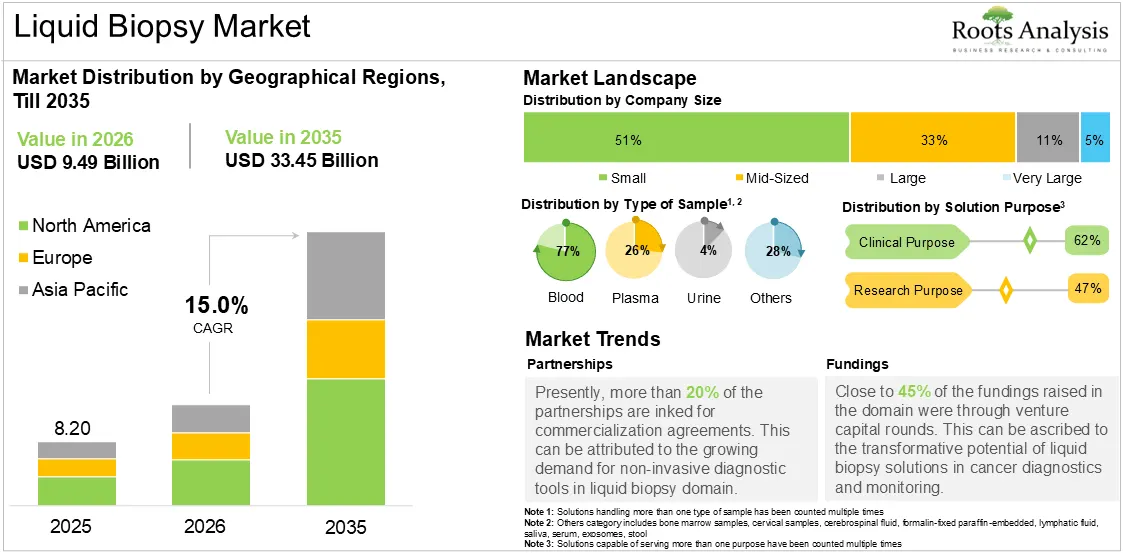
The source frames liquid biopsy as part of a longer market and technology trend extending to 2035, suggesting continued growth in both adoption and development. The core promise is clear: if tests can reliably detect and track cancer from blood, urine, plasma, or other fluids, they could become a more routine part of how oncology is practiced.
The next phase will depend on how well these biomarker-based tools are validated across different cancers and clinical settings. Even so, the direction outlined by the source is unmistakable: cancer testing is moving toward methods that are less invasive, more repeatable, and better suited to continuous monitoring over the course of disease.