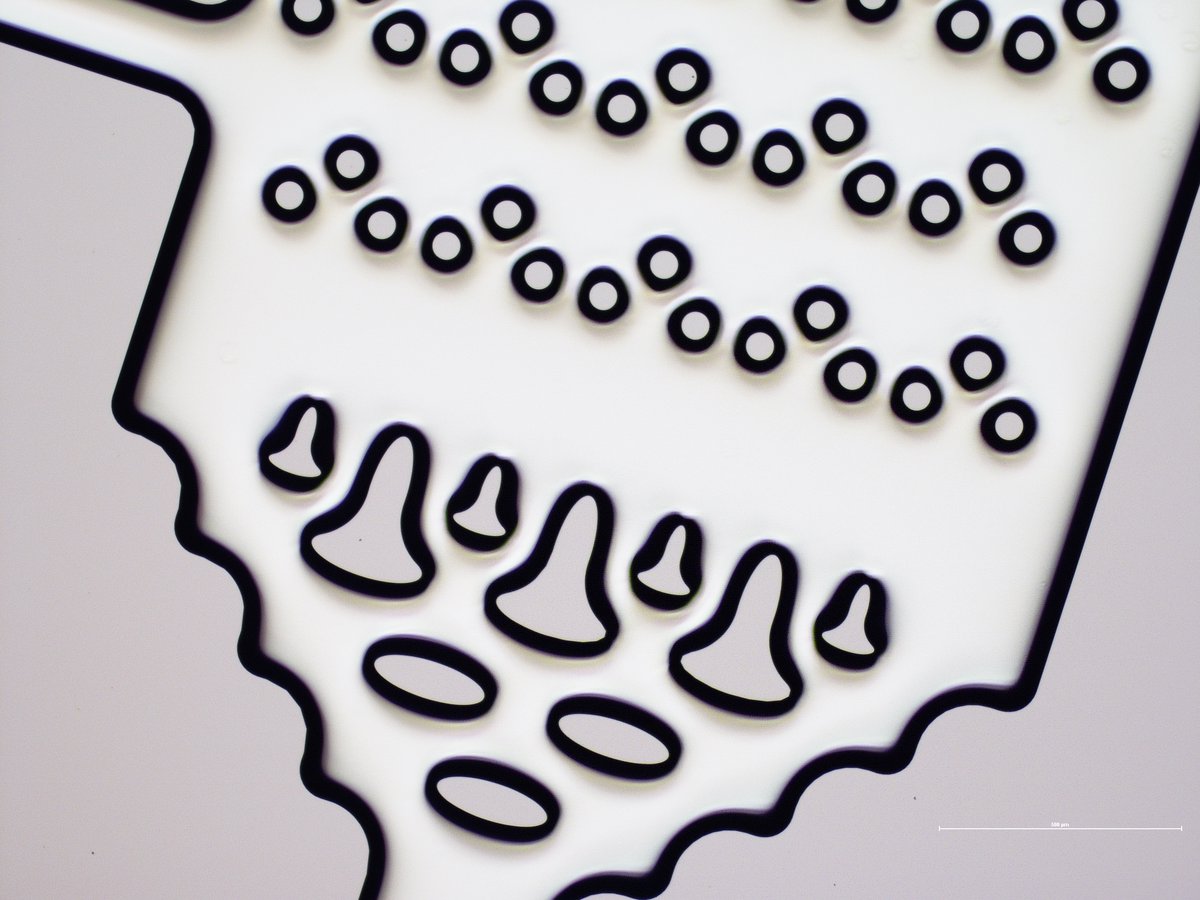
Source: Massachusetts General Hospital, by Katie Marquedant. AI-generated summary by biochip.com, published . Not independently reviewed.
Key takeaways
- Massachusetts General Hospital's LPCTC-iCHIP improved CTC-assay sensitivity 100-fold versus existing approaches.
- The microfluidic chip processes an entire leukopak in under an hour by magnetically removing most white blood cells.
- The report does not establish clinical validation or show that the platform improves patient outcomes.
Massachusetts General Hospital researchers have developed an ultrahigh-throughput microfluidic chip designed to retrieve rare circulating tumor cells from blood samples at far greater scale than existing approaches. The device, called the LPCTC-iCHIP, improves the sensitivity of circulating tumor cell assays by 100-fold compared with existing methods. It does this by subtracting the overwhelming number of normal blood cells that hide tumor cells, rather than trying to recognize a particular cancer cell directly. That design makes the chip cancer-type agnostic, meaning it could work with blood from patients with any solid tumor. The system can process a leukopak, a large blood-cell preparation containing billions of nucleated cells, in less than an hour. The advance addresses a central obstacle in liquid biopsy, where tumor cells may occur at a rate of roughly one cell per billion cells in the bloodstream. By enabling researchers to search much larger volumes of blood, the platform could yield thousands more circulating tumor cells than competing isolation technologies. The work, reported in the Proceedings of the National Academy of Sciences, moves blood-based cancer testing closer to the level of cell recovery needed for clinical use.
The needle in the bloodstream
Circulating tumor cells, or CTCs, are cells that break away from a tumor and enter the bloodstream. Because they carry genetic information from the cancer, they could offer a real-time view of a tumor without requiring a tissue biopsy.
Finding them is exceptionally difficult. A typical 10 milliliter clinical blood sample may contain anywhere from zero to about a dozen CTCs, making the result vulnerable to chance and limiting the analytical reliability of many liquid-biopsy tests.
A larger sample changes the search
Looking for CTCs in a standard blood draw is a little like searching for a few specific grains of sand on a beach. The LPCTC-iCHIP is designed to make that search more practical by handling a leukopak, which contains roughly six billion nucleated cells.
That scale matters because more starting material creates a better opportunity to capture rare tumor cells. Alternative CTC-isolation technologies can process only about 3% to 5% of a leukopak, while the iCHIP is built to process the entire sample.
Removing cells instead of guessing tumor identity
The chip uses a subtraction strategy. White blood cells are first labeled with a magnetic tag, then the full sample flows through the microfluidic device, where on-chip magnetic microlenses remove most of those tagged white blood cells.
Microfluidics means controlling very small amounts of fluid through tiny channels. Here, the channels and magnetic components work like a sorting line that pulls away the abundant, labeled blood cells and leaves behind a much smaller fraction enriched for the rare cells of interest.
Why cancer-type agnostic sorting matters
Many methods for isolating tumor cells depend on a marker found on the surface of certain cancer cells. Such approaches can miss tumor cells that lack that marker or that have changed as the disease progressed.
The LPCTC-iCHIP instead removes blood cells, so its sorting principle does not depend on identifying a particular tumor marker. The MGH team says this allows the platform to work with samples from any solid tumor, potentially broadening the range of cancers that can be studied through CTC analysis.
More cells for downstream analysis
The device can recover thousands more CTCs than current competing approaches because it can analyze an entire leukopak. Greater cell recovery could give researchers more material for genetic analysis and reduce the risk that a sparse sample fails to represent the tumor.
That does not mean every captured cell automatically produces a diagnosis. Tumor cells still must be identified and analyzed after enrichment, but the chip aims to solve the preceding bottleneck: getting enough rare cells out of a vast population of normal blood cells.
Why This Matters
Liquid biopsies are appealing because blood can be collected with far less burden than an invasive needle biopsy. If they can reliably retrieve and analyze tumor-derived material, clinicians could potentially use them to help diagnose cancer, match tumors to treatment regimens, and monitor a treatment response in real time.
CTCs offer a particularly direct cellular window into cancer, but their scarcity has kept that promise difficult to realize. A platform that processes far more blood-derived cells in under an hour could make CTC-based testing more practical where conventional sample volumes fall short.
What comes next
The PNAS report establishes a high-throughput approach to CTC enrichment, centered on magnetic depletion of white blood cells rather than tumor-specific capture. The next important question is how consistently the recovered cells can support clinical decisions across different solid tumors and patient samples, but the LPCTC-iCHIP gives researchers a way to begin that evaluation with many more cells in hand.
Topics: Microfluidics · Cancer
Start here: Microfluidics explained