A review of light-addressable potentiometric sensors, or LAPS, examines how these semiconductor-based devices can measure chemical signals and electrical activity with both quantitative precision and spatial detail. Rather than relying on a fixed array of many individual electrodes, a LAPS can use controlled light to select where a measurement occurs on its sensing surface. That basic feature makes the technology attractive for mapping conditions such as pH, detecting ions and biomolecules, and recording electrical behavior in living cells and tissues. The review brings together recent progress in the semiconductor devices themselves, the chemical interfaces that recognize targets, and illumination systems that control where the sensor reads. It also surveys applications ranging from chemical imaging and microfluidic monitoring to recordings from single cells, organoids, and living tissue. In plain terms, LAPS aims to turn a light-scanned surface into a flexible map of biology. The authors present the field as a practical route toward more capable biosensors and imaging tools, while also identifying technical hurdles that still limit wider use. Their central message is that successful LAPS systems require coordinated advances in electronics, surface chemistry, optics, and biological experimental design.
How light selects a sensing location
A LAPS is a type of potentiometric sensor, meaning it detects changes in electrical potential, or voltage, that arise near a sensing surface. A useful analogy is a dark room with a movable flashlight: wherever the beam lands becomes the spot that can be inspected. In a LAPS device, light shining onto a semiconductor creates charge carriers, electrically active particles that allow the system to probe the local condition at that illuminated position.
The sensor surface is commonly designed so that nearby chemical changes alter its electrical behavior. By moving or shaping the light, researchers can sample different regions without physically moving an electrode from place to place. This light-based addressing is what gives LAPS its potential for spatially resolved measurements, where the result is not just one number but a map showing how a signal varies across a sample.
Three parts must work together
The review organizes progress around three connected elements: the semiconductor device, the sensing interface, and the illumination system. The semiconductor provides the physical platform that converts a local change at the surface into a measurable electrical signal. Its design affects sensitivity, signal stability, response speed, and the quality of the resulting image.
The sensing interface is the functional layer that encounters the sample. It can be configured to respond directly to acidity, ions, or other chemical properties, or it can carry biological recognition elements that bind particular targets. The illumination system then determines the location, size, timing, and pattern of light exposure, making it an active part of measurement rather than a simple accessory.
From pH maps to molecular recognition
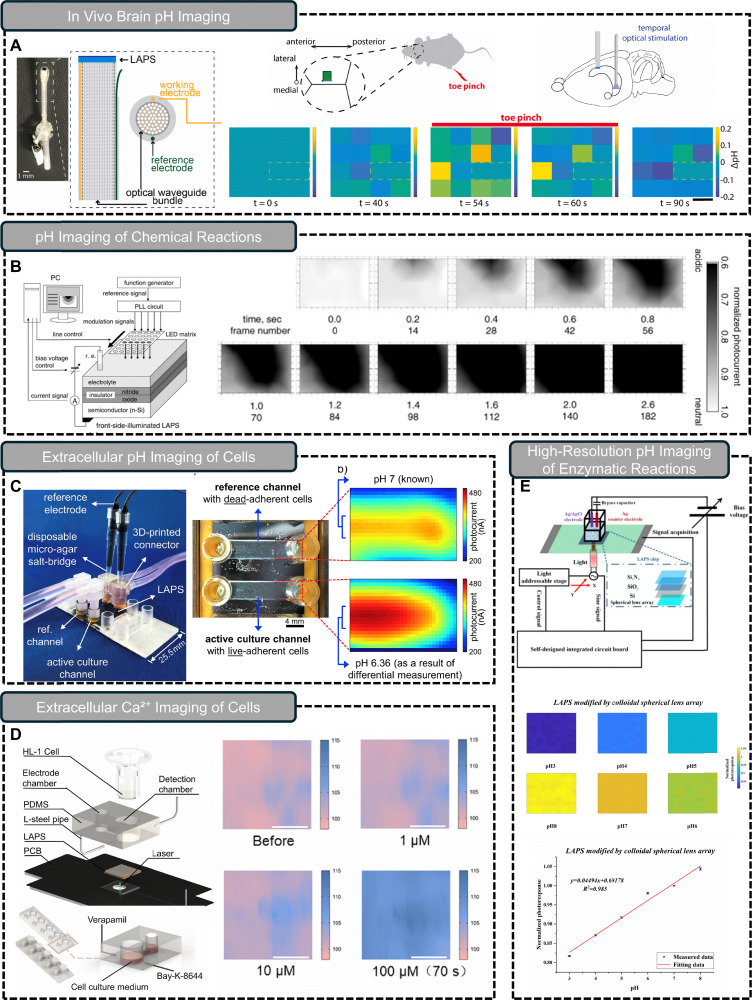
Among the representative uses discussed in the review is pH mapping, which measures how acidic or alkaline conditions vary over a surface. pH is a measure of hydrogen ion concentration, and even small local changes can matter in cell culture, tissue behavior, and biochemical reactions. A LAPS can scan those variations across a region, providing a chemical picture rather than a bulk average from an entire sample.
The review also covers ion detection and sensing approaches based on enzymes and aptamers. Enzymes are proteins that catalyze chemical reactions, while aptamers are short nucleic-acid molecules selected to bind chosen molecular targets. These recognition layers can translate the presence of an analyte, the substance being measured, into a local electrical change that the LAPS can read.
Watching biology in microfluidic systems
Microfluidic systems guide very small volumes of liquid through tiny channels, much like plumbing scaled down to the dimensions needed for cell experiments. They are useful because they can control the environment around cells and organize samples in compact devices. The review highlights extracellular monitoring in such systems, where LAPS can observe chemical changes outside cells as they grow, metabolize nutrients, or respond to conditions in the channel.
This combination can be valuable because cells do not experience biology as a uniform bath. Chemical signals may differ from one part of a culture chamber to another, especially when fluid flow, cell density, or localized stimulation is involved. Light-addressable measurements offer a way to investigate those differences while retaining the controlled setting that microfluidics provides.
Recording electrical activity from living samples
LAPS is not limited to chemical sensing. The review also describes its use in electrophysiological detection, the measurement of electrical signals produced by cells and tissues. Like placing microphones around a room to locate different sounds, spatially controlled optical addressing can help researchers identify where electrical activity occurs across a biological sample.
The applications surveyed include recordings from single cells, organoids, and in vivo tissues. Organoids are laboratory-grown three-dimensional cell systems that mimic selected features of organs, and they are increasingly used to study development and disease. Being able to monitor their electrical activity alongside local chemical conditions could help researchers connect cell behavior with its immediate environment.
Why This Matters
Many biological measurements force a trade-off between detail and flexibility. A conventional sensor may provide a highly accurate reading at one location, while a fixed electrode array can cover many locations but requires complex fabrication and predefined electrode positions. LAPS offers a different approach by using programmable illumination to decide where the sensing surface is interrogated.
That flexibility could be especially useful when samples are irregular, dynamic, or difficult to access with conventional electrodes. Chemical gradients, cell metabolism, and electrical activity often change over short distances, and averaging them into one measurement can hide important behavior. The review therefore positions LAPS as a platform for studying biology in ways that are both localized and adaptable.
Challenges before broader adoption
The review also makes clear that the promise of LAPS depends on overcoming practical challenges. Device performance, sensing-interface stability, illumination control, spatial resolution, and integration with biological samples all shape whether a measurement is trustworthy and useful. A system that performs well electrically but has an unstable recognition layer, for example, cannot deliver dependable molecular sensing.
Interpreting spatial measurements can also be demanding because the observed signal reflects both the sensor and the sample. Researchers must distinguish genuine biological variation from artifacts caused by illumination, surface properties, fluid movement, or changes in the semiconductor response. Careful device design and experimental controls are therefore as important as the ability to generate visually compelling maps.
Where the field may go next
The review offers practical guidance for future biomedical research and global health applications by treating LAPS as an integrated system rather than a single component. Progress will likely depend on pairing improved semiconductor platforms with selective sensing chemistries and configurable light delivery that suits real biological experiments. If those pieces continue to mature together, light-addressable potentiometric sensing could become a useful way to observe chemical and electrical life at the same time, from controlled lab-on-a-chip studies to more complex tissue measurements.