Researchers have identified a primate-specific genetic regulator called LINC01021 that appears to push cells, and even whole animals, toward aging. The study focused on long non-coding RNAs, or lncRNAs, a class of RNA molecules that do not make proteins but can still control how genes behave. While aging research has mostly centered on protein-coding genes, this work argues that newer, species-specific RNA regulators may help explain why aging can differ across lineages, including between humans and mice. Using evolutionary screening and cross-species analysis, the team found several primate-specific lncRNAs linked to human aging, then singled out LINC01021 for deeper testing. In human cells, boosting LINC01021 promoted cellular senescence, the state in which cells stop dividing and begin showing stress-related changes, while silencing it eased those aging-like traits. The researchers then traced the effect to a nuclear mechanism involving the RNA-binding proteins DAZAP1 and RBMX, which ultimately switched on the well-known p53 stress pathway. To see whether the signal extended beyond isolated cells, they expressed human LINC01021 in mice and observed aging-like effects including greater frailty and worse motor coordination. The findings suggest that some drivers of aging may be evolutionarily recent, helping shape species-specific aging patterns that older animal models do not fully capture.
A search for newer aging regulators
The study began with a simple but important question: are scientists missing part of the aging story by looking mostly at protein-coding genes? Long non-coding RNAs are often treated as supporting players, yet many of them act like control switches, influencing when other genes are turned on, turned off, or processed.
What makes this work especially interesting is its focus on primate-specific lncRNAs. These are RNA sequences that appeared relatively recently in evolution, meaning they may contribute to traits that are harder to model in non-primate species. Through evolutionary screening and aging-associated comparisons across species, the researchers identified several candidates linked to human aging, including LINC01021, CTC-575l10.1, CTA-150C2.13, and RP11-305F18.1.
LINC01021 stood out in human cells
The team chose LINC01021 as a representative candidate to test whether these RNAs are merely correlated with aging or actually help cause it. In human cells, the answer pointed toward causation: when LINC01021 was active, cells were more likely to enter senescence, a hallmark state of aging in which cells stop dividing and begin secreting distress signals.
When the researchers silenced LINC01021, those senescence-associated features were reduced. That matters because it suggests the molecule is not just a passive marker of older cells. It is participating in the process itself, nudging cells toward a more aged state.
How the RNA appears to do its work
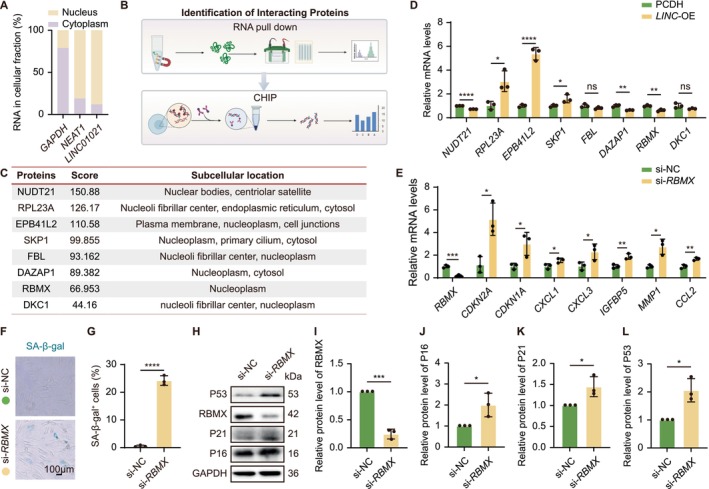
Mechanistically, LINC01021 was found mainly in the cell nucleus, the compartment where DNA is stored and much gene regulation occurs. A useful analogy is a backstage manager in a theater: it does not perform on stage, but it cues the actors, redirects timing, and changes what the audience ultimately sees.
In this case, LINC01021 appears to help DAZAP1 destabilize the messenger RNA for RBMX. Messenger RNA, or mRNA, is the working copy cells use to make a protein, so destabilizing RBMX mRNA means less RBMX protein is likely produced. That drop then feeds into activation of the p53 pathway, a central cellular stress response network that can trigger senescence when damage or dysfunction builds up.
Why RBMX and p53 matter
RBMX is an RNA-binding protein involved in managing RNA processing and gene expression, so disrupting its levels can have broad downstream effects. The study places RBMX as a key link between a non-coding RNA signal and the cell's core aging machinery.
The p53 pathway is one of the best-known guardians against damaged or abnormal cells, but it comes with tradeoffs. In the short term, activating p53 can protect tissues by halting risky cell growth. Over time, however, repeated activation can contribute to tissue decline by increasing the burden of senescent cells. LINC01021 appears to tap into that balancing act.
From cells to whole animals
One of the stronger parts of the study is that it did not stop at cultured human cells. The researchers ectopically expressed, meaning artificially introduced, human LINC01021 in mice to ask whether the molecule could influence organism-level aging traits even in a species that does not naturally carry this primate-specific RNA.
The mice developed aging-like phenotypes, including increased frailty and poorer motor coordination. Those are broad functional measures rather than a single molecular readout, which gives the findings added weight. The result does not mean LINC01021 alone explains aging, but it does suggest that this RNA can push multiple systems in an aging direction.
Why species differences matter in aging research
A major implication of the work is methodological. If some important aging regulators are specific to primates, then standard animal models may miss part of the biology that shapes human aging. That does not make mouse studies less valuable, but it does mean researchers may need to complement them with human-cell systems and cross-species evolutionary analysis.
This idea could also help explain why some interventions that look promising in animals do not translate cleanly to people. A regulatory layer built from lineage-specific lncRNAs would be easy to overlook, because these molecules often do not have obvious counterparts in common laboratory species.
Why This Matters
The study expands the aging field beyond the usual protein-centered framework and points to non-coding RNA as an active driver of age-related decline. That is important scientifically because it opens a new category of mechanisms, and medically because molecules like LINC01021 could become targets for future efforts to slow harmful senescence in specific tissues.
Just as important, the work offers a more nuanced view of aging as something shaped not only by ancient, conserved pathways but also by recently evolved regulators. In practical terms, that means human aging may depend in part on genetic control systems that are uniquely primate. Future studies will need to test how broadly LINC01021 acts across tissues, whether related lncRNAs have similar effects, and whether blocking this pathway can reduce frailty or cellular decline without interfering with the protective functions of p53.