AI-generated summary by biochip.com, published . Not independently reviewed. Source: Cancer Screening and Prevention, by Xuexin Liang; Qingqing Tang; Jiawei Chen; Yanghui Wei.
Key takeaways
- The review describes liquid biopsy as analysis of CTCs, ctDNA, and other tumor biomarkers in fluids including blood, urine, saliva, and cerebrospinal fluid.
- CTC-chip systems can isolate viable circulating tumor cells from whole blood, while the NP-HB CTC-Chip combines microfluidics with gold nanoparticles.
- Clinical implementation remains limited by high costs, lengthy setup, bulky instruments, and restricted single-cell molecular analysis capacity.
This review examines liquid biopsy, a minimally invasive way to look for cancer-related material shed into body fluids rather than removing a piece of tissue from a tumor. The approach began with efforts to find circulating tumor cells, or CTCs, in blood, but it now also includes circulating tumor DNA, or ctDNA, and other tumor-associated biomarkers. Its central promise is practical: a blood draw or another fluid sample can potentially be repeated more easily than a conventional tissue biopsy. That repeatability could help clinicians track how a tumor changes, whether a treatment is working, and whether resistance to therapy is emerging. The review places the technology in the context of early cancer screening, where disease is often difficult to detect because initial symptoms can be vague or absent. Cancer caused an estimated 9.7 million deaths worldwide in 2022, alongside nearly 20 million new cases, underscoring why earlier detection remains a major goal. The authors describe advances in molecular analysis, microfluidics, and nanotechnology that are making liquid-biopsy samples more useful, while also emphasizing practical barriers to wider clinical use. This is a review of a fast-moving field, not evidence that liquid biopsy has solved early cancer screening across all cancer types.
What a Liquid Biopsy Looks For
A conventional tissue biopsy is like taking a small core sample from one part of a large, changing landscape. It can provide detailed information about the sampled tissue, but a single sample may not represent every part of a tumor, especially when different regions carry different genetic changes. It also requires an invasive procedure that may be difficult or impractical to repeat frequently.
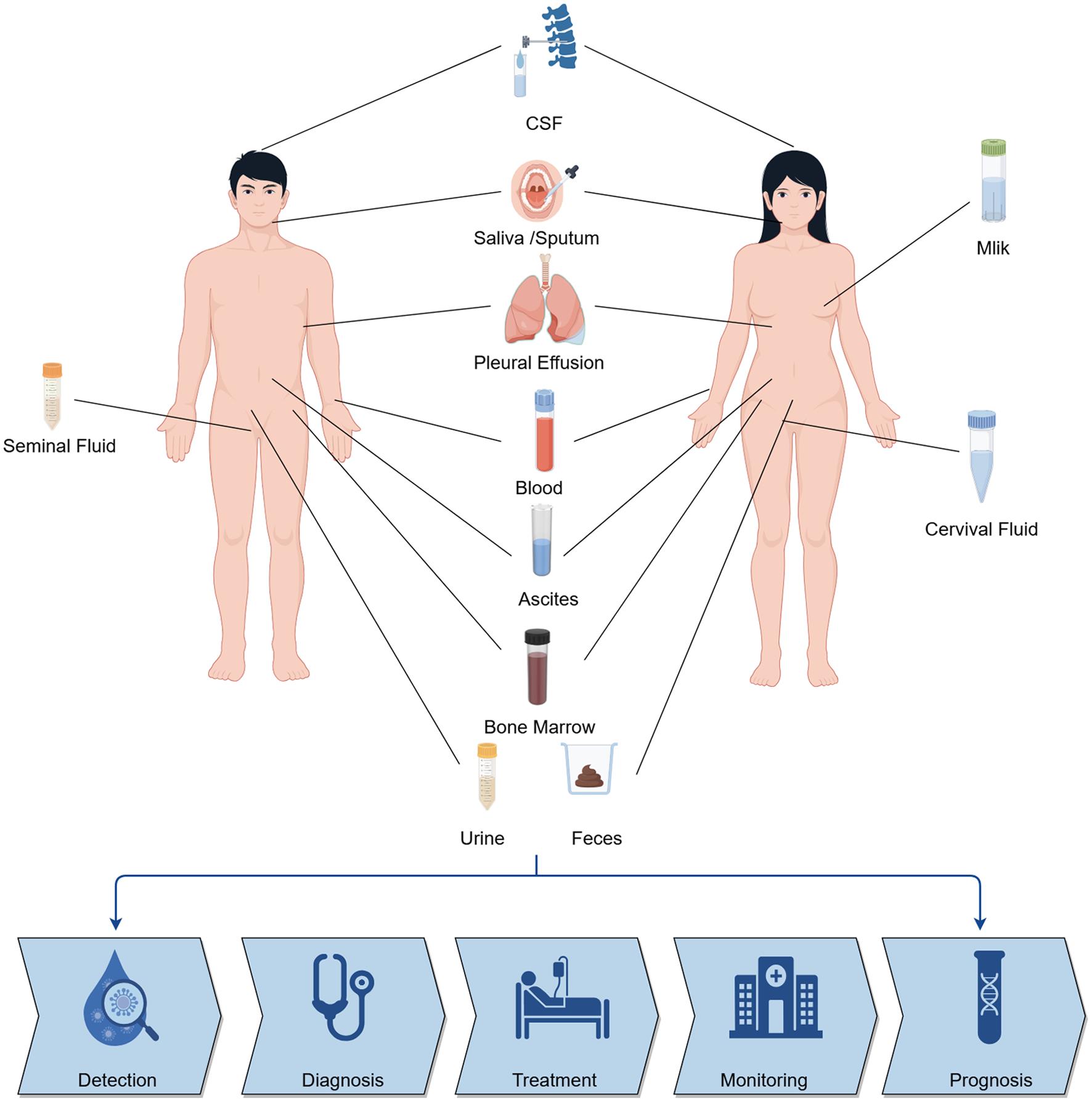
Liquid biopsy takes a different route. It examines biological fluids, including blood, urine, saliva, and cerebrospinal fluid, for material associated with a tumor. In blood, that material can include whole cancer cells circulating away from a tumor, fragments of DNA released into circulation, and other molecular signals linked to cancer biology.
From Cell-Free DNA to Tumor DNA
One major target is cell-free DNA, meaning DNA fragments that circulate outside cells. These fragments can come from normal cells as well as cancer cells. Circulating tumor DNA is the subset of cell-free DNA that originates from tumor cells, making it potentially useful for identifying cancer-related molecular features.
The distinction matters because cancer-associated DNA can support molecular profiling, the process of examining a tumor's genetic characteristics to guide more tailored care. The review describes liquid biopsy as a tool for precision oncology, an approach that aims to match decisions about cancer treatment to a tumor's particular biology. Because samples can be collected over time, the method could offer a moving picture rather than a single snapshot.
Why Repeat Sampling Is Attractive
Repeated sampling is one of liquid biopsy's clearest advantages over tissue collection. A tumor is not static: it can evolve during treatment, and cancer cells with treatment-resistant traits may become more prominent over time. Serial fluid samples could help reveal those changes earlier than waiting for symptoms or a more invasive procedure.
That potential extends beyond initial detection. The review highlights treatment-response assessment and identification of resistance mechanisms as important uses for liquid biopsy. In simple terms, the technique could function like checking a changing signal over time, rather than relying on one reading taken at the start of a journey.
The Challenge of Finding Circulating Tumor Cells
CTCs are intact cancer cells found in the bloodstream, but locating them is technically demanding. They are rare compared with the many normal blood cells in a sample, so researchers need ways to separate and collect them without damaging them. A useful system must balance capture efficiency, sample purity, and the ability to keep cells viable for later study.
The review describes microfluidics, the manipulation of tiny amounts of fluid through miniature channels, as one route to better CTC sorting. Think of it as a highly controlled plumbing system built at a scale small enough to guide individual cells. These devices can use physical and chemical features to enrich cancer cells from whole blood.
Chips, Nanoparticles, and Cell Recovery
One example is CTC-chip technology, which the review says can isolate viable CTCs directly from whole blood without pre-labeling or extensive sample preparation. Pre-labeling means attaching a marker to cells before separation, so avoiding it may simplify the workflow while preserving cells for downstream analysis. The emphasis on viable cells is important because living, intact cells can be examined further after capture.
The review also discusses the NP-HB CTC-Chip, a platform that combines herringbone-shaped microfluidic structures with gold nanoparticles. Its chemical ligand-exchange process is designed to support both efficient capture and safe release of viable CTCs. Capturing cells is only half the task: if researchers cannot recover them intact, the sample may be less useful for molecular testing.
Why This Matters
Earlier cancer detection could give patients and clinicians more opportunities to act before disease becomes advanced, but screening tools must be accurate enough to justify their use. Liquid biopsy is appealing because it seeks tumor information from accessible fluids and can be repeated during screening, diagnosis, or treatment monitoring. It may also address a basic limitation of tissue biopsy by sampling signals that could reflect tumor material from more than one location.
Still, the review does not present liquid biopsy as a replacement for every tissue biopsy or as a universal screening test ready for all cancers. The same microfluidic platforms that show high CTC capture efficiency and cell viability face substantial implementation hurdles, including high initial costs, long setup times, bulky instruments, and limited capacity for single-cell molecular analysis. Those constraints matter because a promising laboratory workflow must also be reliable, practical, and affordable enough for routine clinical settings.
What Comes Next
The next phase for liquid biopsy will depend on improving both biological interpretation and the tools used to collect rare tumor signals. Researchers will need to determine how well different biomarkers perform in real screening and care settings, while engineers work to make cell-sorting platforms smaller, faster, and easier to deploy. For now, the field offers a compelling direction: use information already circulating in the body to observe cancer more often, with less invasive sampling, while recognizing that technical progress alone does not establish broad clinical readiness.