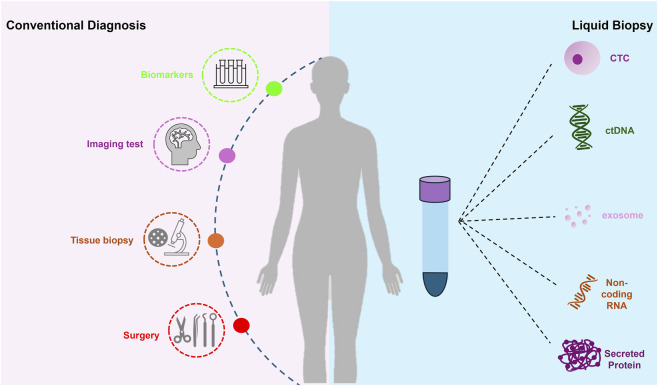
Liquid biopsy is moving cancer care toward something doctors have wanted for decades: a simpler way to detect tumors, read their genetic signals, and track how treatment is working without repeatedly cutting into the body. Instead of removing a piece of tumor tissue with a needle or surgery, clinicians can analyze a blood sample for circulating tumor DNA, or ctDNA, which are tiny fragments of genetic material shed by cancer cells, and for circulating tumor cells, or CTCs, which are whole cancer cells that have escaped into the bloodstream. That matters because tissue biopsy, while still essential in many cases, can be slow, invasive, and sometimes impossible when a tumor sits in a risky location or a patient is too unwell for a procedure. The source article argues that liquid biopsy is especially promising for early detection, measuring minimal residual disease—the small number of cancer cells that can remain after treatment—and monitoring whether a therapy is succeeding or failing in real time. It also points to growing clinical use, including the U.S. Food and Drug Administration approval of FoundationOne Liquid CDx, a blood-based test designed to profile tumor genetics from ctDNA. A cited international Phase IV study, NCT05846594, is testing whether adding such a test to routine workups for suspected metastatic lung or gastrointestinal cancer can shorten the time to diagnosis and treatment. The larger story is not that blood tests will replace every tissue biopsy tomorrow, but that they are becoming a practical new layer of information in precision oncology, where treatment is matched to the biology of each patient’s cancer. If that trend holds, cancer care could become faster, less invasive, and more responsive to what the disease is doing from week to week.
How liquid biopsy works
A useful way to think about liquid biopsy is as a kind of molecular weather report. Instead of digging into the ground to inspect the source directly, doctors sample the bloodstream and read the biological traces tumors leave behind.
Those traces can include ctDNA and CTCs. The DNA fragments may contain mutations, insertions, deletions, or other genomic changes that help identify what kind of cancer is present and which drugs may be most relevant.
Why it differs from a tissue biopsy
Traditional tissue biopsy remains the standard method for confirming many cancers because it lets pathologists examine actual tumor cells and tissue structure under a microscope. But getting that sample can require an invasive procedure, and the tissue collected captures only one place and one moment in a disease that can vary across the body and change over time.
Liquid biopsy offers a less invasive alternative because it relies on blood rather than surgery or a needle placed into the tumor. For patients with hard-to-reach lesions, or for those in fragile health, that difference can be clinically important, making repeat testing more feasible and reducing procedural risk.
Where it may help most
The source highlights several points in the cancer journey where liquid biopsy could be useful. One is early detection, where finding cancer-related signals sooner could improve survival by catching disease before it spreads or becomes harder to treat.
Another is tracking treatment response. Because blood samples can be taken repeatedly, clinicians may be able to watch ctDNA levels rise or fall over time, giving an earlier clue than imaging alone about whether a therapy is shrinking the cancer or whether resistant cells are starting to emerge.
Minimal residual disease and relapse monitoring
One of the most important applications discussed is the assessment of minimal residual disease. In plain terms, this means looking for faint molecular evidence that cancer is still present after surgery, chemotherapy, radiation, or another treatment, even when scans look clear.
That kind of monitoring could help doctors decide who needs more treatment and who might safely avoid it. It also opens the door to more personalized follow-up, with therapy adjusted in response to real-time biological signals rather than waiting for symptoms or visible tumor growth.
Clinical momentum and FDA-cleared testing
The article points to FoundationOne Liquid CDx as a sign that liquid biopsy is no longer just a research concept. The test was approved by the FDA for clinical and commercial use and analyzes ctDNA from a blood sample to provide broad genomic profiling, offering a faster and less invasive option than tissue testing in some settings.
Broad genomic profiling means scanning many cancer-related genes at once rather than checking a single mutation. In precision oncology, that matters because targeted drugs are chosen based on specific genetic alterations, so a wider search can improve the odds of matching a patient to the right therapy.
A study testing whether blood-based diagnosis can speed care
The source also describes a prospective international Phase IV study, registered as NCT05846594. It enrolled patients with clinically suspected advanced metastatic lung or gastrointestinal cancer who had not yet been treated for metastatic disease and did not yet have a confirmed pathological diagnosis.
The study’s goal was practical and important: to see whether adding liquid biopsy to the standard diagnostic workflow could reduce the time needed to complete a diagnosis and start treatment. The source notes that full outcome data on survival or treatment response were not yet available, so the current significance lies in workflow and decision speed rather than proven long-term benefit.
Limits and open questions
Liquid biopsy is promising, but it is not magic. A blood test can miss cancers that shed very little DNA into circulation, and the presence or absence of ctDNA does not always give the full picture a tissue sample can provide.
That is why the technology is best understood, at least for now, as a complement to established tools rather than a universal replacement. Questions remain about sensitivity, interpretation, and how best to use these tests across different tumor types and stages of disease.
Why This Matters
The appeal of liquid biopsy comes down to access, speed, and adaptability. Cancer treatment works best when doctors know what they are treating as early as possible and can keep updating that picture as the disease responds or evolves.
For patients, a blood draw is simpler than a surgical procedure and easier to repeat. For clinicians, the ability to profile a tumor molecularly, detect residual disease, and monitor response in near real time could make precision oncology more practical in everyday care, especially when tissue is scarce or risky to obtain.
What comes next
The field now needs careful clinical validation, not just enthusiasm. If ongoing studies show that using liquid biopsy earlier and more routinely truly shortens diagnostic delays, improves treatment matching, and leads to better outcomes, it could become a standard part of how many cancers are diagnosed and managed. Even before that point, the direction is clear: cancer care is shifting toward tools that are less invasive, more data-rich, and better able to follow a disease that rarely stands still.