Researchers studying Polygonatum cyrtonema Hua, a medicinal plant used in traditional remedies, have identified a flavonoid called methylophiopogonanone B, or MOB, as a likely driver of the plant’s anti-inflammatory effects. The team combined chemical analysis, computer-based target prediction, and lab experiments to trace how this compound may work inside cells. Their central finding is that MOB appears to bind to SRC, a signaling protein that acts like an on-off switch for several inflammation pathways, and then dampens activity in the PI3K-Akt pathway, which helps cells respond to stress and immune signals. Inflammation itself is a normal defense response, but when it runs too high or too long, it can contribute to diseases including diabetes and its complications. The study identified 67 compounds in the plant extract, then narrowed in on MOB as the key candidate with measurable biological activity. From there, the researchers used surface plasmon resonance, a method that can detect whether two molecules physically bind, and western blotting, which tracks changes in protein activation, to test the prediction. The result is not just a catalog of plant chemicals, but a more specific explanation of how one flavonoid may interrupt inflammatory signaling. That matters because natural products are often described as broadly helpful, while studies like this try to pin down the exact molecules and pathways behind those effects.
How the researchers narrowed the search
The work began with chemical profiling of flavonoids from P. cyrtonema Hua. To do that, the researchers used UPLC-QTOF-MS/MS, short for ultra-performance liquid chromatography coupled to quadrupole time-of-flight mass spectrometry, a tool that separates complex mixtures and identifies molecules by their mass. Think of it like sorting a box of mixed keys and then measuring each one precisely to figure out which key is which.
They paired that with the Global Natural Products Social Molecular Networking platform, usually called GNPS. GNPS groups related chemical signals into networks, helping scientists spot families of compounds rather than treating every signal as an isolated mystery. Using this approach, the team identified a total of 67 compounds in the plant material.
From a long compound list to one likely active molecule
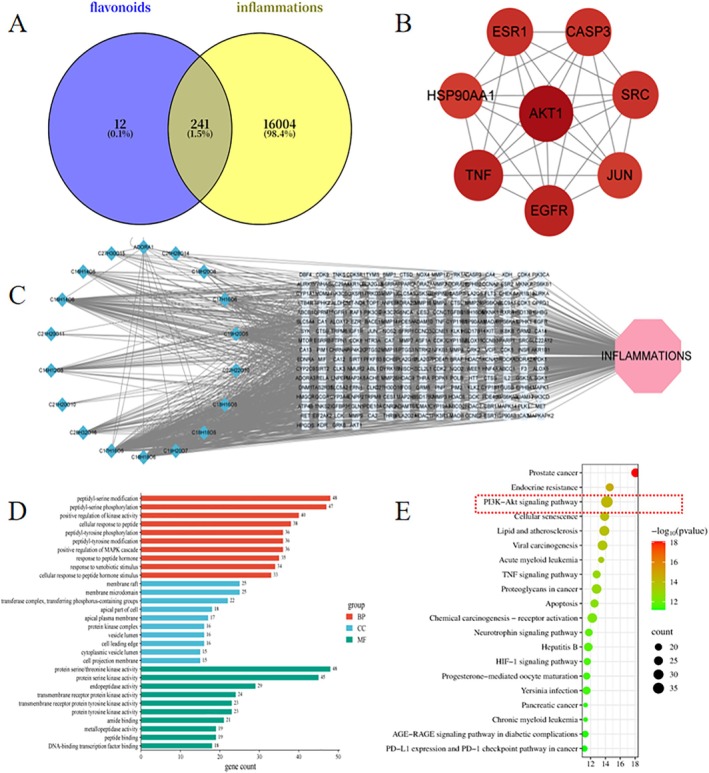
Finding dozens of compounds is common in plant research, but the hard part is deciding which ones actually matter biologically. The researchers turned to network pharmacology, a computational strategy that maps how chemicals may interact with genes and proteins involved in disease. Instead of assuming one compound hits one target, it asks which molecules are most likely to affect a whole disease-related network.
That analysis pointed to MOB as the standout flavonoid. It also highlighted several possible protein targets, with SRC, TNF, and AKT1 emerging as core nodes in the inflammatory network. In plain terms, these proteins sit at important junctions where many signaling messages pass through, so changing their activity can have outsized effects.
Why SRC and PI3K-Akt matter in inflammation
SRC is a protein kinase, meaning it modifies other proteins by attaching phosphate groups that alter their activity. A useful analogy is a supervisor flipping switches in a control room: once SRC is activated, it can trigger several downstream systems at once. One of those systems is the PI3K-Akt pathway, which helps govern cell survival, metabolism, and immune responses.
That pathway is especially interesting because it links inflammation to metabolic disease. The paper notes that P. cyrtonema Hua has been reported to help in the treatment and prevention of diabetes, and chronic low-grade inflammation is now understood to be part of that disease process. If MOB really can quiet SRC and PI3K-Akt signaling, it offers a plausible bridge between the plant’s traditional use and modern molecular biology.
Testing the prediction in the lab
Computer predictions are useful, but they are only the starting point. To see whether MOB could actually interact with SRC, the team used molecular docking and surface plasmon resonance, or SPR. Docking simulates how well two molecules might fit together, like testing whether a plug matches a socket, while SPR checks in real time whether binding occurs on a sensor surface.
According to the study, both methods supported a strong binding affinity between MOB and SRC. That does not prove every step of the drug-like effect inside a living body, but it strengthens the idea that SRC is not just a statistical guess from a computer model. It is a physically plausible target for this flavonoid.
What happened when cells were stimulated to inflame
The researchers then looked at what MOB does in a standard inflammation model triggered by LPS, or lipopolysaccharide, a bacterial molecule often used to provoke immune signaling in experiments. When cells were exposed to LPS, phosphorylation of SRC, PI3K, and AKT1 increased, which is what you would expect when the pathway is switched on. MOB reduced that phosphorylation in a dose-dependent way, meaning stronger treatment led to stronger suppression.
Importantly, MOB did not change the total amount of SRC, PI3K, or AKT1 protein. That suggests the compound is affecting activation rather than simply causing the proteins to disappear. In signaling biology, that distinction matters because it points to a more precise mechanism: MOB seems to turn down the volume on the pathway rather than remove the speakers.
Evidence that NF-κB sits downstream
The study also tracked the NF-κB pathway, one of the best-known engines of inflammatory gene activity. NF-κB is a transcription factor, a protein that helps switch genes on, and it is often activated when upstream alarm systems detect stress or infection. If SRC and PI3K-Akt are part of the upstream wiring, NF-κB is one of the downstream programs that can translate those signals into an inflammatory response.
Here, MOB significantly suppressed phosphorylation of IκB and p65, two proteins commonly used to monitor NF-κB activation. That result fits the broader model proposed by the authors: MOB binds SRC, reduces signaling through PI3K and AKT, and in turn limits NF-κB activity. The pathway is presented as a chain of events rather than a collection of unrelated observations.
Why This Matters
Natural-product research often stops at the phrase “has anti-inflammatory activity,” which is interesting but incomplete. This study goes further by combining compound identification with target prediction and experimental validation, giving MOB a more concrete mechanism of action than many plant-derived molecules have. It also provides what the authors describe as the first evidence linking MOB’s anti-inflammatory effect specifically to SRC and the SRC-PI3K-Akt signaling axis.
That does not mean MOB is ready to become a therapy tomorrow. The findings still sit in the early, mechanism-focused stage, and the summary does not establish clinical efficacy in people. But by tying a defined plant compound to a specific inflammatory pathway, the work creates a clearer starting point for future studies on drug development, dosing, safety, and possible use in inflammation-linked metabolic disorders such as diabetes.
What comes next
The broader promise of the study is methodological as much as biological. By linking modern mass spectrometry, molecular networking, computational pharmacology, and lab validation, the researchers show one way to turn a chemically messy herbal source into a testable mechanistic story. Future work will need to determine how MOB behaves in more complex animal and human systems, whether its effects are strong enough for practical use, and how it compares with other anti-inflammatory candidates from the same plant.