AI-generated summary by biochip.com, published . Not independently reviewed. Source: Frontiers in Immunology, by Europe PMC.
Scientists are increasingly finding that the immune system does not operate as a set of isolated compartments, with each organ minding its own business. Instead, the body behaves more like a tightly linked network in which the microbiome—the community of bacteria, viruses, fungi, and other microbes living mostly in the gut—helps shape immune activity far beyond the intestine. This review examines how signals that begin in the microbiome can travel across the body and influence autoimmune disease in distant tissues such as the brain, joints, skin, and endocrine organs. The core idea is that microbes do not simply trigger inflammation locally; they produce metabolites, train immune cells, and alter barrier tissues in ways that can amplify or calm disease elsewhere. That matters because autoimmunity, in which the immune system mistakenly attacks the body’s own tissues, is often difficult to explain through genetics alone. Environmental exposures, diet, infections, and microbial imbalances appear to help determine who develops disease, when it starts, and how severe it becomes. By pulling together evidence across multiple organ systems, the article argues for a broader model of disease: one in which cross-organ immune communication is central, not incidental. It also points toward new therapeutic possibilities, from microbial metabolites to targeted microbiome engineering, that could reshape how autoimmune disorders are treated.
A networked view of autoimmune disease
Traditional medicine often studies autoimmune diseases one organ at a time: the pancreas in type 1 diabetes, the joints in rheumatoid arthritis, the brain and spinal cord in multiple sclerosis, or the skin in psoriasis. The review challenges that siloed model by emphasizing cross-organ immunity, meaning immune interactions in one tissue can affect disease in another.
This perspective helps explain why patients with one autoimmune disease often have symptoms outside the primary target organ, or are more likely to develop a second autoimmune condition. It also helps account for why disruptions in the gut microbiome can be linked to disorders that seem, at first glance, unrelated to digestion.
How the microbiome talks to the immune system
The microbiome influences immunity through several overlapping channels. One of the most important involves metabolites, the small molecules microbes make as they break down food and interact with their environment.
Among the best studied are short-chain fatty acids, including acetate, propionate, and butyrate, which are produced when gut bacteria ferment dietary fiber. These compounds can strengthen the intestinal barrier, reduce inflammatory signaling, and promote regulatory T cells, a class of immune cells that helps prevent the immune system from attacking the body’s own tissues.
Other microbial products can have more complex or even harmful effects depending on context. Bile acid derivatives, tryptophan metabolites, and components of bacterial cell walls can all interact with immune receptors, shifting how strongly the body reacts to self-antigens, the molecules that autoimmune cells mistake as threats.
From the gut to distant organs
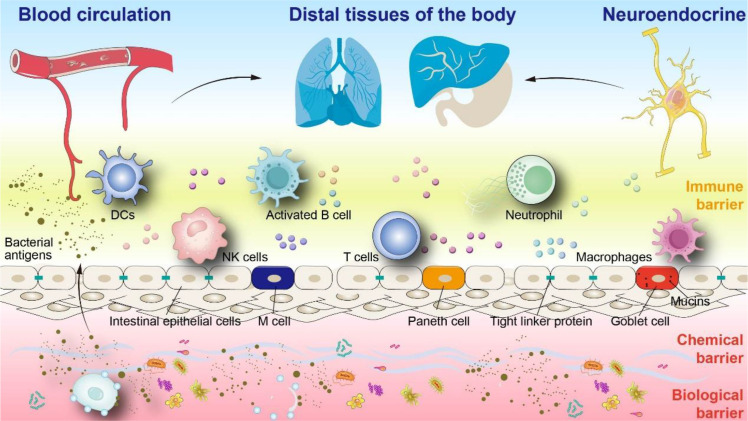
A central theme of the review is that the gut can influence distant organs through multiple routes. Microbial metabolites can enter the bloodstream, immune cells primed in the gut can migrate elsewhere, and disruption of barrier tissues may allow inflammatory signals to spread systemically.
In the gut-brain axis, for example, microbiome changes may affect the nervous system by altering inflammation, blood-brain barrier integrity, and signaling molecules that reach the brain. This has made the microbiome a major area of interest in diseases such as multiple sclerosis, where immune attacks damage the protective covering around nerve fibers.
Similar links are being studied in the gut-joint axis and gut-skin axis. In rheumatoid arthritis and psoriasis, researchers have reported associations between microbial imbalance, inflammatory immune pathways, and disease activity in tissues far removed from the intestine.
Why metabolites matter so much
Metabolites are attractive to researchers because they provide a direct, measurable bridge between microbes and host biology. Unlike simply listing which bacteria are present, metabolite analysis can reveal what those microbes are actually doing.
That functional view is important in autoimmunity because the same broad bacterial group may behave differently depending on diet, drugs, host genetics, and the surrounding microbial community. A microbe is not just a name on a sequencing chart; it is part of a chemical ecosystem that can either support immune tolerance or push the system toward chronic inflammation.
This is one reason the field is moving beyond simple “good microbe versus bad microbe” narratives. The review highlights that disease-relevant effects may come from networks of organisms and their products, rather than a single culprit species.
Barriers, mimicry, and immune misfiring
The review also discusses mechanisms that could connect microbiome disruption with autoimmune attacks. One is barrier dysfunction, sometimes called a “leaky” barrier, in which the intestinal lining becomes more permeable and allows microbial fragments or inflammatory molecules to interact more directly with the immune system.
Another is molecular mimicry, where microbial molecules resemble the body’s own proteins closely enough to confuse immune cells. In that scenario, an immune response initially aimed at a microbe may spill over and begin attacking self-tissue.
These ideas are not mutually exclusive. A person with genetic susceptibility might experience altered microbiome composition, increased barrier permeability, and abnormal immune activation at the same time, producing a cascade that contributes to disease onset or flare-ups.
Therapeutic targets beyond broad immunosuppression
Most current autoimmune treatments work by damping down the immune system, sometimes effectively but often with side effects such as increased infection risk. The review points toward a more precise future in which therapies could target microbial pathways upstream of inflammation.
Potential strategies include prebiotics that feed beneficial microbes, probiotics that introduce live organisms, diet-based interventions, engineered bacteria, and direct delivery of protective metabolites. More advanced approaches could involve fecal microbiota transplantation, defined microbial consortia, or drugs designed to mimic microbiome-derived molecules.
The challenge is that microbiomes vary sharply between individuals, making one-size-fits-all treatment unlikely to work well. That is pushing the field toward personalized approaches that combine microbial sequencing, metabolite profiling, and immune analysis to identify which pathway is disrupted in a given patient.
Why This Matters
This review matters because it reframes autoimmune disease as a systems problem rather than a purely organ-specific one. If microbiome signals help orchestrate immune behavior across the body, then researchers may be able to detect disease earlier, classify patients more accurately, and intervene before tissue damage becomes irreversible.
It also broadens the therapeutic landscape. Instead of only suppressing the final inflammatory response, future treatments may aim to restore immune tolerance by repairing barrier function, reshaping microbial metabolism, or interrupting harmful cross-organ signaling pathways.
That does not mean the microbiome is the sole cause of autoimmune disease, or that simple consumer-friendly fixes will solve highly complex disorders. But the evidence summarized here suggests that microbes and their metabolites are not just bystanders: they are active participants in the immune circuits that connect one organ to another.
What comes next
The next phase of research will likely focus on turning broad associations into mechanism-based medicine. To do that, scientists will need better longitudinal studies, more precise animal and human experiments, and clinical trials that test whether changing the microbiome can reliably improve autoimmune outcomes. If those efforts succeed, the microbiome may become not only a marker of disease risk, but a practical source of new therapies that work with the body’s own regulatory systems rather than simply shutting immunity down.