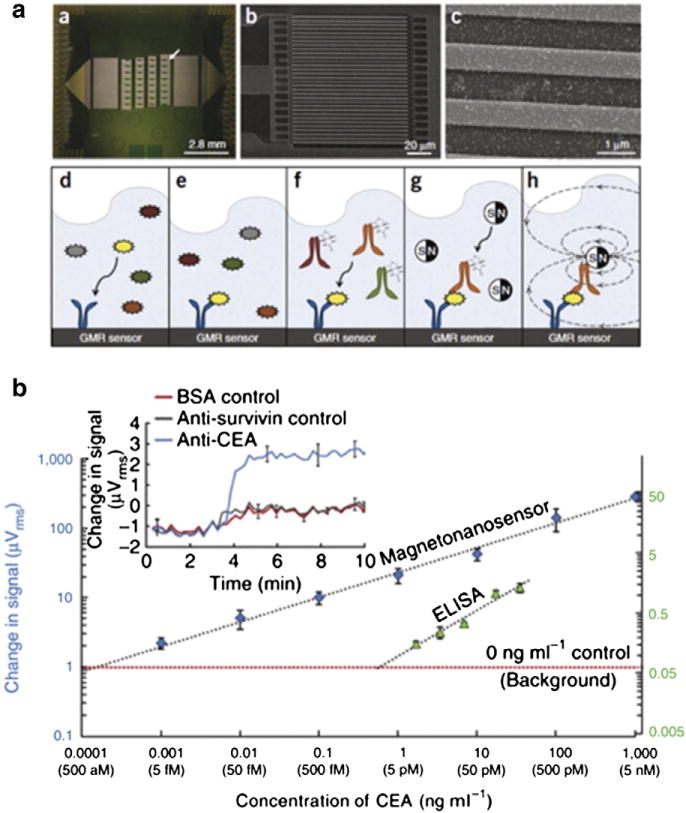
Researchers are building tiny magnetic sensing chips that could make cancer monitoring simpler, faster, and less invasive. The core idea is straightforward: tag rare cancer-related targets in blood with magnetic nanoparticles, then read those tags with a microchip that ignores most of the biological clutter around them. That matters because one of the hardest jobs in cancer diagnostics is finding circulating tumor cells, or CTCs, the small number of cancer cells that break away from a tumor and travel through the bloodstream. A blood sample may contain only a handful of these cells among millions of normal blood cells, which makes conventional detection difficult and labor-intensive. The review article on microchip-based detection of magnetically labeled cancer biomarkers argues that magnetic methods are especially useful here because they are largely insensitive to the background signals that often interfere with optical or chemical tests. It also highlights how microfluidic chips, which guide tiny amounts of fluid through narrow channels, can combine cell sorting and analysis on a compact device. Among the examples discussed is the iChip, a platform that can isolate tumor cells using either markers on the cancer cells themselves or markers on white blood cells that should be removed. Taken together, the paper presents magnetic microchip diagnostics as a practical route toward more accessible cancer testing and more frequent disease monitoring.
Why magnetic labeling is useful
Finding a cancer biomarker in blood is a bit like trying to hear a whisper in a packed stadium. Most diagnostic signals are overwhelmed by everything else in the sample, especially when the target is rare. Magnetic detection changes the problem by adding a label that very few natural components in blood can mimic.
That is the key advantage of magnetic nanoparticles, tiny particles that respond to magnetic fields. When they are attached to a cell or molecule of interest, a sensor can look specifically for that magnetic signature instead of sorting through a noisy biochemical background. The review describes this built-in resistance to background interference as one of the strongest reasons magnetic detection works well for cancer diagnostics.
The challenge of circulating tumor cells
CTCs are attractive because they offer a liquid biopsy, meaning doctors may be able to learn about a tumor from a blood draw instead of surgery. In principle, repeated blood tests could help track how a cancer changes over time, whether treatment is working, and whether resistant cell populations are emerging.
But the biology is unforgiving. CTCs are rare, and blood is crowded with host cells such as red blood cells and leukocytes, also known as white blood cells. The review emphasizes that this imbalance makes efficient isolation and profiling difficult, even though the clinical value of these cells could be high.
How microchips help sort and read cells
Microchips bring precision to this problem by controlling small volumes of blood inside miniature channels. Think of a microfluidic device like a highly organized road system for cells: the design forces different particles to move in specific ways, making it easier to separate what matters from what does not. That small scale can also reduce reagent use and shorten processing time.
When magnetic labeling is paired with microfluidics, the chip can both capture rare targets and prepare them for downstream analysis. In other words, the same platform can act as a sorter and a detector. The review presents this combination as a route toward compact diagnostic systems that could move sophisticated testing closer to routine clinical use.
The iChip example
One of the notable devices discussed in the paper is the iChip. This platform isolates tumor cells using two strategies: positive selection, which captures cells based on antigens present on the CTCs, and negative selection, which removes unwanted cells based on antigens found on leukocytes. An antigen is simply a molecular feature on a cell surface that can be recognized by a matching binding agent.
That dual approach is important because not all cancers present the same surface markers. According to the review, the iChip was able to isolate and analyze cells from both epithelial and nonepithelial cancers, including lung, prostate, pancreas, breast, and melanoma. This broadens its usefulness beyond a single cancer type and addresses a common weakness of methods that rely too heavily on one marker.
What miniaturization could change
The review frames miniaturization as more than an engineering trick. Shrinking molecular diagnostics onto chips can lower cost, reduce sample handling, and speed up the path from blood draw to answer. Less processing also means fewer opportunities to lose fragile rare cells before they are measured.
That matters for patients and clinicians alike. A faster, cheaper test is easier to repeat, and repeated measurements are often what make monitoring valuable. Cancer is not static, so a tool that can follow change over time may tell doctors more than a single snapshot ever could.
Limits and realism
The article is optimistic, but it does not suggest the problem is solved. Detecting a magnetically labeled target is only one part of a clinically useful test. Researchers still need robust ways to identify which captured cells matter, characterize their molecular state, and show that the results improve real-world care.
There is also the challenge of standardization. A chip that works well in a research setting must be reproducible across hospitals, operators, and patient populations. Reviews like this one are valuable because they show not only where the technology is succeeding, but also where practical translation still needs work.
Why This Matters
Cancer care increasingly depends on seeing what a tumor is doing right now, not what it looked like months ago in a tissue sample. Magnetic microchip systems aim to provide that live update through a simple blood test, using sensors that can spot rare labeled cells without being confused by the overwhelming background of normal blood components.
If that promise holds up, patients could benefit from more timely diagnosis, better tracking of treatment response, and lower-cost monitoring. The review's broader message is that magnetic detection is not just a clever physics trick; it could become a practical clinical tool because it pairs sensitivity with simplicity. That combination is often what decides whether a technology stays in the lab or reaches the bedside.
Looking ahead, the field will likely advance by integrating better cell capture, richer molecular analysis, and easier clinical workflows on the same chip. The review paints a hopeful picture of that future: compact diagnostic devices that can pull rare cancer signals out of ordinary blood samples and turn them into useful medical information. If researchers can keep improving accuracy and validation across cancer types, magnetic microchips may become an important part of how doctors monitor disease over time.