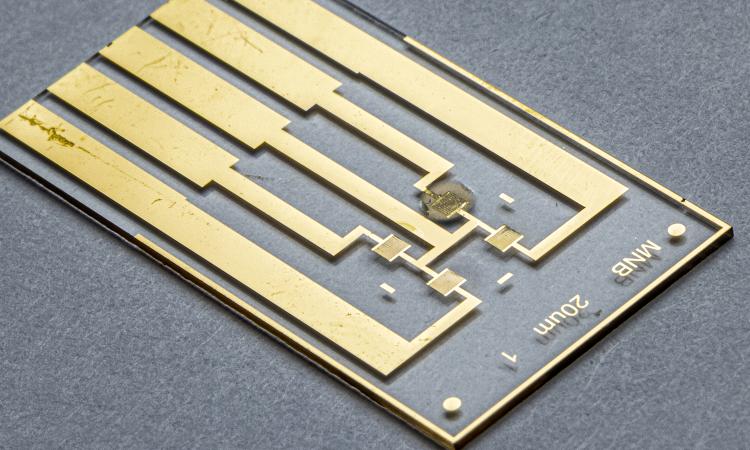
A research team at Georgia Tech and Emory University has built a small diagnostic chip that can detect Covid-19 antibodies from a single drop of blood and send the result to a smartphone. The idea is simple but powerful: take the core chemistry used in established laboratory antibody tests and redesign it so the answer is read electrically instead of optically, meaning by changes in conductivity rather than by light-based instruments. That change could make testing faster, cheaper, and easier to use outside a traditional lab. The chip is also multiplexed, which means one test can look for several different antibodies at once instead of checking only a single target. In principle, that could let one finger-prick sample screen for multiple infections, including diseases such as HIV or Lyme disease, not just Covid-19. The system also does more than give a yes-or-no result, because it can estimate how much antibody is present. Published in the journal Small, the work points toward portable diagnostics that shrink a sophisticated lab workflow down to a chip, a reader, and an app.
How the chip works
The new device borrows from the logic of standard antibody testing, often considered the gold standard for confirming whether the immune system has seen a virus. In those conventional tests, antibodies in a patient sample bind to specific viral proteins, and the result is usually detected using optical equipment that measures color or light.
Rafat, Sarkar, and their colleagues replaced that optical readout with an electronic one. Their chip measures changes in electrical conductivity, the ease with which electricity moves through a material, to determine whether the target antibodies are present.
Why electrical detection matters
That shift may sound technical, but it has practical benefits. Optical systems often need bulky hardware, careful calibration, and more centralized lab infrastructure, while an electronic readout can be built into a compact portable reader.
In the team’s setup, the reader connects to a smartphone through Bluetooth, allowing results to appear on an app. That opens the door to testing in clinics, community settings, or potentially even homes, where sending samples to a full laboratory is slower and less convenient.
More information from less blood
One of the most notable features of the chip is that it is multiplex. A multiplex test checks several biological signals at the same time, so a single drop of blood can provide multiple answers instead of being consumed by one narrow assay.
For infectious disease testing, that matters because symptoms often overlap. A platform that can distinguish among several infections from one finger prick could help clinicians narrow down causes more quickly, especially in settings where patients may not return for repeat testing.
Not just positive or negative
The chip does not merely indicate whether antibodies are there. The researchers say they can also quantify antibody levels, meaning estimate how much of the immune molecule is present in the blood.
It does this based on how much silver ends up deposited on the chip during the test chemistry. In plain terms, more silver corresponds to a stronger signal, which can reveal something about the concentration of antibodies rather than just their presence.
A step toward pocket-size diagnostics
The article compares the concept to the medical tricorder from Star Trek, and while that is a dramatic comparison, the basic appeal is real. Doctors and patients have long wanted tools that can do lab-grade analysis with almost no sample, little training, and immediate digital output.
This work does not mean a universal handheld scanner is here, but it does show one credible path toward that future. By combining established biochemistry with miniaturized electronics and phone-based software, the researchers are shrinking an important category of diagnostics into a far more portable format.
Why This Matters
Portable antibody testing could be useful well beyond the Covid-19 pandemic. In outbreaks, rural clinics, low-resource health systems, and even large hospitals under strain, small tests that deliver fast and information-rich results can help guide decisions without waiting on centralized lab turnaround.
The broader significance is that this is a platform technology, not just a single Covid test. If the chip can be adapted reliably for other diseases, it could support faster screening, better monitoring of immune responses, and more accessible diagnostics for conditions that currently require specialized testing.
What comes next
The promise now has to be matched by the slower work of validation, manufacturing, and real-world deployment. Researchers will need to show that the chip performs consistently across larger patient populations and in practical settings, not just in controlled experiments.
Still, the concept is compelling: one drop of blood, one small chip, and a result delivered electronically to a phone. If future studies confirm its accuracy and flexibility, this kind of system could help move diagnostics away from the central lab and closer to the patient.