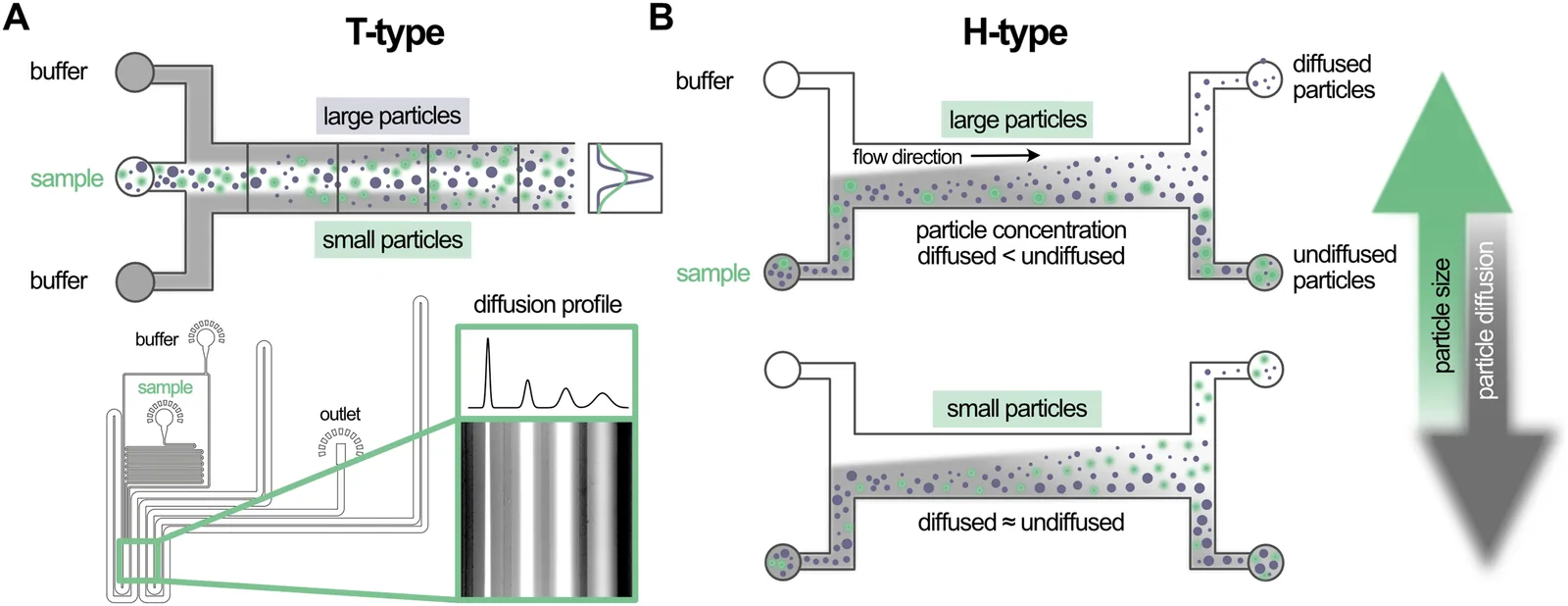
Source: Lab on a Chip, by Lena Bauernhofer; Jasmin Baron; Sandro Keller; Georg Krainer (August 26, 2026). AI-generated summary by biochip.com, published . Not independently reviewed.
Key takeaways
- Microfluidic diffusional sizing measures hydrodynamic radius, binding affinity, and stoichiometry by tracking fluorescent analytes under laminar flow.
- The review highlights MDS applications in protein aggregation, antibody affinity profiling, protein-lipid interactions, and nanoparticle sizing.
- The review anticipates diagnostic and therapeutic uses but does not establish clinical validation or routine deployment.
Microfluidic diffusional sizing, or MDS, is a lab-on-a-chip method that measures how biomolecules spread through flowing liquid to determine their size and interactions. A review in Lab on a Chip by researchers at the University of Graz and the Medical University of Graz surveys how the technique is being used in bioanalysis and biosensing. MDS works with very small sample volumes and can measure molecules at nanomolar concentrations, a range relevant to many biological experiments. Its central readouts include hydrodynamic radius, which describes a particle's effective size in solution, along with binding affinity and molecular stoichiometry. The method is designed for fluorescent analytes and can examine proteins, DNA, RNA, lipid nanoparticles, and biomolecular complexes. The review highlights applications ranging from protein aggregation and antibody affinity profiling to protein-lipid interactions and nanoparticle sizing. It also tracks technical advances in single-molecule detection, label-free measurement, and multidimensional analysis. Together, these developments position MDS as a flexible sensing platform for studying biomolecules in solution, including samples that are complex, heterogeneous, or unpurified.
Measuring Size Through Diffusion
MDS relies on a simple physical idea: smaller objects wander through liquid more quickly than larger ones. It is like watching people move through a crowded room, where a person carrying only a phone can change position more easily than someone pushing a large cart. In a microfluidic channel, that difference in movement becomes a measurable signal.
The chip guides liquid under laminar flow, meaning the streams move side by side in smooth layers rather than mixing turbulently. Molecules can still cross from one layer into another by diffusion, their natural random motion. By monitoring this diffusion-driven transfer, MDS calculates the analyte's hydrodynamic radius, often written as Rh.
What Hydrodynamic Radius Reveals
A hydrodynamic radius is not simply the diameter of a molecule measured with a ruler. It reflects how a molecule or particle behaves while moving through a liquid, including the influence of its shape and surrounding solvent. That makes it useful for comparing a free protein with the same protein after it binds another molecule or joins an aggregate.
MDS can also be used to characterize binding affinity, commonly represented by KD. Binding affinity describes how tightly two partners associate, such as an antibody and its target, while stoichiometry indicates how many molecules of one partner bind the other. These measurements let researchers study interactions in solution rather than requiring the molecules to be fixed on a surface.
Applications Across Biomolecular Analysis
The review covers MDS studies of protein-protein and protein-nucleic acid interactions, along with protein folding, unfolding, and aggregation. Protein aggregation matters because abnormal clusters of proteins are associated with pathogenic processes, and a sizing method can track changes as individual molecules assemble into larger structures. The platform can also support studies of drug-target binding and other non-covalent interactions, which are associations held together by relatively weak forces rather than permanent chemical bonds.
Antibody affinity profiling is another highlighted use. Antibodies are proteins that recognize molecular targets, and their practical performance depends in part on how strongly and selectively they bind. MDS can assess these interactions by detecting the change in diffusive behavior that occurs when a fluorescent analyte becomes part of a larger complex.
Complex Samples and Tiny Volumes
Microfluidic systems manipulate liquid at the micrometer scale, allowing experiments with sub-microliter volumes. That economy can be important when samples are scarce, costly, or difficult to purify. MDS uses microliter-scale samples while working at nanomolar analyte concentrations, according to the review.
Biological samples are rarely neat mixtures. Blood-derived material, cell extracts, and other real-world specimens can contain many components that differ in size and abundance. The review notes that MDS can function in complex, heterogeneous, and unpurified biological samples, a capability that supports interest in diagnostic and clinical applications.
Expanding the MDS Toolbox
The field is moving beyond conventional bulk measurements. The review identifies single-molecule detection as an important technological development, bringing MDS closer to experiments that can detect individual biomolecules rather than relying only on average behavior across a population. Advanced optical technologies can make such sensitive measurements possible within microfluidic systems.
The authors also point to label-free strategies and multidimensional analysis. A label-free approach seeks to measure an analyte without attaching a fluorescent or other reporting tag, which can be useful when labeling changes molecular behavior or is difficult to perform. Multidimensional analysis combines more than one informative measurement, potentially broadening the types of molecular states and interactions that MDS can distinguish.
Why This Matters
MDS sits at the intersection of microfluidics and molecular sensing. Rather than merely moving tiny liquid samples through a chip, it turns diffusion into quantitative information about molecular size, complex formation, and affinity. This is especially valuable for biomolecules whose behavior changes as they bind, fold, unfold, or aggregate.
The platform's broad stated application range includes proteins, nucleic acids, lipid nanoparticles, and other biomolecular complexes. Lipid nanoparticles are of particular interest because their size and assembly state can affect how they behave in biological settings. A method that can size such particles in solution may help researchers characterize them alongside more traditional biomolecular targets.
What Comes Next
The review anticipates an expanding role for MDS in biomedical research, diagnostics, and therapeutic development. Its future usefulness will depend on how well new detection modes, label-free approaches, and multidimensional measurements translate into dependable workflows for demanding samples. For now, the method offers a compact way to watch molecules reveal their size and partnerships through one of the most basic behaviors in nature: diffusion.