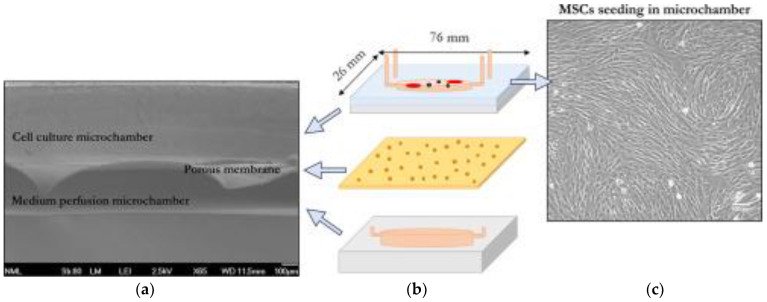
Source: International Journal of Molecular Sciences, by Uyen M N Cao; Yuli Zhang; Julie Chen; Darren Sayson; Sangeeth Pillai; Simon D Tran. AI-generated summary by biochip.com, published . Not independently reviewed.
Key takeaways
- Organ-on-a-chip devices combine living cells and microfluidic channels to model functions of organs including the lung, liver, gut, and heart.
- PDMS enables transparent, gas-permeable microfluidic chips but can absorb hydrophobic drugs, while thermoplastics, glass, and hydrogels offer distinct manufacturing and biological tradeoffs.
- Standardization and scalable manufacturing remain difficult because material choices, channel dimensions, membranes, and fabrication methods vary across laboratories.
Organ-on-a-chip devices are tiny lab systems designed to mimic how real human organs behave, and the core message of this guide is simple: the material used to build the chip can shape the biology just as much as the cells inside it. Researchers use these devices to recreate pieces of organs such as the lung, liver, gut, and heart in a controlled setting, often by combining living cells with microfluidics, the science of moving very small amounts of liquid through narrow channels. That makes organ chips attractive as faster, more human-relevant tools for drug testing, disease modeling, and basic biology. But building a useful chip is not just an engineering problem. The biomaterial has to support cell growth, allow nutrients and oxygen to move, survive fabrication, and sometimes stretch, bend, or let molecules pass through in organ-like ways. The source article lays out how researchers choose among materials such as silicone, hydrogels, thermoplastics, paper, and glass depending on what organ function they want to reproduce. It also reviews the manufacturing methods behind these systems, from soft lithography to three-dimensional printing, showing that fabrication choices can affect cost, precision, scalability, and experimental reliability. Taken together, the guide frames organ-on-a-chip development as a balancing act between biological realism and practical manufacturing.
What an organ-on-a-chip is trying to do
An organ-on-a-chip is best understood as a tiny, living model of part of the body. Picture a miniature plumbing system lined with human cells, where researchers can control flow, pressure, and chemical signals to imitate the environment those cells would experience inside an organ.
The goal is not to build a whole organ in miniature, but to capture the functions that matter for a specific question. A lung chip, for example, may need an air-liquid barrier and rhythmic stretching, while a gut chip may need flowing fluid, a porous membrane, and room for microbes or immune cells.
Why biomaterials matter so much
The guide argues that biomaterial choice is central because the material is not just a container. It determines whether cells stick, spread, communicate, and organize into tissue-like structures, much like the walls and floor of a house influence how people move through it and use the space.
In scientific terms, a biomaterial affects mechanical stiffness, permeability, optical clarity, and chemical compatibility. Those properties influence whether researchers can image cells clearly, expose them to drugs accurately, or reproduce organ-level behavior such as barrier function and tissue-to-tissue signaling.
The tradeoffs behind common materials
One of the best-known materials in this field is polydimethylsiloxane, or PDMS, a flexible silicone widely used in microfluidics. Researchers like it because it is transparent, easy to mold, and gas permeable, meaning oxygen and carbon dioxide can pass through it, which helps keep cells alive.
But PDMS also comes with a serious drawback: it can absorb small hydrophobic molecules, including some drugs. That is a bit like testing a dye in a sponge instead of a glass tube; part of what you add may disappear into the material, making results harder to interpret.
Other materials offer different strengths. Thermoplastics such as polystyrene or cyclic olefin polymers can be better suited for large-scale manufacturing and may interact less with test compounds, while glass provides excellent optical properties and chemical resistance but is less flexible and often harder to fabricate into complex devices.
Hydrogels play a different role. These water-rich polymer networks act more like soft tissue than hard device walls do, giving cells a three-dimensional environment that can better mimic the extracellular matrix, the supportive scaffold that surrounds cells in the body.
Matching the material to the organ
The source emphasizes that there is no universally best material because each organ model asks for different features. A blood-vessel chip may need elasticity and smooth channel walls for flowing cells, while a bone model may need a much stiffer matrix that encourages the right cellular behavior.
This is where design becomes purpose-driven rather than generic. Researchers must decide whether they care most about mechanical stretching, electrical signaling, long-term culture, drug compatibility, or the ability to integrate sensors, and then choose materials that support those priorities.
How these chips are fabricated
The guide also reviews the manufacturing methods used to turn designs into working devices. Soft lithography, a common approach, works a bit like making a detailed stamp: a patterned mold is created first, and then a material such as PDMS is cast on top to reproduce tiny channels and features.
This method is popular in academic labs because it is relatively accessible and can produce fine structures. Still, it is not always ideal for mass production, and device-to-device consistency can become a challenge when the goal is to move from a research prototype to a broadly usable platform.
Other fabrication routes include micromachining, injection molding, laser cutting, and 3D printing. Three-dimensional printing is especially attractive because it can create custom geometries quickly, but the printable materials must still meet biological requirements, and printing resolution may limit how accurately very small features can be reproduced.
The push toward more realistic biology
A major theme in the article is the effort to make organ chips more physiologically relevant, meaning more faithful to what happens in the body. That often requires combining multiple materials rather than relying on one, such as pairing a rigid structural frame with a soft hydrogel where cells can grow and organize.
Researchers are also trying to recreate more than one tissue type at once. Barrier tissues, blood vessels, immune components, and mechanical cues can all be built into a single system, but each added layer raises the demands on materials and fabrication methods.
Why standardization remains difficult
The field has moved quickly, but standardization remains a bottleneck. If labs use different materials, channel dimensions, membrane types, and fabrication steps, then it becomes harder to compare results across studies or to convince industry and regulators that a chip will behave reliably.
The guide suggests that better material selection frameworks and more scalable manufacturing strategies could help close that gap. In practice, that means choosing materials not only for short-term experimental convenience but also for reproducibility, storage, cost, and compatibility with routine testing workflows.
Why This Matters
Organ-on-a-chip technology matters because many current models fall short. Animal studies do not always predict what happens in people, and simple cell cultures often miss the fluid flow, physical forces, and tissue architecture that shape real biology.
By focusing on biomaterial choice and fabrication, this guide highlights a less visible truth: better biology depends on better building materials. If the chip absorbs drugs, blocks imaging, stresses cells unnaturally, or cannot be manufactured consistently, then even clever biological design may produce misleading answers.
That is why this topic reaches beyond engineering. The materials and methods behind organ chips could influence how quickly new therapies are screened, how convincingly diseases are modeled in the lab, and how confidently these systems move from niche research tools toward wider use in medicine and toxicology.
What comes next
The field now seems to be moving toward hybrid devices that combine manufacturable plastics with tissue-like hydrogels, along with fabrication methods that are easier to scale. As researchers refine those combinations, the most successful organ chips will likely be the ones that treat materials science and cell biology as inseparable parts of the same problem.
Topics: Microfluidics · Organ-on-a-chip
Start here: Microfluidics explained
Related articles
- Biomedical Materials and Fabrication Methods for Construction of In Vitro Neurovascular Unit Models
- Organoids, Organ-on-a-Chip, and the Case for Online LC–MS
- TissueGnostics collaborates with Diya Biological Technology in organoid and organ-on-a-chip innovation
- Organ-on-a-chip platforms for disease modeling and in vitro diagnostic applications