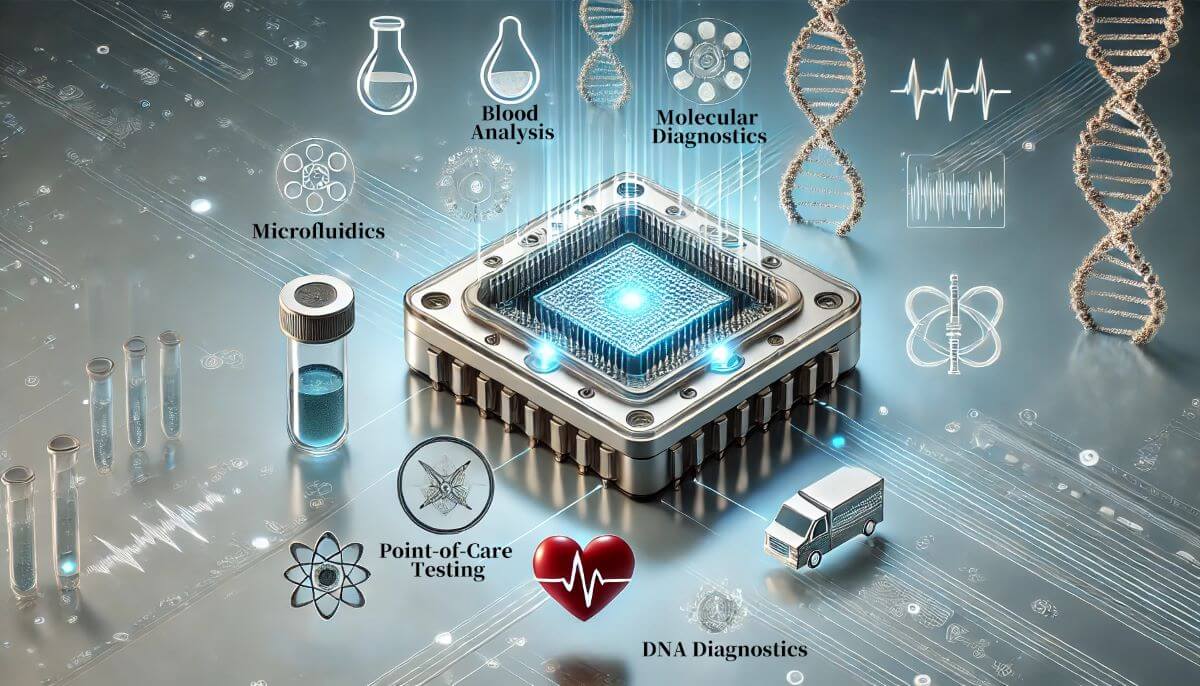
Microfluidics is shrinking point-of-care testing devices by moving an entire lab workflow onto a chip small enough to fit in the hand. In the in vitro diagnostics, or IVD, world, that matters because tests are increasingly expected to work not just in central labs, but in clinics, pharmacies, homes, and even on the body. The core idea is simple: instead of pushing milliliters of liquid through bulky instruments, microfluidic systems guide tiny amounts of fluid through microscopic channels where sampling, mixing, reactions, and detection happen in sequence. That shift can cut reagent use, lower cost, and speed up turnaround time. It also helps reduce contamination because fewer manual steps are needed once the sample enters the device. The source material highlights how these systems are being applied across biochemical testing, immunodiagnosis, and molecular diagnostics, especially where portability and ease of use matter most. Taken together, the story is less about making existing machines a bit smaller and more about redesigning diagnostic testing so it can happen closer to the patient.
What Microfluidics Changes
Think of a conventional diagnostic lab like a full restaurant kitchen: separate stations, multiple tools, skilled staff, and lots of movement between steps. A microfluidic device works more like a compact vending machine that takes in one item and handles the process internally. In technical terms, it manipulates very small volumes of fluid inside tiny channels etched or molded into a chip.
This setup is often called a lab on a chip. The phrase captures the main advantage: tasks that usually require separate instruments, such as sample preparation, reagent mixing, reaction control, and signal detection, can be integrated into one platform. That integration is what makes devices smaller without simply stripping away capability.
Why POCT Benefits First
Point-of-care testing, or POCT, refers to medical testing performed near the patient rather than in a centralized laboratory. These settings include primary care offices, community hospitals, ambulances, and homes. In those environments, a test does not need to process huge batches of samples; it needs to be fast, simple, and reliable for one patient at a time.
The source contrasts microfluidic POCT systems with traditional robotic lab platforms. Large robotic systems are still better at handling high volumes, but they are expensive and fixed in place. Microfluidic devices, by comparison, trade sheer throughput for portability, lower operating costs, and broader access.
Biochemical Testing and Immunodiagnosis
One of the clearest use cases is biochemical analysis and immunodiagnosis. Biochemical tests measure substances in body fluids, while immunodiagnostic tests detect disease markers using antibodies, proteins made by the immune system that can recognize specific targets. These are common formats for checking infection, inflammation, hormones, and chronic disease markers.
According to the source, microfluidic devices suit these applications because they are easy to operate and can return results quickly. That combination is useful in front-line care, where clinicians may need an answer during the visit rather than hours later. A smaller fluid path also means less sample and fewer reagents are needed, which can make routine testing cheaper and more practical outside major hospitals.
The source also points to an important limitation of older strip-based approaches such as immunochromatography, where liquid usually moves in one direction across a test strip. Those systems are convenient, but they can suffer from uncontrolled sample flow and inconsistent reaction times, which can bias results. They also tend to produce qualitative answers, like yes or no, instead of precise quantitative measurements.
From the Clinic to the Home and the Body
Microfluidics becomes especially interesting when testing moves beyond the exam room. The source describes portable urine and blood testing systems that could support home diagnostics and connect results with larger data platforms for chronic disease management. In plain terms, that means the test is not just a one-time readout; it becomes part of an ongoing record that can help track conditions over time.
Wearable diagnostics are another extension. The source highlights sweat analysis as an example, where microfluidic structures can collect and guide tiny fluid volumes continuously. A useful analogy is a system of miniature gutters and valves built into a patch on the skin, directing sweat to small sensing zones that can monitor health-related signals without a blood draw.
Molecular Diagnostics on a Chip
The source describes molecular diagnostics as a gold standard for detecting infectious diseases, genetic conditions, and cancers because these tests can identify nucleic acids, the DNA or RNA that carry biological instructions. Traditional molecular testing is powerful, but it often requires multiple labor-intensive steps, specialized equipment, and trained staff. That has limited its use in places where speed and simplicity matter most.
Microfluidics tackles this by combining several steps on one chip. The source specifically mentions cell lysis, which breaks cells open, nucleic acid extraction, which isolates genetic material, and amplification, which makes tiny amounts of DNA or RNA easier to detect. Instead of moving a sample between tubes and machines, a closed microfluidic system can guide it through the whole sequence internally.
That closed design offers two practical benefits called out in the source. First, it lowers contamination risk because operators handle the sample less. Second, it enables rapid testing in portable formats, making it possible to get answers in minutes in non-laboratory settings rather than sending specimens away for centralized analysis.
Why Smaller Also Means Smarter
Miniaturization is only part of the value. When fluid volumes shrink, physical processes can become easier to control, which helps reactions happen faster and with less waste. That is why microfluidic systems often use smaller reagent volumes while still performing multi-step chemistry that once demanded much larger instruments.
This is also where engineering matters. A successful microfluidic POCT device has to manage timing, flow control, mixing, and detection with very little room for error. If the liquid moves too quickly, too slowly, or unevenly, the result can become less reliable, so the chip design itself becomes a critical part of test accuracy.
Why This Matters
The larger significance is access. Many of the benefits named in the source, portability, speed, lower cost, and reduced contamination risk, address the exact reasons advanced diagnostics are often unavailable outside major labs. A smaller device can travel to places where a full laboratory cannot, and a simpler workflow can help testing fit into ordinary clinical practice.
There is also a shift in who gets tested and when. If biochemical, immunologic, and molecular assays can be run at the point of care or at home, diagnosis can happen earlier and monitoring can happen more often. For chronic disease management, infectious disease screening, and routine follow-up, that could make testing feel less like a rare event and more like part of continuous care.
What Comes Next
The source presents microfluidics as a platform technology rather than a single product category, which is why it appears in everything from immunoassays to wearable sensors to molecular tests. The next phase will depend on how well developers turn chip-level precision into robust, low-cost devices that work for real users, not just in controlled demonstrations. If they succeed, the most important effect may not be that diagnostic machines look smaller. It may be that accurate testing becomes ordinary in places where it used to be impractical.