Source: uFluidix, by Pouriya Bayat. AI-generated summary by biochip.com, published . Not independently reviewed.
Key takeaways
- An Italian team used a PDMS microfluidic chip to test fluid-flow mechanosensitivity in C. elegans AWC ON olfactory neurons.
- Reduced neuronal activation in a shear-minimizing chamber indicated tangential mechanical stress drives much of the AWC ON response.
- The reported work does not establish which specific odorant receptor or receptors mediate AWC ON mechanotransduction.
A microfluidic device helped researchers separate chemical sensing from flow sensing in the tiny roundworm Caenorhabditis elegans. The team found that a type of olfactory neuron called AWC ON, known for guiding worms toward volatile chemical attractants, also responds to mechanical changes caused by fluid flow. That matters because microfluidic experiments often use flowing liquids to deliver stimuli, and the flow itself can unintentionally affect cells. To investigate this problem, researchers in Italy designed a chip that reduced shear stress, the tangential dragging force that moving fluid applies to a surface. Worms placed in the device showed lower activation of AWC ON neurons than worms exposed to flow-related mechanical stimulation. Calcium imaging, a technique that tracks changes in cellular calcium as a proxy for neural activity, showed that the size of calcium events tracked the strength of the mechanical stimulus. The findings suggest that shear stress is a major driver of the neurons' mechanosensitivity and that the response arises within AWC ON rather than through signals from other neurons. The work also demonstrates why carefully controlling fluid mechanics is essential when using worm-on-a-chip systems to study sensation in living animals.
A sensory neuron with two jobs
C. elegans is a widely used model organism because it is small, transparent, easy to genetically modify, and has a life cycle of about two weeks. Although the worm is simple, its nervous system supports behaviors and signaling pathways that can be studied in detail, including sensory responses.
AWC olfactory neurons play an established role in chemotaxis, the movement of an organism toward or away from chemicals. In this case, AWC ON neurons detect volatile attractants. The research showed that these same neurons can also react when fluid flow changes around the animal, making them polymodal, or responsive to more than one kind of stimulus.
Why flow can complicate microfluidic experiments
A microfluidic chip moves and controls extremely small volumes of liquid through channels measured in microns, or millionths of a meter. It is a little like directing water through an elaborate system of miniature pipes, where even gentle movement can produce meaningful forces on a cell or small animal.
That control makes microfluidics useful for worm-on-a-chip experiments, in which researchers can expose animals to carefully timed chemicals while observing their behavior or neural activity. But a chemical stimulus delivered in flowing liquid may be accompanied by mechanical forces, creating a difficult question: is a neuron responding to the chemical, the flow, or both?
A chip designed to reduce shear
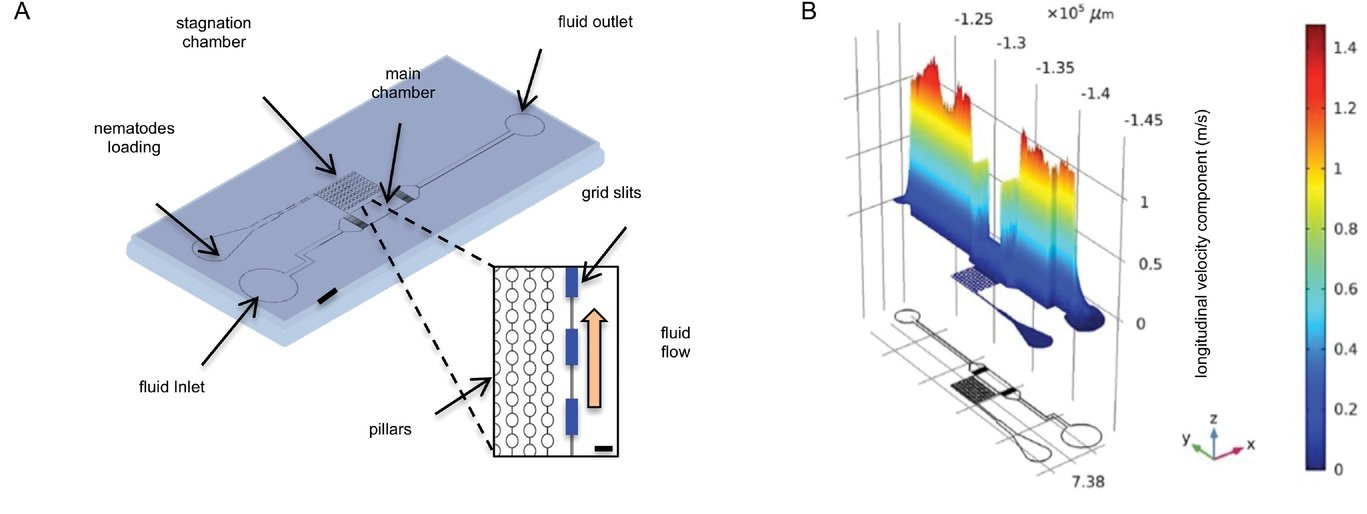
The Italian research team built a polydimethylsiloxane, or PDMS, microfluidic chip that was 50 microns thick. PDMS is a transparent, flexible silicone material commonly used to make research chips because it can be shaped into small channels through soft lithography and photolithography.
The device divided its channels into two compartments. Worms entered through a loading inlet and became trapped in a stagnation chamber, while fluid entered a main chamber through a separate inlet. Grid-like slits, optimized through simulations, were designed to keep changes in mechanical stress from reaching the worms while still allowing controlled fluid conditions.
This arrangement aimed to isolate hydrostatic pressure from the mechanical force associated with moving fluid. Hydrostatic pressure is the pressure exerted by a fluid at rest, while shear stress comes from fluid sliding along a surface. The distinction is important because a cell may experience both forces in a typical flowing microfluidic system.
Tracking neurons through calcium signals
The researchers exposed the nematodes to repeated mechanical stimulation and recorded AWC ON activity with calcium imaging. When neurons activate, calcium levels can rise inside the cells. Fluorescent calcium indicators make those changes visible, allowing researchers to follow neural activity in living worms without removing the neurons from the animal.
The calcium events correlated with stimulus amplitude, meaning stronger mechanical stimulation was associated with stronger or different neural signals. Many responses also displayed plateau-like behavior resembling bistable calcium dynamics. In simple terms, the neurons appeared able to switch between two relatively stable activity states rather than merely rising and falling in a smooth, proportional way.
Evidence for an intrinsic response
The work indicated that AWC ON mechanosensitivity is intrinsic to the neuron rather than originating from synaptic input. A synapse is the junction where one neuron communicates with another, so this result points to the sensory cell itself as the direct detector of the mechanical change.
The calcium transient also depended on the TAX-4 cyclic guanosine monophosphate-gated cation channel. Ion channels are molecular gates in cell membranes that open or close to let charged particles pass, changing a cell's electrical state. Because TAX-4 is involved in AWC ON signaling, the result suggests that one or more odorant receptors may contribute to how the neuron converts mechanical force into a biological signal.
Why This Matters
The central result is practical as well as biological. When researchers use microfluidics to deliver smells, nutrients, drugs, or other substances to organisms and cells, fluid flow can become an unplanned stimulus. A chip that reduces shear can help distinguish a response to the intended chemical treatment from a response to the mechanics of the experiment.
For neuroscience, the findings expand the picture of an olfactory neuron that was chiefly associated with chemical attraction. They indicate that AWC ON neurons can integrate information about both chemical surroundings and physical forces. For microfluidic engineering, the work underscores that channel geometry, flow patterns, and shear stress are experimental variables, not simply background conditions.
A platform beyond worms
The shear-reducing platform combines controlled perfusion with calcium imaging and could be adapted for experiments involving cultured cells as well as micro-organisms. Future studies can use similar designs to test which receptors detect mechanical signals, how bistable calcium activity shapes worm behavior, and when low-shear delivery systems are necessary to prevent flow from confounding an experiment.