AI-generated summary by biochip.com, published . Not independently reviewed. Source: Biosensors, by Fumin Chen; Qinqin Hu; Huimin Li; Yi Xie; Leshan Xiu; Yuqian Zhang; Xiaokui Guo; Kun Yin.
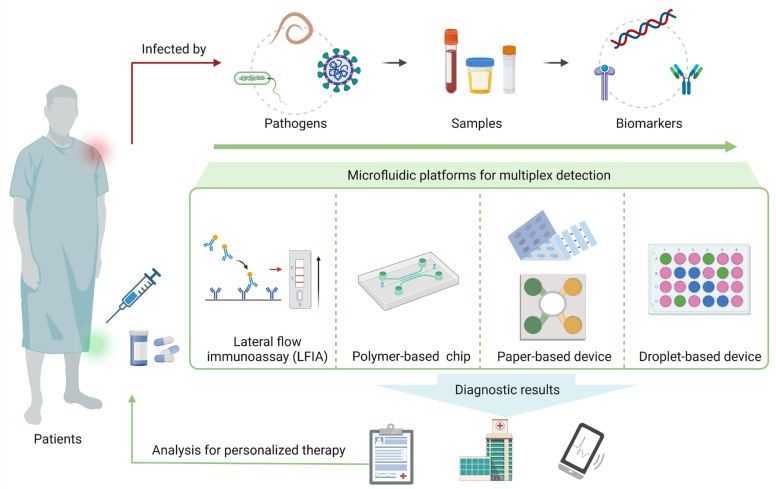
Microfluidic platforms are shrinking infectious disease testing down to chips, strips, and droplets that can detect several pathogens at once from a very small sample. That matters because many infections cause overlapping symptoms, so a test that can check for multiple culprits in parallel can save time and reduce missed diagnoses. The source article reviews how researchers are combining miniature fluid-handling systems with both immunosensors, which detect proteins or antibodies, and nucleic acid sensors, which look for genetic material such as DNA or RNA. It focuses on four major formats: lateral flow immunoassays, polymer-based chips, paper-based devices, and droplet-based systems. Each format tries to solve the same practical problem in a different way: move tiny amounts of liquid precisely, run several reactions at once, and produce a readable result quickly. The appeal is easy to see: these systems promise integration, miniaturization, automation, and high throughput, meaning many tests can run in a compact device with less hands-on work. At the same time, the review makes clear that the field is still maturing, especially when it comes to large-scale manufacturing and commercial rollout. The story is not that one perfect device has arrived, but that a set of technologies is getting closer to turning multiplex infectious disease testing into something faster, cheaper, and more portable.
Why multiplex testing is useful
When different infections produce similar signs such as fever, cough, or inflammation, a single-target test can leave clinicians guessing. A multiplex test, which checks several targets in one run, is more like using a key ring instead of trying one key at a time.
That approach can matter in outbreaks, in primary care, and in low-resource settings where speed and sample volume are critical. Instead of collecting more specimen and running separate assays, a microfluidic device can route one small sample into multiple channels or reaction zones.
How microfluidics changes the test format
Microfluidics is the controlled movement of very small volumes of liquid through tiny channels. An easy analogy is a miniature plumbing system on a chip, where valves, chambers, and pathways replace the tubes and beakers of a standard lab setup.
By shrinking the system, researchers can integrate sample handling, mixing, reaction, and readout into one platform. The source review highlights four advantages repeatedly associated with this design: integration, miniaturization, automation, and high throughput.
Two main sensing strategies
The review divides these devices into microfluidic immunosensors and microfluidic nucleic acid sensors. Immunosensors detect biological markers such as antigens or antibodies, while nucleic acid sensors identify pathogen-specific genetic sequences.
Those two approaches answer slightly different questions. Protein-based detection can be fast and convenient, while nucleic acid detection often offers strong specificity because it looks directly for the pathogen's molecular signature.
Lateral flow tests remain a practical favorite
Lateral flow immunoassay, or LFIA, is the format many people know from rapid test strips. The review describes it as an especially attractive diagnostic method because it is fast, simple to operate, stable in storage, and low in cost.
On a microfluidic level, LFIA uses capillary flow, meaning liquid moves through the strip without pumps. That simplicity makes it appealing for point-of-care use, especially when the goal is a portable test with an easy visual or instrument-assisted readout.
Polymer and paper chips offer different strengths
Polymer-based microfluidic chips are presented as highly automated and integrated platforms. In plain terms, they can pack multiple laboratory steps into a structured chip made from synthetic materials, allowing more controlled fluid movement and more complex test workflows.
Paper-based microfluidic devices take a different route. The review highlights their ease of processing, their ability to guide reagent flow without external power, and the relative ease of customization, which makes them attractive for low-cost and field-ready diagnostics.
Droplet systems push throughput higher
Droplet-based microfluidics treats each tiny droplet as an individual reaction vessel. A useful analogy is a factory conveyor turning out thousands of sealed mini test tubes, each carrying a slightly different reaction in parallel.
According to the review, that format is promising for large-scale and parallel biological or chemical reactions. Its main strengths are high throughput, low cost, and multiplex capability, all of which are important when many pathogens or biomarkers need to be tested at once.
Commercial hurdles are still real
The review is optimistic, but it does not pretend the job is finished. It states that the industrialization of microfluidic platforms is still in its infancy, which means the science has advanced faster than the manufacturing ecosystem needed to produce and distribute these devices widely.
That gap matters because a clever prototype is not the same as a dependable product. Mass production, quality control, liquid handling reliability, and market distribution all determine whether a device can move from the lab bench to routine clinical use.
Why This Matters
This review points to a practical future for infectious disease diagnosis: one in which a small, portable device can sort among multiple possible infections quickly and with limited sample volume. That is especially valuable when diseases look alike at first presentation, when laboratory access is limited, or when rapid triage could change patient management.
The larger significance is that microfluidics does not just make tests smaller. It changes how testing can be delivered, moving capabilities once tied to centralized laboratories closer to clinics, community settings, and potentially homes, while preserving sensitivity and specificity as central design goals.
What comes next
The most likely near-term path is not a single winning platform but several, each suited to a different use case. Rapid strips may dominate simple screening, polymer chips may handle more automated multi-step assays, paper devices may expand access in low-resource settings, and droplet systems may support highly parallel testing where scale matters.
If developers can solve manufacturing and commercialization challenges, these platforms could become a standard part of infectious disease care. The review's core message is straightforward: the technical pieces are coming together, and the next phase is turning that promise into reliable products that work outside the research lab.