AI-generated summary by biochip.com, published . Not independently reviewed. Source: Environment & Health, by Naresh Mandal; Bidhan Pramanick; Tarun Kanti Bhattacharyya; Baljit Singh.
Key takeaways
- The review highlights CRISPR-Cas, graphene-FET and microfluidic platforms for rapid point-of-care pathogen detection.
- CRISPR-based methods can rapidly and specifically detect SARS-CoV-2 without sophisticated laboratory equipment.
- Future devices must handle untreated clinical samples, reduce cost, and prove reliable despite interference from complex bodily fluids.
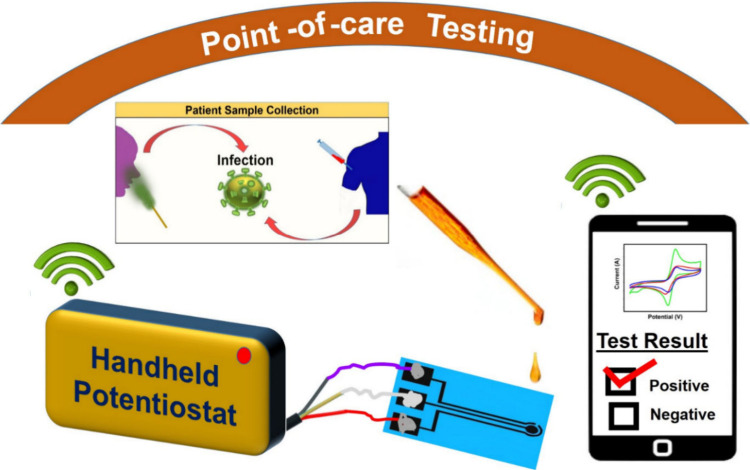
A review titled “Advancing Point-of-Care Healthcare Diagnostics to Tackle Future Outbreaks and Pandemics” argues that nanotechnology could make infectious-disease testing faster and more practical when the next outbreak arrives. Its focus is point-of-care, or POC, testing: diagnostic tools used near the patient rather than sent to a centralized laboratory. The review highlights CRISPR-Cas biosensors, graphene field-effect transistor platforms, and microfluidic devices as promising routes to rapid pathogen detection. These approaches are designed to pair high sensitivity, meaning the ability to detect small amounts of a target, with simpler equipment and shorter turnaround times. The authors place particular emphasis on rural and resource-limited settings, where sophisticated laboratories and health infrastructure may be unavailable. COVID-19 exposed the consequences of delayed and uneven access to diagnostic testing, while also showing how decentralized testing can extend care into remote locations. Still, the article is a review of emerging approaches, not evidence that a single universal pandemic test is ready for deployment. Its central message is practical: future preparedness will depend on affordable, scalable, increasingly self-operating tests that can work directly with real clinical samples.
Testing Where Decisions Are Made
Traditional laboratory diagnostics often involve collecting a sample, transporting it to a lab, preparing it with specialized instruments, and waiting for a result. That model can work well in established health systems, but each step adds time, cost, and opportunities for delays during a fast-moving outbreak.
Point-of-care diagnostics aim to move much of that process closer to the person being tested. Think of the difference between mailing a document to a distant office for approval and using a secure app that provides an immediate response. In diagnostic terms, that means a health worker, clinic, or potentially another local care setting could identify an infection sooner and act on the result without relying on a major laboratory.
Why Nanotechnology Enters the Picture
Nanotechnology involves engineering materials and structures at an extremely small scale, often close to the size of biological molecules. At that scale, a sensor can be designed to interact with a virus, a fragment of genetic material, or another disease-related signal in ways that improve detection.
The review presents nanotechnology as an enabling layer rather than one standalone test. It can help make diagnostic devices smaller, sharpen their ability to recognize a biological target, and potentially reduce the amount of equipment needed to produce a useful result. The goal is not simply a compact device, but a test that remains reliable outside a highly controlled laboratory environment.
CRISPR Sensors: Recognition by Genetic Matching
One technology highlighted in the review is based on CRISPR-Cas, a family of molecular tools originally associated with gene editing. In a diagnostic setting, CRISPR-Cas can be adapted to recognize a specific genetic sequence from a pathogen. It works somewhat like a spell-checker that has been programmed to flag one exact string of letters, except the letters are pieces of viral genetic material.
The source notes that CRISPR-based methods can provide rapid and highly specific detection of SARS-CoV-2, the virus responsible for COVID-19, without requiring sophisticated laboratory equipment. Specificity matters because a diagnostic test must distinguish its intended target from closely related or irrelevant biological material. That makes such approaches attractive for field and remote settings, although the review does not establish that every CRISPR test performs equally well across real-world conditions.
Graphene Electronics and Microfluidic Chips
The article also identifies graphene field-effect transistor, or graphene-FET, platforms. A field-effect transistor is an electronic component whose signal changes in response to nearby electrical effects. When graphene, a very thin carbon material, is used in such a sensor, biological binding events can potentially be converted into measurable electrical changes.
Microfluidic devices offer another route. These devices guide tiny volumes of liquid through miniature channels, much as plumbing directs water through pipes, but on a scale suitable for droplets and clinical samples. A microfluidic chip can potentially combine sample handling, chemical reactions, and signal readout in a smaller format, which is useful when laboratories, trained personnel, and bulky instruments are scarce.
The Hard Part: Untreated Samples
The review makes clear that detecting a pathogen in a neat laboratory preparation is not the same as testing an untreated clinical sample. Bodily fluids are chemically complex and can contain substances that interfere with a sensor or obscure the signal it is trying to detect. A useful POC device must cope with that messiness, not just perform under ideal conditions.
That is why the authors call for diagnostics that can detect infections directly from untreated samples while accounting for interference from complex bodily fluids. Speed alone is not enough. Future devices need to improve sensitivity, specificity, and operational simplicity at the same time, while remaining affordable enough to reach the communities that need them.
Why This Matters
Early detection can shape nearly every later public-health decision, from isolating infected people to directing limited medical resources and monitoring whether an outbreak is expanding. When results arrive quickly and locally, health systems may be able to respond before delays in sample transport and laboratory processing slow action.
The COVID-19 pandemic, as the review notes, underscored how point-of-care testing can broaden diagnostic availability for rural populations and remote locations. But access is not guaranteed simply because a technology is small. Cost, manufacturing scale, usability, supply chains, and confidence in test performance all determine whether a promising device becomes a practical public-health tool.
From Promising Platforms to Preparedness
The authors argue that research and development should focus on economical, scalable, self-operating diagnostic systems. They also call for collaborations and public-private partnerships to translate advances in detection technology into durable preparedness for future outbreaks and pandemics.
The next step is to show which combinations of CRISPR sensing, graphene electronics, microfluidics, and other nanotechnology approaches can deliver dependable results in the settings where they are most needed. If developers can meet the linked challenges of direct sample testing, affordability, and easy operation, point-of-care diagnostics could become a more resilient first line of defense when a new infectious threat emerges.