This review examines how capillary electrophoresis coupled to mass spectrometry, or CE-MS, is becoming a more capable tool for glycomics, the study of the complex sugars attached to proteins and other molecules. Rather than reporting a single experiment, it surveys recent advances in preparing glycans for analysis, separating them, and identifying them with mass spectrometry. Glycosylation, the cellular process that adds sugars to proteins, affects biological recognition, protein stability, and many disease-related processes. Yet glycans are unusually difficult to measure because molecules with the same building blocks can differ in their linkages, branching patterns, and small chemical decorations. The review argues that CE-MS is particularly useful because it can separate closely related glycan variants while consuming nanolitre-scale sample volumes. It also assesses the practical choices that determine whether a CE-MS workflow produces reliable quantitative data, from releasing glycans from proteins through labelling, cleanup, injection, and ionization. The authors place special attention on interfaces that connect the separation capillary to the mass spectrometer, since that connection often determines sensitivity and robustness. Their central message is measured but important: continued progress in automation, labelling chemistry, and instrument interfaces could make high-resolution CE-MS more practical across biomedical, clinical, and biopharmaceutical glycomics.
Why glycans are difficult analytical targets
Glycans are not simply linear strings of sugar units. A useful analogy is a set of trees built from the same small box of branches: each tree may contain similar materials, but its branch points and connections create a distinct structure. In glycans, these structural variations include isomerism, meaning molecules can share a chemical formula while differing in arrangement, and microheterogeneity, meaning a single protein can carry a mixture of related glycans at one attachment site.
Other features add to the difficulty. Glycans may have highly branched structures, and some residues are labile, meaning they can be lost or altered during preparation or measurement. Standard approaches such as liquid chromatography, abbreviated LC, or matrix-assisted laser desorption/ionization, known as MALDI, can provide valuable information, but some variants remain unresolved in those workflows. The review identifies CE-MS as a complementary approach for exposing that hidden structural diversity.
Preparing glycans without losing the signal
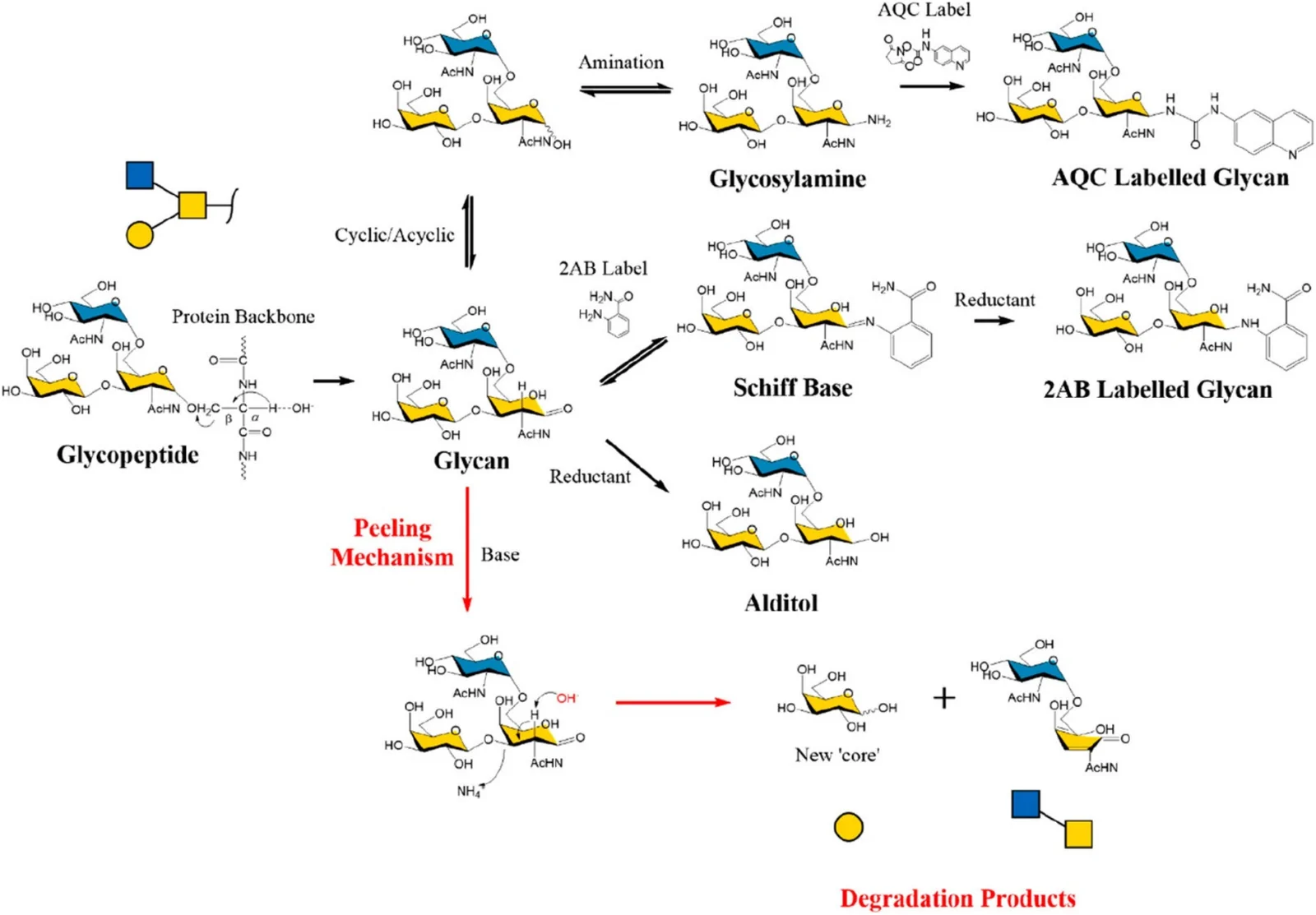
Before a glycan can be measured, it generally must be released from its parent protein. The review considers both enzymatic release, which uses enzymes to cut specific glycan bonds, and chemical release, which uses controlled reactions to free the sugars. This first step is not merely routine preparation: the selected method can influence recovery and determine which classes of glycans are retained for analysis.
Workflow format and cleanup also shape the final data. Cleanup removes salts, proteins, reagents, and other contaminants that can suppress the mass spectrometry signal or interfere with separation. The review emphasizes that these choices affect recovery, quantitative precision, and compatibility with subsequent CE-MS measurement, so a workflow needs to be designed as a connected process rather than a series of independent steps.
Labelling changes how glycans travel and fragment
A major focus of the review is derivatization at the glycan's reducing end, a chemically reactive end that can serve as a consistent attachment point for a tag. Labelling is a little like attaching a colored handle to a nearly invisible object: it can make the object easier to detect and distinguish, but the handle also changes how it behaves. In CE-MS, a label may alter electrophoretic mobility, or how quickly a molecule migrates through the capillary under an electric field, while also changing ionization efficiency and fragmentation during mass spectrometry.
The authors evaluate several labeling families, including reductive amination, hydrazide chemistry, and Michael-addition labeling. They also cover stable-isotope and isobaric labels, which can support comparative or multiplexed measurements, as well as emerging instant-labeling strategies intended to simplify sample handling. Permethylation, a chemical modification that replaces certain hydrogen atoms with methyl groups, is considered alongside reducing-end labels because it can change both glycan behavior and the information obtained in tandem mass spectrometry, or MS/MS, where selected ions are broken apart to reveal structural clues.
These choices involve tradeoffs rather than a universal winner. A chemistry that improves ionization may not deliver the best isomer resolution, while a method that produces helpful fragments may introduce added workflow complexity. The review's value lies in bringing those tradeoffs together, particularly for researchers selecting a method based on whether their priority is sensitive detection, quantitative precision, or separation of closely related glycan structures.
What makes CE-MS distinct
Capillary electrophoresis separates molecules inside a narrow tube using an electric field. Picture runners moving through a very thin track, where each runner's charge, size, and interaction with the track influence its speed. Because CE works with very small sample volumes and can deliver high separation efficiency, it can distinguish glycan variants that overlap in other analytical formats.
That separation depends on several practical variables. The review discusses background electrolytes, the solutions that carry electric current through the capillary, as well as capillary coatings that control interactions between glycans and the capillary wall. It also addresses injection modes, which determine how samples enter the capillary, because inconsistent injection can weaken quantitative precision even when the instrument itself is highly sensitive.
Connecting CE to mass spectrometry remains a central engineering challenge. The review covers sheath-flow interfaces, which add a supporting liquid flow near the capillary outlet; sheathless approaches, which seek to reduce dilution; nanoflow configurations; and microfluidic interfaces that integrate fluid handling into small devices. It also highlights dopant-enriched gases and integrated CE-MS cartridges as recent developments intended to improve signal, usability, or system stability.
Why This Matters
Better glycan characterization matters because glycosylation is deeply tied to biology and to the quality of therapeutic proteins. In biomedical and clinical settings, researchers may need to distinguish subtle glycan differences associated with a biological state. In biopharmaceutical development, those differences can be relevant to understanding and monitoring complex protein products, making methods that combine isomer resolution with quantitative performance especially valuable.
The review does not suggest that CE-MS has solved every obstacle. Instead, it evaluates performance through sensitivity, isomer resolution, robustness, and quantitative precision, and identifies continuing barriers to broader deployment. A method that is highly resolving but difficult to reproduce outside a specialist laboratory will have limited reach, which is why automation and dependable interfaces feature so prominently in the discussion.
The next phase for CE-MS glycomics will depend on whether technical refinements translate into workflows that are repeatable and accessible beyond expert instrument laboratories. The review points to mass-spectrometry-compatible labels, improved interface design, and automation as the areas most likely to move the technique toward routine use. If those pieces mature together, CE-MS could give researchers a sharper view of glycan complexity while retaining the small sample requirements that make capillary separations so attractive.