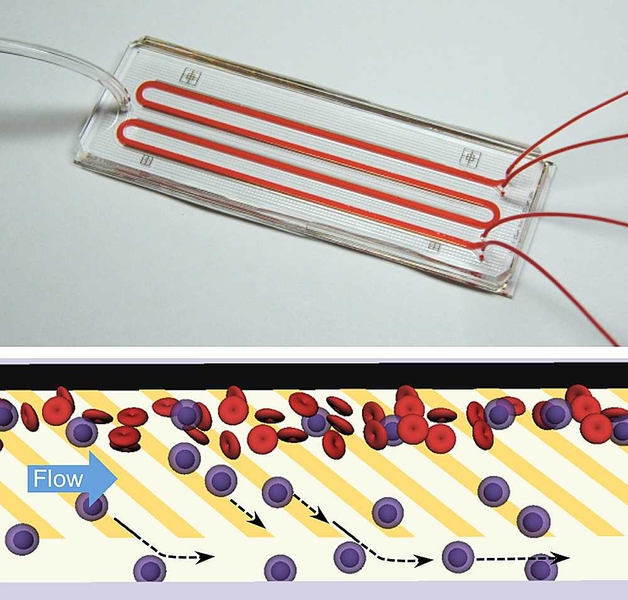
MIT researchers have developed a microfluidic chip that can pull a specific type of white blood cell, called a neutrophil, directly out of whole blood. That matters because neutrophils are central players in infection and inflammation, yet isolating them usually requires several preparation steps that can be slow, messy, and hard on the cells themselves. The new device avoids that bottleneck by separating cells inside a tiny chip, without the cumbersome sample processing that standard lab methods often need. Its key trick is to copy a natural behavior known as cell rolling, in which immune cells briefly stick and glide along blood vessel walls as they move through the body. On the chip, patterned adhesive molecules coax neutrophils out of a flowing blood stream and into a separate buffer stream, leaving other blood components behind. According to MIT News, the result is ultrahigh purity and high efficiency in a format compact enough to suggest future use in research and clinical testing. In practical terms, the chip points toward faster ways to study immune cells and potentially monitor disease using a small, precisely engineered device rather than a bench full of tubes and reagents.
How the chip works
The device belongs to the field of microfluidics, which means it manipulates tiny amounts of liquid in channels about as wide as a human hair. A good analogy is a miniature highway system for cells: blood flows down one lane, a clean buffer solution flows beside it, and the chip is designed so only the target cells are nudged into the exit lane.
What makes this chip unusual is the way it selects cells. Instead of using brute force filtration or extensive chemical preparation, it imitates a process the body already uses. In living blood vessels, neutrophils can slow down, make temporary adhesive contacts, and roll along vessel walls before moving into tissue. The chip recreates that behavior with patterns of adhesive molecules placed inside the channel.
Why neutrophils are important
Neutrophils are the most abundant type of white blood cell and one of the immune system’s first responders. When bacteria invade or tissue is damaged, they rush to the scene, attack microbes, and help coordinate inflammation. Because of that, researchers often want clean neutrophil samples to understand infections, inflammatory disorders, and how the immune system reacts under stress.
Getting those cells out of blood, however, is not simple. Whole blood is crowded with red blood cells, platelets, plasma proteins, and many kinds of immune cells. Traditional isolation methods typically involve multiple steps such as centrifugation, density gradients, or chemical treatments. Those procedures can take time and may alter the cells researchers are trying to study, a bit like handling a delicate object so much that you change it before you can examine it.
What makes this approach different
The MIT device is designed to skip much of that handling. By separating neutrophils directly from whole blood, it reduces the need for labor-intensive sample preparation. That is a meaningful engineering advance because every extra step in a lab workflow adds time, equipment, and opportunities for error or contamination.
The report says the chip achieves ultrahigh purity and high efficiency. Those two ideas are related but different. Purity means the collected sample contains mostly the desired cells, while efficiency means the device captures a large share of the target cells present in the original blood sample. A useful sorter needs both: a pure sample is less valuable if most target cells are lost, and a highly efficient sample is less useful if it is full of unwanted cells.
Biology copied into hardware
One of the most interesting parts of the work is that it turns a biological behavior into a physical sorting rule. Think of it like designing a doorway that only people wearing a certain kind of shoe can grip as they pass by. The adhesive patterns on the chip are tuned so neutrophils interact with them in the right way, briefly catching and rolling while other blood cells continue flowing past.
That design choice reflects a broader trend in bioengineering: instead of forcing cells through a generic machine, researchers build devices that respect how cells naturally behave. When a chip uses native cell properties, it can often separate cells more gently. For immune cells, gentleness matters because their behavior can change quickly in response to stress, temperature shifts, or rough processing.
What researchers could do with it
A chip that quickly isolates neutrophils from whole blood could help both basic research and medical testing. In research labs, it may make it easier to study how these cells respond to infection, inflammation, or drugs without the confounding effects of lengthy preparation. In a hospital setting, compact microfluidic systems might eventually support faster immune-cell analysis from small blood samples.
The MIT News description does not claim that this chip is already a routine clinical product, and that distinction matters. A promising prototype still has to prove that it works reliably across many patients, different blood conditions, and real-world workflows. But the concept is strong because it addresses a very practical problem: how to get the right cells out of a complex sample quickly and cleanly.
Why This Matters
Blood is one of the most information-rich tissues in the body, but it is also one of the hardest to simplify. Devices that can sort useful cells directly from whole blood could shrink the gap between a sample draw and an actionable measurement. That can speed experiments, reduce costs, and open the door to more portable diagnostic tools.
This work also shows why biochips are compelling. They are not just miniaturized lab equipment; at their best, they encode biology into the architecture of a device. By using patterned adhesives to mimic cell rolling, the MIT team demonstrates how a tiny chip can perform a subtle biological task that would otherwise require bulky equipment and skilled manual processing.
What comes next
The next steps for this kind of technology will likely involve testing it across broader sample sets, refining throughput, and exploring whether the same design principles can be adapted for other cell types. If that happens, microfluidic sorters could become versatile front ends for immune profiling, disease monitoring, and point-of-care diagnostics. For now, the MIT chip stands out as a clear example of how borrowing a trick from nature can make blood analysis faster, cleaner, and more precise.