Source: American Chemical Society (ACS), by Jiaze Wu; Joshua Fung-A-Fat; Weixiang Ben; Liping Song; Shupei Yu; Weichu Xu; Niko Hildebrandt; Kai Huang; Gang Han (September 20, 2026). AI-generated summary by biochip.com, published . Not independently reviewed.
Key takeaways
- University of Toronto engineers developed dye-sensitized nanoparticles that detect trace chemicals and distinguish nearly identical molecules.
- The particles convert near-infrared light into green luminescence using dye molecules, ytterbium ions and erbium ions.
- The report does not provide performance results for specific drug impurities, pollutants or real-world samples.
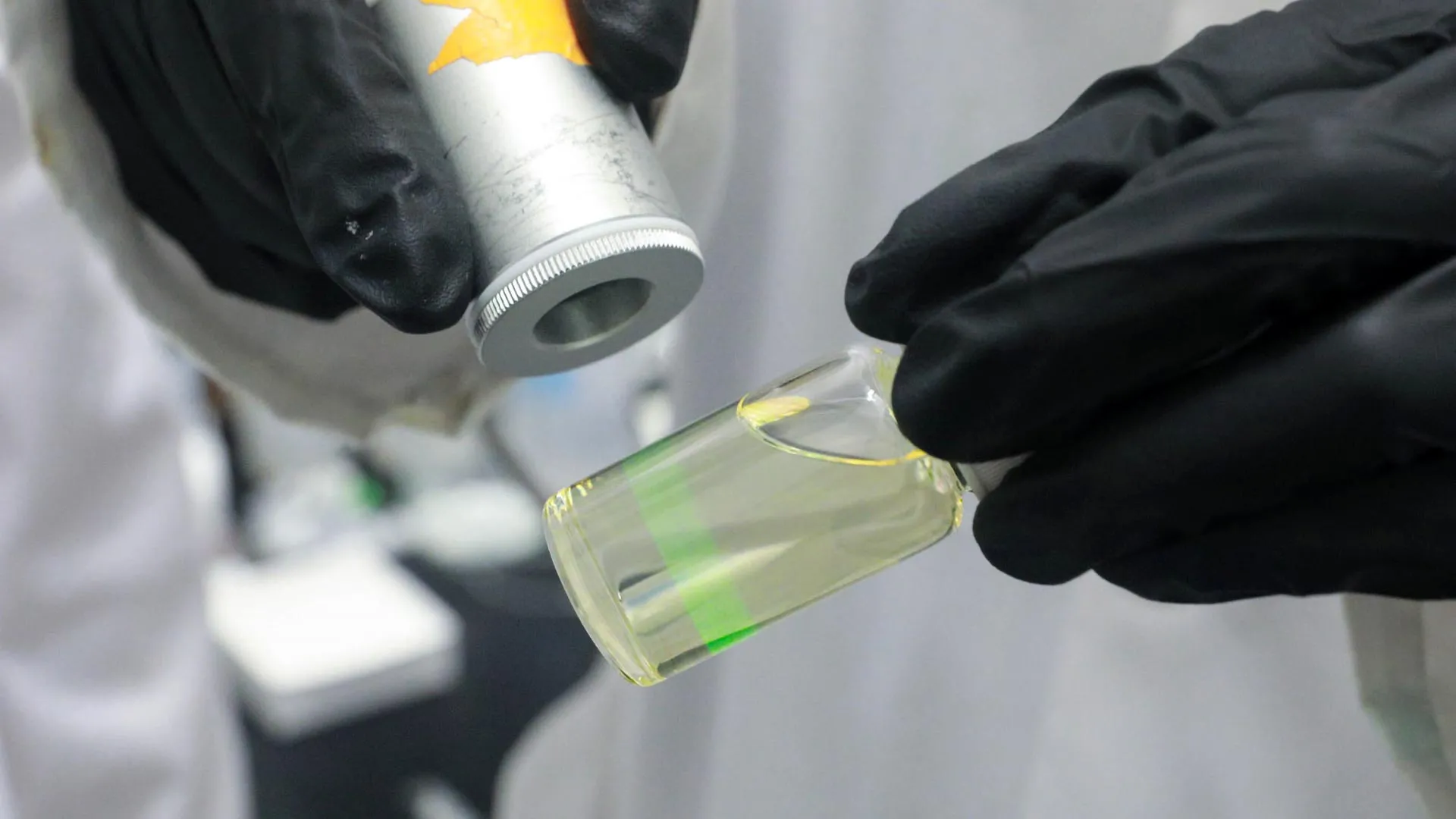
Engineers at the University of Toronto have designed dye-sensitized nanoparticles that turn near-infrared light into a bright green signal while detecting extremely small amounts of chemicals. The particles are intended to do more than flag a substance's presence: they can also distinguish molecules that have nearly identical shapes. That combination could be useful for finding unwanted impurities during drug manufacturing or tracing chemical pollutants in groundwater. The sensing approach relies on upconversion, a process in which the particles absorb lower-energy light and emit higher-energy light. Near-infrared excitation can come from relatively low-cost lasers, while the resulting green luminescence is easier to measure. The team improved the particles by changing both their chemical host material and their internal structure. Their layered, diamond-shaped design channels incoming energy toward light-emitting ions while limiting a loss process that previously dimmed the signal. The work, reported in the Journal of the American Chemical Society, points to a strategy for making optical chemical sensors brighter and better separated from background light.
Turning infrared light into green light
Most familiar fluorescent materials work in the opposite direction. They absorb relatively high-energy light, such as ultraviolet or visible light, and release lower-energy light at another color. Professor Kai Huang compares the new nanoparticle behavior to reversing that normal flow: low-energy near-infrared photons enter, and higher-energy green photons leave.
The particles accomplish this with a chain of energy transfers. Organic dye molecules coating the nanoparticle surface first absorb the near-infrared light. That energy moves to ytterbium ions, then to erbium ions, which release the accumulated energy as green luminescence.
Why a color shift helps sensing
Upconversion helps solve a practical optical problem: samples themselves can glow under illumination. This unwanted glow, called autofluorescence, can obscure a faint signal from a target chemical, much as daylight makes stars hard to see. By exciting the particles with near-infrared light and measuring green emission at a distinctly different frequency, researchers can more easily separate the nanoparticle signal from background light.
Huang likens the difference to turning off the sun for stargazing. The stars have not become brighter, but the surrounding glare has fallen away. In the same way, shifting to lower-frequency excitation can create a zero-autofluorescence background while the luminescent nanoprobes continue to shine.
The brightness problem
Earlier sensing particles typically used a host material made from sodium, yttrium and fluorine, with ytterbium and erbium ions spread through a flat hexagonal structure. The team describes the embedded ions as chocolate chips in a cookie, while the light-absorbing organic dyes form an outer coating like icing. Adding more ytterbium could help capture incoming energy, but it also created a competing energy loss.
That loss is called back-energy transfer. When ytterbium ions are packed too closely, they can take back energy that erbium ions would otherwise emit as green light. Instead of reaching the particle surface as a detectable signal, the energy returns to the relay ions and is lost from the desired optical pathway.
A layered route for energy
Jiaze Wu, a PhD student in Huang's lab and the paper's lead author, helped redesign both the particle composition and its shape. The new host matrix uses lithium, lutetium and fluorine rather than sodium, yttrium and fluorine. The team also moved from flat hexagons to three-dimensional diamond-shaped nanoparticles.
Each redesigned particle includes a dense core, an inner shell and an outer shell. Ytterbium concentration increases through those layers, reaching its highest level in the core. This gradient lets the particles hold more ytterbium while directing incoming light energy inward toward erbium ions, rather than allowing energy to move back toward the surface.
Modeling before manufacturing
The researchers did not select the final particle design through laboratory trial and error alone. They used Monte Carlo simulations, a computational method that tests many possible outcomes through repeated random sampling, and density functional theory, a method used to model how electrons and energy behave in materials. Those calculations allowed the team to examine dozens of candidate formulations and particle shapes before making the most promising versions.
That design process matters because these particles depend on several linked choices: the host chemistry, the placement of rare-earth ions, the structure of the shells and the dye coating. Altering one component can change how efficiently energy enters the particle, travels between ions and ultimately escapes as light. Computer modeling gave the researchers a way to evaluate those interactions before committing to laboratory synthesis.
Potential uses in chemical testing
The particles attach to chemicals they are designed to detect, then produce an optical signal that can be measured. In pharmaceutical manufacturing, this could provide a route for identifying unwanted impurities that may be present at very low concentrations. In environmental work, the same basic approach could be adapted to search groundwater for trace chemical pollutants.
The appeal of near-infrared activation is practical as well as scientific. Huang noted that low-cost lasers can produce near-infrared light, potentially reducing the complexity of the illumination hardware needed for sensing. A strong green output could also make it easier to distinguish the desired measurement from optical clutter created by the surrounding sample.
Why This Matters
Chemical sensing often faces a tradeoff between sensitivity and clarity. A detector may respond to a tiny amount of a substance but struggle to separate that response from background signals, especially when the target sits in a complicated mixture. The University of Toronto design addresses both sides of that problem by making the optical readout brighter and moving it into a color range that is easier to isolate from the excitation light.
The work also illustrates how nanoscale architecture can shape a sensor's performance. The same ingredients arranged differently can send energy along a less useful route or create a more one-way path toward light emission. Future studies will determine how the redesigned nanoparticles perform with particular target chemicals and in real pharmaceutical or environmental samples.