Source: ACS Omega, by Qiqi Cai; Zijie Xiao; Qingbin Chen; JieCheng Xu; Huihua Xia; Luyang Zhao; Erkai Liu; Shuguang Xuan (September 2, 2026). AI-generated summary by biochip.com, published . Not independently reviewed.
Key takeaways
- Shenzhen Salus BioMed achieved more than 93% iodine-induced cleavage of multi-phosphorothioate-modified DNA on a biochip surface.
- The platform produced Q30, SNP, and INDEL sequencing results equivalent to established standards while remaining compatible with PCR amplification.
- The study does not establish clinical diagnostic performance or deployment across different chip materials and assay formats.
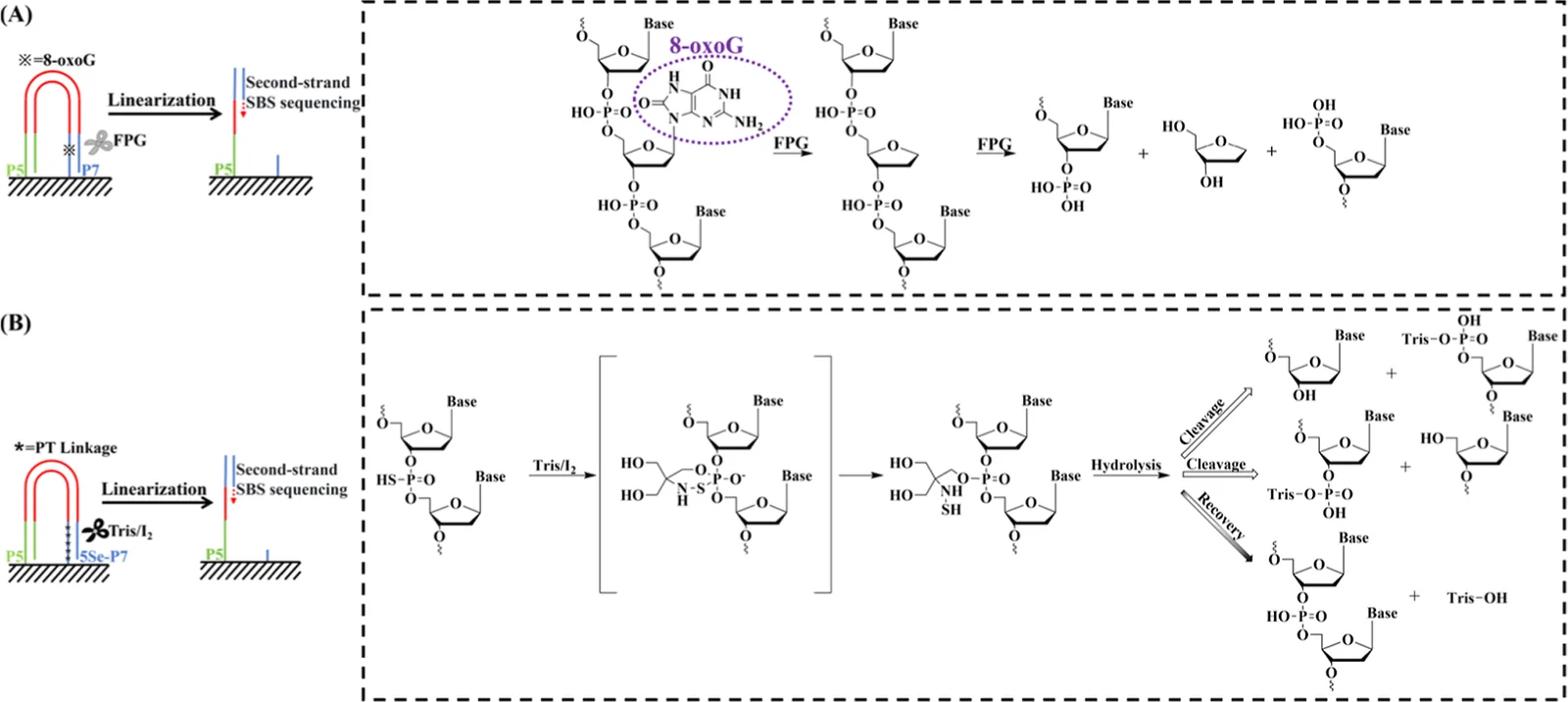
Researchers at Shenzhen Salus BioMed Co. developed a chemical method for releasing DNA from a biochip surface with more than 93% cleavage efficiency under mild conditions. The approach uses several phosphorothioate, or PT, modifications in a DNA strand, then cuts those modified locations with iodine. PT DNA replaces one oxygen atom in the phosphate backbone with sulfur, creating a site with distinct chemical behavior while retaining much of DNA's usual structure and charge. The team optimized both the number and positions of these PT linkers to make surface-bound DNA easier to release without relying on an enzyme. They then incorporated the chemistry into a next-generation sequencing workflow, where it produced Q30 quality scores and variant-calling accuracy comparable to established standards. The reaction conditions also remained compatible with polymerase chain reaction, or PCR, amplification, allowing the workflow to skip a traditional purification step. That combination matters because DNA capture and release are core operations in sequencing flow cells, microfluidic diagnostics, microarrays, and biosensors. The study positions iodine-triggered PT cleavage as a potentially simpler alternative to the conventional 8-oxoG and formamidopyrimidine DNA glycosylase, or FPG, enzyme system.
A Chemical Release Switch for Surface DNA
DNA-functionalized surfaces are built by attaching short DNA sequences, called oligonucleotides, to materials such as gold, silica, or synthetic polymers. These surfaces can recognize biological targets, organize molecules at very small scales, or support automated genomic workflows. But a useful DNA surface needs more than strong attachment: it often needs a reliable way to let DNA go at the right point in the process.
A simple analogy is a package secured with a specially designed tear strip. The package remains stable while it is handled, but a specific action opens it when needed. Here, the PT-modified segment acts as that designed weak point, and iodine supplies the chemical trigger that cuts the DNA at the linker.
Why PT Modifications Matter
A DNA backbone is normally made of repeating phosphate groups that connect its nucleotide building blocks. In a phosphorothioate linkage, one nonbridging oxygen in a phosphate group is replaced with sulfur. PT modifications were initially used to make synthetic DNA more resistant to enzymes that degrade nucleic acids, and they were later found in microbial genomes, where they have roles in defense systems, responses to oxidative stress, and epigenetic regulation.
The sulfur substitution also gives PT sites a useful chemical identity. Iodine can react at these locations and induce cleavage, offering a sequence-independent means of cutting DNA. Unlike an approach that depends on a particular DNA sequence, this chemistry is driven by the deliberately installed PT linker, giving developers a defined location for release.
Optimizing Multiple Linkers
The Shenzhen Salus BioMed team did not rely on a single PT modification. It used multiple PT sites in the DNA backbone and optimized their placement and the reaction conditions. That design achieved cleavage efficiency above 93% on a biochip surface under mild conditions.
Using several cleavable sites can be understood as adding several perforations to a tear strip rather than just one. The goal is not merely to make the DNA easier to sever, but to do so efficiently on a solid surface, where attached molecules can behave differently than DNA floating freely in solution. Surface chemistry, steric crowding, and access of a reagent to its target can all affect whether a molecular reaction translates into a dependable chip workflow.
An Alternative to Enzymatic Cleavage
The study compares the PT and iodine strategy with a conventional system based on 8-oxoG and FPG. FPG is an enzyme that recognizes and processes damaged DNA bases, and enzymatic methods can offer high specificity. Yet enzymes can add cost and impose tighter requirements on reaction conditions, which can complicate large-scale or automated workflows.
Chemical, oxidative, and light-based DNA-cleavage approaches bring different tradeoffs. Light-triggered methods can offer tight timing and spatial control but may require specialized instrumentation. Chemical methods can be simpler to perform, but they must avoid nonspecific DNA damage or long incubations. The researchers selected iodine-induced PT cleavage because the method is described as efficient, sequence-independent, and compatible with biological workflows.
Sequencing Workflow Performance
The key practical test was whether this release chemistry could fit into next-generation sequencing, or NGS. NGS systems read many DNA fragments in parallel, and their output depends on retaining sufficient DNA integrity for amplification and accurate base calling. The optimized PT platform delivered Q30 scores, single-nucleotide polymorphism, or SNP, accuracy, and insertion and deletion, or INDEL, accuracy equivalent to established standards.
A Q30 score is a widely used sequencing-quality benchmark that indicates a low probability of an incorrect base call. SNPs are changes at one DNA letter, while INDELs are short insertions or deletions of DNA letters. Matching established standards on these measures suggests that the iodine cleavage process did not prevent the workflow from generating sequencing data of comparable quality.
Removing a Purification Step
The reaction's mild conditions were also compatible with PCR, the technique used to make many copies of selected DNA sequences. That compatibility allowed the process to bypass a traditional purification step before downstream amplification. In a multistep genomic assay, removing a cleanup operation could simplify automation and reduce handling between steps.
For chip-based systems, that operational detail is as important as the cleavage yield. A surface chemistry that requires harsh conditions, extensive washing, or separate equipment can be difficult to integrate into a compact device. A release reaction that works alongside PCR is more readily positioned within an automated sequence of capture, release, amplification, and analysis.
Why This Matters
Biochips and related genomic platforms depend on controlled molecular handoffs. They must capture DNA or another target securely, process it on a surface, and release it without damaging the material needed for the next step. The multi-PT linker strategy addresses that enabling challenge directly by putting a chemically addressable release point into the DNA itself.
The work also highlights how a small backbone change can influence the architecture of a larger analytical system. Rather than treating DNA only as the information-bearing molecule to be sequenced, the researchers use it as an engineered component with a built-in chemical release function. Future work will determine how broadly this strategy performs across different chip materials, assay formats, and diagnostic workflows, but the reported results establish a route for integrating efficient chemical DNA release into automated genomic platforms.