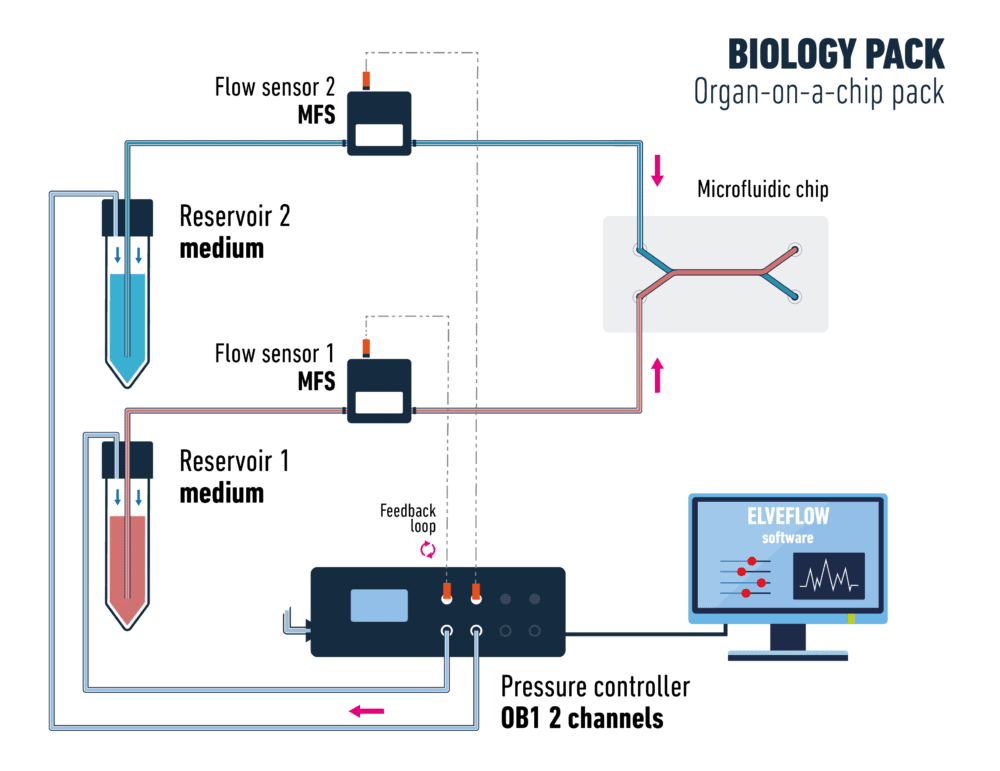
Source: Elveflow. AI-generated summary by biochip.com, published . Not independently reviewed.
ChipShop is pitching a ready-to-use organ-on-a-chip pack aimed at labs that want to run microfluidic cell culture experiments without building the whole setup from scratch. The core idea is simple: instead of growing cells in a still dish, researchers place them inside a small chip where liquid media can flow in controlled ways, closer to what happens inside the body. In ChipShop’s system, a key component is its cross-flow membrane chip, called Fluidic 480, which contains two separate culture chambers divided by a permeable membrane. That layout lets scientists grow different cell types on opposite sides of the barrier and study how they interact under flowing conditions. The company says this format can be used to model interfaces found in organs such as the gut, brain, kidney, and skin. The broader promise of organ-on-a-chip research is better drug testing and more realistic disease models than standard static cell culture can offer. ChipShop’s package is framed as a practical way to make these experiments easier to start, easier to automate over several days, and easier to reproduce across one or many chips.
What the pack is designed to do
At its heart, the package combines microfluidic flow control with compatible chip hardware for organ-on-a-chip experiments. Microfluidics means moving very small amounts of liquid through tiny channels, a bit like running a miniature plumbing system for cells.
That matters because cells respond strongly to their physical environment. In the body, they are constantly exposed to flowing fluids, changing nutrient levels, and signals from neighboring tissues, so a chip that can control those factors offers a more lifelike setup than a stationary well plate.
The role of the membrane chip
ChipShop highlights its Fluidic 480 cross-flow membrane chip as a tool for building tissue interfaces. Think of the membrane like a selective wall between two rooms: each side can host a different cell population, while small molecules can pass through and create communication between them.
This arrangement is especially useful for organ models built around barriers. In the gut, for example, one side can represent the intestinal lining and the other the supporting tissue environment; in a kidney or skin model, the same basic architecture can be adapted to mimic how layers of cells exchange signals and molecules.
Why flowing culture conditions matter
One of the main selling points in the source material is the ability to expose cells to dynamic flow conditions. That phrase just means the cells are not sitting in stagnant liquid; media can be pushed past them at controlled rates and, if needed, in controlled directions.
An everyday analogy is the difference between standing water in a bowl and water moving through a stream. A stream constantly refreshes its contents and applies gentle forces to whatever is inside it. On a chip, those forces can affect how cells grow, align, communicate, and form tissue-like structures.
Built for longer and more automated experiments
ChipShop also emphasizes convenience. The company describes the pack as a way to run long-term experiments with quick setup, intuitive software, and automation that can handle several days of operation.
That practical layer is important because organ-on-a-chip systems often fail not for biological reasons but because the fluid handling is cumbersome. If pumps, tubing, and timing all need constant manual attention, experiments become hard to repeat. A more user-friendly control system lowers that barrier, especially for biology labs that are not specialized in engineering.
Compatibility beyond a single chip format
The source says the Organ-on-a-chip Pack can be used with commercial chips or self-made chips, not only a single proprietary device. If that flexibility works as advertised, it could make the platform appealing to researchers who already have their own chip designs but need a simpler way to control flow.
That point also reflects how mixed the organ-on-a-chip field still is. Different labs use different materials, channel layouts, membranes, and cell types, so support for multiple chip formats can matter almost as much as the chip itself.
How this fits into the larger field
Organ-on-a-chip systems sit at the intersection of semiconductor-style fabrication and cell biology. The source notes that scalable production draws on techniques from both industries, which is one reason these devices have moved from niche prototypes toward more standardized research tools.
The goal is not to build a full organ in miniature. It is to recreate one useful function of an organ, especially the local environment around a tissue interface. By narrowing the focus, researchers can ask sharper questions about drug transport, toxicity, inflammation, and cell-to-cell signaling.
Why This Matters
The appeal of organ-on-a-chip technology is that traditional static cell culture often oversimplifies biology. Cells in a flat dish may survive and divide, but they do not experience the same mechanical cues, gradients, and layered interactions they would inside the body.
More realistic models could improve the predictability of drug screening by revealing responses that ordinary culture systems miss. They may also support personalized medicine efforts, where researchers test how cells from a specific patient behave in a more lifelike microenvironment.
What to watch next
What ChipShop is really offering here is not a new biological discovery but an attempt to package organ-on-a-chip work into a more accessible workflow. That may sound modest, yet in fast-moving research fields, practical tools often determine what gets adopted widely and what stays confined to specialist labs.
The next question is whether setups like this can deliver consistent results across different users, tissues, and study designs. If they can, organ-on-a-chip experiments could become less of a custom engineering project and more of a routine lab method for studying human biology in a controlled, scalable way.