Source: Rochester Business Journal, by Special to the RBJ (September 14, 2026). AI-generated summary by biochip.com, published . Not independently reviewed.
Key takeaways
- Phlotonics' automated at-line platform measures IgG, aggregates, IL-6, LDH, and host-cell proteins from a single bioreactor sample loop.
- The University of Rochester spinout uses silicon photonic ring resonator chips to detect protein binding without specialized chemical labels.
- The platform's analytical performance and validation in real manufacturing settings have not been established.
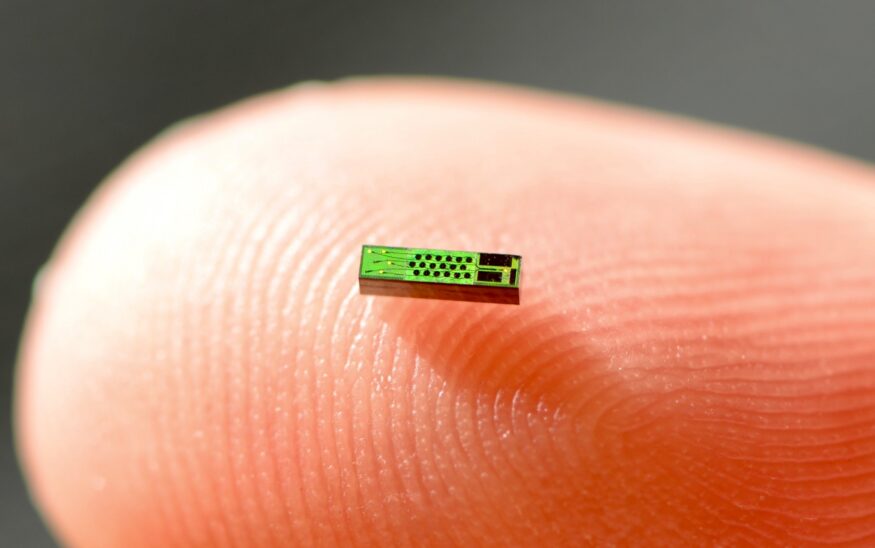
Phlotonics Inc. is developing a sensor platform intended to give biopharmaceutical manufacturers a near-real-time view of proteins inside working bioreactors. The company’s automated at-line system uses silicon photonic chips, tiny devices that use light to detect molecular interactions, to measure several protein markers from a single sample loop in minutes. That could address a stubborn gap in biomanufacturing: operators can continuously track conditions such as temperature, pH, and dissolved oxygen, but many of the molecules that signal product quality or cell stress still require delayed laboratory tests. Phlotonics says its platform can simultaneously measure immunoglobulin G, protein aggregates, interleukin-6, lactate dehydrogenase, and host-cell proteins. The goal is to help teams recognize a developing problem while a batch is still running rather than diagnosing a failed run after the fact. The company emerged from work in the University of Rochester laboratory of co-founder Benjamin Miller, PhD, and is led by CEO Mickey Bryan, PhD, with Daniel Steiner, PhD, as chief technology officer. By bringing molecular measurements closer to the production floor, Phlotonics is pursuing a more data-driven approach to producing biologic medicines.
The blind spot inside bioreactors
Many modern medicines are made by growing living cells in large, closely controlled tanks called bioreactors. These cells can produce antibodies and other therapeutic proteins, but their performance can shift as nutrients change, waste products build up, or the cells experience stress.
Plant operators already monitor physical and chemical conditions continuously. Yet the proteins that may reveal whether cells are healthy, whether a desired product is accumulating, or whether impurities are rising have often remained difficult to follow during production.
Why delayed tests create costly decisions
Conventional laboratory assays can be highly accurate, but they generally require operators to remove a sample, prepare it, and send it through separate testing workflows. Results may arrive hours or days after the sample was taken, leaving a gap between what happened inside the bioreactor and what the production team knows.
That delay matters because a bioreactor is not static. If a process begins drifting, the cells may continue moving away from the desired state while a lab test is underway. Manufacturers can then end up investigating a failed batch after production instead of adjusting the process during the run.
An at-line alternative
Phlotonics calls its approach automated at-line testing. An at-line instrument sits beside the manufacturing process and analyzes material drawn from it, rather than placing a sensor directly inside the tank or relying entirely on a distant laboratory.
The company positions the system between two familiar options. Offline assays can offer molecular specificity but take time, while optical methods such as Raman spectroscopy can quickly detect broad chemical changes but may not identify the particular proteins that determine whether a batch is on track.
Multiple molecular markers from one sample
Phlotonics says its panel can measure immunoglobulin G, or IgG, a major antibody class that includes many therapeutic drugs. It also targets IgG aggregates, which are clumps of protein molecules, along with interleukin-6, a signaling protein associated with inflammation and cellular responses.
Other listed markers include lactate dehydrogenase, or LDH, an enzyme that can indicate cell damage, and host-cell proteins, often shortened to HCP. Host-cell proteins are unwanted proteins made by the production cells that manufacturers need to monitor and remove during purification.
How silicon photonics reads proteins
The platform is built around silicon photonic ring resonators. A useful analogy is a tiny circular racetrack for light: when light travels around the loop, a molecular binding event near the ring can alter the light signal in a measurable way.
In Phlotonics' design, protein binding changes how the chip handles light, allowing the instrument to detect selected molecules without specialized chemical labels. The company says these chips can be made using foundry-scale architecture, referring to semiconductor manufacturing methods designed to produce many devices consistently.
From batch postmortems to intervention
Bryan argues that the value of the system lies in shortening the time between a biological change and an operator’s response. He described a 10-day manufacturing run in which a probe identifies an early cell-stress excursion at hour 96, leaving time for intervention before the run reaches hour 240.
That example captures the central operational promise. Instead of combining many individual test plates and instruments to reconstruct what happened, a production team could receive a streaming panel of selected markers while the cells are still producing the therapeutic material.
A platform rooted in Rochester research
Phlotonics traces its technology to the University of Rochester laboratory of Benjamin Miller, PhD, who co-founded the company with Bryan and Steiner. Bryan and Steiner developed the silicon photonic ring resonator biosensors that form the basis of the company’s instrument platform.
The company sees the chip architecture as adaptable beyond antibody manufacturing. Its immediate focus is the molecular information that bioprocess teams need to follow protein production and cell condition, where each delayed measurement can complicate decisions about a valuable manufacturing run.
Why This Matters
Biologic medicines are not manufactured like conventional pills. They depend on living systems, and living systems can change in ways that are hard to predict from basic process measurements alone. More frequent measurements of product, impurities, and stress-related proteins could give operators a richer picture of what is happening inside the tank.
The practical question is whether faster molecular visibility can help manufacturers prevent problems, improve yields, and use factory capacity more efficiently. Phlotonics is aiming to make protein-level monitoring part of routine process control, turning information that traditionally arrived after a decision window closed into data that can guide the run itself.
Next, the platform will need to demonstrate how reliably its measurements perform across real production settings and how effectively operators can act on the signals it produces. If it can fit into biomanufacturing workflows at scale, silicon photonics could become a useful bridge between laboratory-grade molecular analysis and day-to-day industrial process control.