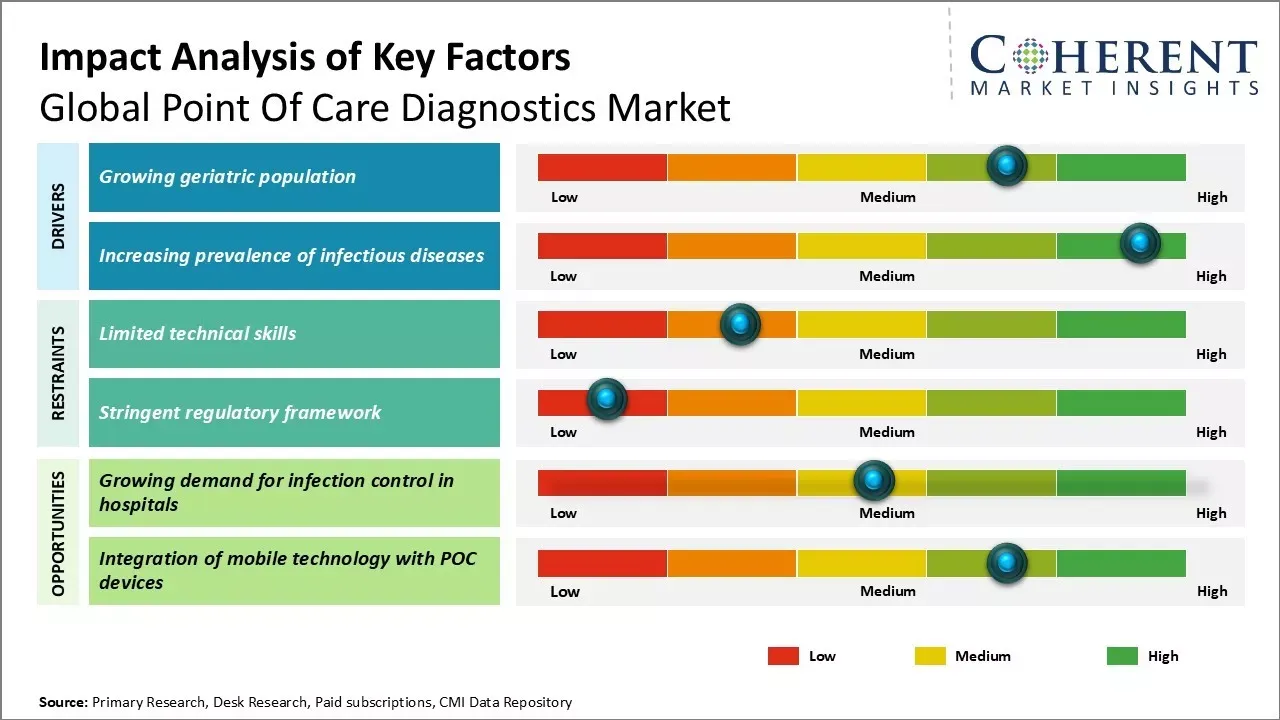
The point-of-care diagnostics market is growing because healthcare providers want test results where and when care happens, not hours or days later in a central lab. These tools are designed to work near the patient, whether that means a hospital bedside, a clinic exam room, or a pharmacy counter. The core value is speed: a clinician can test for an infection, blood sugar level, pregnancy, or other condition and act during the same visit. That matters for routine care, but it matters even more for infection control, where delays can mean more transmission, more unnecessary antibiotics, and higher costs. The source material points to hospital-acquired infections, antibiotic resistance monitoring, and decentralized testing as major forces behind demand. It also describes a technical shift inside the market itself, from simple strip-based rapid tests to compact molecular systems that can deliver results closer to traditional lab quality. Taken together, those changes suggest a market that is not just getting bigger, but also becoming more clinically important. The forecast through 2033 is framed around that idea: faster testing is moving from a convenience to a core part of modern healthcare operations.
What Point-of-Care Testing Actually Means
Point-of-care, often shortened to POC, means diagnostic testing done at or near the place where a patient receives care. Think of it like using a smartphone camera instead of sending film away to be developed: the point is to get useful information immediately, while the moment still matters.
In medicine, that speed can change decisions on the spot. A provider can confirm a condition, start treatment, isolate a contagious patient, or decide that more advanced testing is needed, all without waiting for a sample to travel to a central laboratory.
Why Infection Control Is Driving Growth
The source highlights infection control and prevention as a major growth engine for the market. In hospitals and clinics, rapid testing can help identify infections sooner, which gives staff a better chance to prevent spread to other patients and healthcare workers.
This is especially important for hospital-acquired infections, or HAIs, which are infections people pick up while receiving medical care. When clinicians can detect likely infections quickly, they can make earlier decisions about isolation, treatment, and follow-up, potentially reducing both clinical harm and the financial burden on healthcare facilities.
Speed Also Matters for Antibiotic Use
Another theme in the source is antibiotic resistance. A fast diagnostic test can help doctors avoid prescribing antibiotics blindly, which matters because unnecessary or poorly targeted antibiotic use helps resistant microbes spread.
The basic idea is simple: if you know sooner what kind of infection a patient has, you have a better shot at matching treatment to the problem. Point-of-care testing does not solve antimicrobial resistance on its own, but it can support quicker, more informed decisions that reduce guesswork.
From Simple Rapid Tests to Molecular Platforms
The market is also changing technologically. According to the analyst opinion in the source, point-of-care diagnostics are moving beyond basic lateral-flow assays, the paper-strip style tests used in many pregnancy or rapid antigen tests, toward compact molecular platforms.
A molecular test looks for genetic material from a pathogen rather than relying only on broader chemical signals. The source says this shift is pushing the market toward systems that can deliver results in minutes while approaching lab-quality performance, which raises the clinical value of near-patient testing in settings that need more confidence than a simple screening tool can provide.
Who Is Competing, and Where
The source names Abbott ID NOW and Cepheid GeneXpert as examples of cartridge-based molecular systems that dominate higher-value clinical settings. Cartridge-based means much of the testing chemistry is packaged into a disposable unit, making the system easier to use outside a traditional lab.
At the same time, low-cost rapid tests still compete strongly on price, volume, and distribution reach. That creates a two-track market: one segment focused on affordability and scale, and another focused on higher-performance systems that can justify use in urgent care, hospitals, and other settings where faster, more accurate answers may support more complex decisions.
Why Decentralized Testing Changes Care Delivery
The source emphasizes decentralized testing, meaning diagnostics spread beyond core laboratories into pharmacies, primary care clinics, and other front-line settings. The appeal is practical. If the test travels to the patient instead of the patient sample traveling through a large system, care can move faster and sometimes with less friction.
That model may also reduce transmission risks in some situations by limiting movement through healthcare facilities. It can lower operational costs as well, especially when earlier answers help avoid repeat visits, unnecessary isolation, or delayed treatment decisions.
Access Is Expanding, but So Are the Pressures
The analyst opinion notes the expansion of CLIA-waived testing sites, particularly pharmacies and primary care clinics. CLIA refers to the Clinical Laboratory Improvement Amendments, a U.S. regulatory framework; a CLIA-waived test is considered simple enough, under federal rules, to be used in settings that are not full-service clinical laboratories.
That wider access can put diagnostics closer to everyday care, which is good for convenience and public health reach. But it also creates pressure around reimbursement and regulation, because a test that is easy to use still has to fit payment systems, quality standards, and oversight rules that vary by setting and geography.
Digital Tools Add Another Layer
The source also points to digital integration as a factor behind adoption. In plain terms, this means linking test devices and results to software systems that can track infections, flag trends, and support faster reporting.
That matters because a rapid test is more useful when the result does not stay trapped on a small screen or printed strip. When data flows into broader surveillance and clinical systems, healthcare organizations can monitor outbreaks more effectively and connect individual results to population-level infection management.
Why This Matters
This market forecast is really about a broader shift in healthcare: diagnosis is moving closer to the patient, and that changes both the pace and structure of care. Faster answers can mean earlier treatment, better infection control, and more efficient use of staff and facilities.
But the story is not just about speed. It is also about the growing expectation that point-of-care tests should be accurate enough, connected enough, and easy enough to use that they become part of routine clinical workflow rather than a niche add-on. If that expectation holds, the market's growth through 2033 will reflect a deeper redesign of how healthcare systems make decisions in real time.
Looking ahead, the most important question is not whether point-of-care diagnostics will expand, but which kinds of tests will win in which settings. Low-cost rapid assays will likely remain important for broad access, while compact molecular platforms may keep gaining ground where clinical stakes are higher and lab-like performance is worth the added complexity. How regulators, payers, and providers respond will shape the next phase of adoption just as much as the devices themselves.