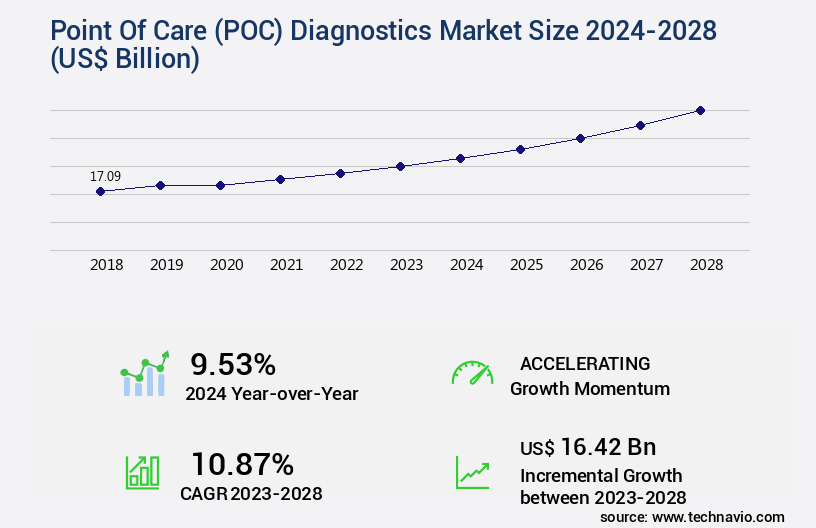
Point-of-care diagnostics—tests performed near the patient rather than in a central lab—are becoming a larger part of everyday healthcare, and a new market forecast from Technavio says that trend is set to continue through 2028. The core idea is simple: instead of sending a sample away and waiting hours or days, clinicians can get useful results during a visit, at a bedside, in a pharmacy, or even at home. That speed matters because faster answers can mean faster treatment decisions, better monitoring of chronic disease, and easier access to care in places where full laboratory infrastructure is limited. The market story also reflects a broader shift in medicine toward more personalized care, where tests help guide decisions for specific patients rather than relying only on broad averages. Technavio’s analysis places point-of-care testing within a wave of technology upgrades, including smarter sensors, compact microfluidic systems, and software tools that help interpret results. The report also points to growing interest in artificial intelligence, mobile health apps, and cloud-connected systems that can turn a single rapid test into part of a larger stream of clinical data. Put together, the forecast describes not just a bigger market, but a change in how diagnostics fit into care: closer to the patient, faster to act on, and increasingly tied to digital tools.
A market built around faster answers
Technavio describes point-of-care diagnostics as a significant healthcare segment because it moves testing closer to where care happens. That can include hospitals, clinics, physician offices, pharmacies, and home settings, all of which benefit when results arrive quickly enough to influence immediate decisions.
The source notes that the global market was valued at USD 35 billion in 2020 and was projected to reach USD 65 billion by 2026, reflecting a 13% compound annual growth rate. A compound annual growth rate, or CAGR, is a way of expressing how fast a market grows each year on average over a period of time.
Why clinicians and patients want point-of-care testing
The appeal of these systems comes down to convenience and timing. Traditional diagnostic workflows often require samples to travel to centralized labs, where processing and reporting can delay decisions; point-of-care tests aim to cut that lag dramatically.
That difference can matter in routine monitoring and in urgent care. If a clinician can confirm a result during a visit, treatment can start sooner, follow-up plans can be adjusted on the spot, and patients may avoid the uncertainty that comes with waiting for a phone call days later.
The technology getting these tests there
Technavio highlights a group of enabling technologies that are improving how these systems perform. One of them is the electrochemical biosensor, which is essentially a tiny detector that converts a biological signal—such as the presence of a biomarker—into an electrical one that a device can measure.
Another is microfluidics, a way of moving very small amounts of liquid through miniature channels. A good analogy is a plumbing system shrunk down to the size of a chip: by precisely guiding droplets or samples, these devices can run reactions quickly, use less material, and fit multiple testing steps into a compact cartridge.
Design is becoming as important as chemistry
The report also emphasizes cartridge-based systems, which package reagents and test steps into self-contained units. For users, that can reduce handling, lower the risk of contamination, and make tests easier to perform outside specialized lab environments.
That shift points to an important change in diagnostics: success is not only about analytical performance, but also about usability. A highly accurate test still has to be easy to run, easy to read, and reliable in the hands of people who may not be laboratory specialists.
AI enters the testing workflow
One of the strongest themes in the source is the growing role of artificial intelligence in point-of-care systems. In practical terms, AI can help software recognize patterns in test results, flag outliers, support assay validation, and make sense of information coming from multiple devices or patient records.
Technavio specifically connects AI to mobile health applications, cloud-based data storage, and disease prediction tools. That means the test is no longer just a one-time readout; it can become part of a connected system that stores trends, compares results over time, and supports clinicians at the moment they need to decide what to do next.
From test strip to decision support
The source notes that lateral flow assays—the simple paper-based format used in many rapid tests—and microfluidic devices are being paired with machine learning tools. Machine learning is a branch of AI in which software improves pattern recognition by learning from data rather than following only fixed rules written in advance.
This matters because some point-of-care tests generate signals that are subtle or depend on context. Software can help interpret those signals more consistently, especially when paired with clinical decision support systems, which are digital tools designed to give providers organized, actionable information at the bedside or in the exam room.
Precision medicine pushes the category forward
Technavio also ties market growth to personalized medicine and disease management. Personalized medicine means tailoring care to the characteristics of an individual patient, often using biomarkers—measurable biological indicators—to guide diagnosis, monitoring, or treatment choices.
Point-of-care tools fit naturally into that model because they can deliver targeted information quickly. When test specificity and accuracy are high enough, they can support more precise decisions in clinical settings and even in research contexts such as clinical trials, where consistent and timely measurement is especially important.
Why This Matters
This forecast matters because diagnostics often shape everything that follows in healthcare. A test result can determine whether a patient is sent home, prescribed medicine, referred for more imaging, or admitted for further care, so shrinking the time between sample and answer can have effects far beyond the lab.
The broader implication is that diagnostics are becoming more distributed and more digital at the same time. Instead of a model where testing lives mainly in centralized facilities, the industry is moving toward a networked approach: compact devices near the patient, software that helps interpret results, and data systems that connect those results to ongoing care.
What to watch next
The next phase for point-of-care diagnostics will likely depend on how well companies balance speed, accuracy, cost, and ease of use. A rapid test only creates value if clinicians trust it, patients can access it, and health systems can fit it into real workflows without adding new friction.
Technavio’s outlook suggests that this market will keep expanding as sensors improve, devices get smarter, and digital tools make results more useful. If that happens, point-of-care diagnostics may increasingly shift from being a convenient alternative to becoming a standard first step in how many medical decisions are made.