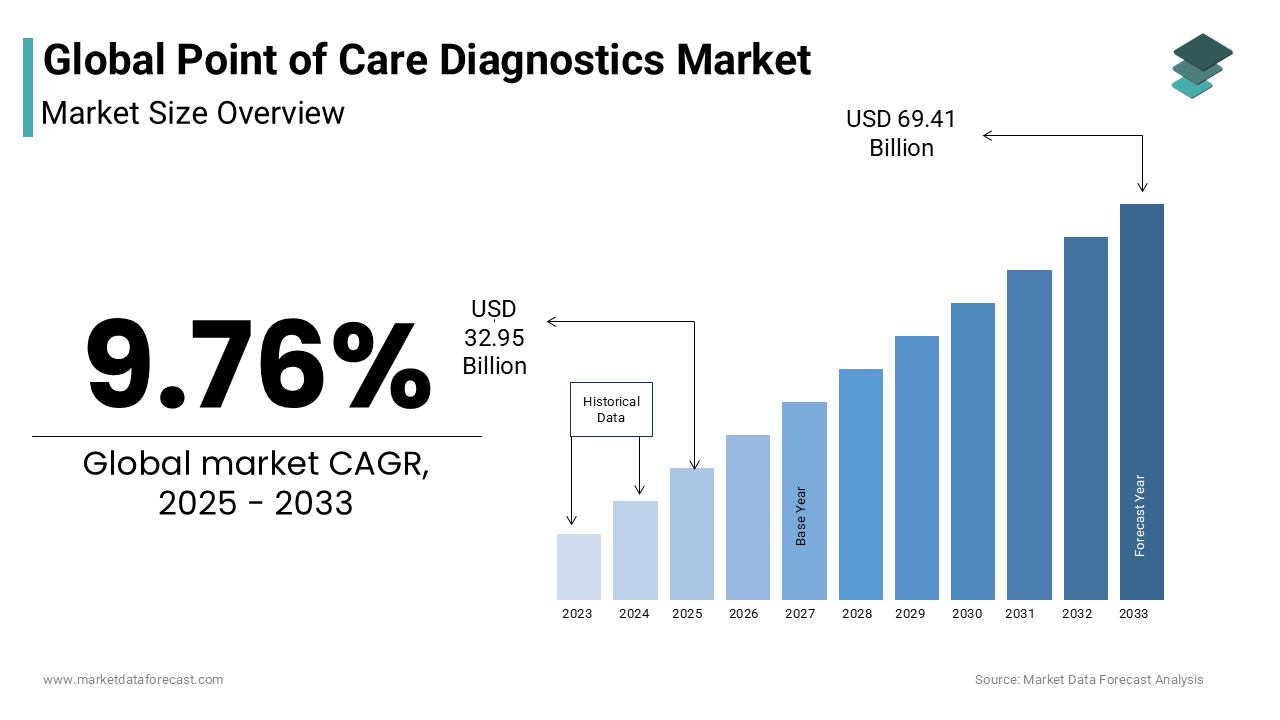
Point-of-care diagnostics, often shortened to POCD, are medical tests designed to deliver results where patients are treated rather than in a distant central lab. The market report summarized here argues that this field is becoming more competitive as healthcare systems push for faster diagnosis, more decentralized care, and better digital links between testing devices and patient records. Large companies such as Abbott, Roche, and Danaher are competing not just on accuracy and speed, but on how well their instruments connect to broader care workflows, including remote monitoring and data management. A major technical battleground is the effort to shrink molecular diagnostics—tests that detect genetic material from viruses, bacteria, or tumors—into smaller, easier-to-use formats without losing sensitivity. The report also highlights how public policy shapes demand, with pandemic preparedness funds, national screening campaigns, and public procurement decisions all steering adoption. Regional examples from Latin America and the Middle East suggest that point-of-care testing is no longer a niche convenience tool; in many places, it is becoming part of routine public health infrastructure. At the same time, the market is not moving evenly, because reimbursement gaps, import dependence, and uneven access still limit how quickly these tests spread. Taken together, the report presents a market driven by a simple idea with big consequences: if accurate testing can move closer to patients, treatment can start sooner and health systems can act faster.
Competition Is Moving Beyond the Test Itself
The report describes a market where the core contest is no longer only about who can produce a fast, accurate test. Companies are also trying to build complete ecosystems around their devices, linking instruments to software, clinical databases, and remote care platforms.
That matters because a point-of-care device is more useful when the result can travel instantly to the right clinician, public health system, or patient record. In practice, this means competition now includes digital connectivity, data handling, and the ability to fit into broader hospital and clinic workflows.
The Push to Miniaturize Molecular Testing
One of the clearest trends in the report is the race to miniaturize molecular diagnostics. Think of it like shrinking a full music studio into a smartphone without losing sound quality: the goal is to compress a complex laboratory process into a compact device that still produces reliable answers.
In medical terms, molecular diagnostics look for biological signatures such as DNA or RNA, the genetic instructions used by living cells and many pathogens. Bringing those tests closer to the patient is especially important in infectious disease and oncology, where waiting days for a result can delay isolation, treatment, or follow-up care.
Public Health Programs Are Shaping Demand
The report makes clear that this market is being pushed not only by technology companies but also by governments and public health agencies. Pandemic preparedness budgets, national screening efforts, and formal procurement programs can create large, stable demand for specific kinds of point-of-care tests.
That changes how vendors compete. A company may win not just by offering the best instrument on paper, but by proving it can supply tests at scale, support public clinics, and meet policy goals such as faster detection of tuberculosis, HIV, diabetes, or prenatal infections.
Latin America Shows How POCD Can Change Care Pathways
Latin America is presented as a region with steady growth potential, supported by concrete examples of public adoption. In Brazil, the report says the Unified Health System, known as SUS, has integrated rapid molecular tests for tuberculosis and HIV into more than 5,000 primary care units.
According to the Brazilian Ministry of Health data cited in the report, that shift cut diagnosis time from weeks to hours. That kind of time reduction is not a small operational tweak; it can change whether a patient begins treatment quickly, whether transmission is reduced, and whether the health system can respond before cases become harder and more expensive to manage.
The same section points to Brazil’s expansion of diabetes screening programs using point-of-care diagnostics in community health centers, reaching more than 2 million patients each year. This suggests that the technology is being used not only for acute infectious disease but also for long-term chronic disease management, where frequent testing close to home can improve follow-up.
Argentina offers another example. The report says national point-of-care syphilis testing in prenatal clinics contributed to a 33% decline in congenital syphilis cases between 2018 and 2022, citing the National Directorate of Epidemiology. Congenital syphilis occurs when the infection passes from a pregnant person to a baby, so earlier diagnosis in prenatal care can directly prevent severe harm.
Growth Is Real, but So Are the Frictions
Even in regions showing strong momentum, the report does not present adoption as frictionless. In Latin America, import dependence and uneven reimbursement remain major obstacles, which means clinics may want these tools before financing systems are fully prepared to support them.
That tension is common in diagnostics. A fast test may save time and improve outcomes, but if a health system does not consistently pay for it, or if supply chains depend heavily on imported devices and cartridges, expansion can slow despite clear clinical benefits.
Middle East and Africa Are Strategic Growth Areas
The report describes the Middle East and Africa as strategically important because of large unmet diagnostic needs and rising public health investment. In simple terms, these are places where faster local testing could fill major gaps in access, especially where central laboratory infrastructure is uneven or overloaded.
The United Arab Emirates is highlighted as an example of organized deployment. According to the report, the country’s Weqaya national screening program uses point-of-care diagnostics for diabetes and cardiovascular risk assessment in more than 300,000 citizens annually, citing the Dubai Health Authority. Cardiovascular risk refers to the likelihood of future heart and blood vessel problems, and rapid local screening can help identify people who need earlier follow-up.
Why This Matters
What makes this market important is not just its commercial scale, but the way it shifts where medicine happens. Instead of sending samples away and waiting, point-of-care diagnostics can bring decision-making closer to the bedside, the clinic, or the community health center.
That shift matters most when time changes outcomes. For tuberculosis, HIV, syphilis, diabetes, and cardiovascular screening, faster answers can mean earlier treatment, quicker isolation or referral, and fewer patients lost between testing and care. It also matters for health systems trying to extend services beyond large hospitals into primary care settings.
What to Watch Next
If the report’s direction is right, the next phase of this market will depend on who can combine strong test performance with practical deployment. Accuracy still matters, but so do affordability, reimbursement, supply reliability, and software systems that make results immediately useful.
The broader signal is that point-of-care testing is becoming part of healthcare infrastructure rather than a specialist add-on. As countries continue to invest in early diagnosis and decentralized care, the companies and health systems that succeed will likely be the ones that treat diagnostics not as isolated devices, but as connected tools inside a larger care pathway.