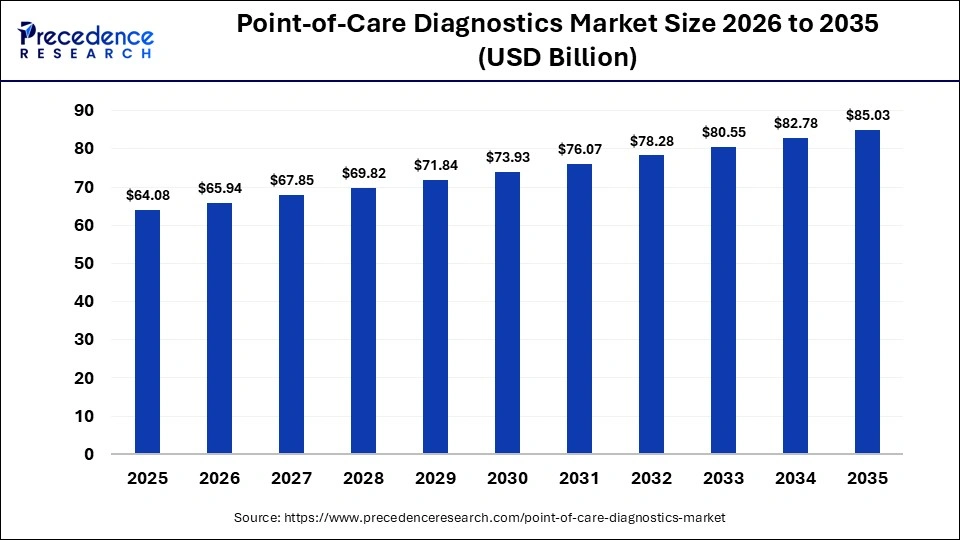
The market for point-of-care diagnostics—tests that deliver results near the patient instead of in a central lab—is projected to reach USD 85.03 billion by 2035, according to the source material. That forecast reflects a broad shift in healthcare toward faster, more local decision-making, especially for conditions where time matters, such as infectious disease, diabetes, cancer, and heart disease. The basic idea is simple: rather than sending a sample away and waiting hours or days, a clinician can run a test in a clinic, pharmacy, ambulance, or even at home and get an answer quickly. The report ties expected growth to several forces moving at once, including advances in device design, rising disease burden, and continued spending by major companies. It also points to the growing influence of microfluidics, a technology that moves tiny amounts of liquid through miniature channels, often on a chip no larger than a credit card. That matters because smaller, cheaper, and easier-to-use devices can expand access far beyond large hospitals. In practical terms, the market story is not just about sales growth; it is about how diagnostics are being redesigned to fit the pace and geography of real-world care. If the forecast holds, point-of-care testing will become an even more visible part of how patients are diagnosed and monitored over the next decade.
What the Market Forecast Is Pointing To
The source describes point-of-care diagnostics as medical devices used for the diagnosis and monitoring of disease with near-immediate results. These tools already cover a wide clinical range, from glucose testing in diabetes to assays used in cancer, cardiovascular disease, and infectious disease.
The projected market size of USD 85.03 billion by 2035 suggests that investors and manufacturers expect this category to keep expanding. The report also says the industry offers room for growth for both established companies and newer entrants, a sign that the field is still open to technical differentiation and niche applications.
Why Speed Changes Care
A useful way to think about point-of-care testing is to compare it to the difference between streaming a live update and waiting for a mailed report. In medicine, that time gap can shape what happens next: whether a patient gets an antibiotic, whether a clinician orders more tests, or whether a chronic condition is adjusted on the spot.
The source emphasizes that these devices provide a boost to a patient-centric approach. In plain terms, that means care can happen closer to where the patient is, with less delay between testing and action. For monitoring long-term illness, that convenience can be as important as the test itself.
The Technology Behind the Trend
One of the clearest drivers in the report is continued improvement in point-of-care device technology. The source specifically highlights microfluidics, which is the controlled handling of tiny droplets or streams of liquid through very small channels. If a traditional lab is like a full industrial kitchen, a microfluidic chip is more like a compact coffee machine that performs a specific process with very little material.
That miniaturization matters because diagnostic chemistry often works well at small scales. When developers combine microfluidics with microfabrication—manufacturing techniques used to build tiny structures—they can create devices that use smaller sample volumes, require less reagent, and deliver results quickly in portable formats.
Why Costs and Portability Matter
The source says recent advances have made point-of-care devices cheap to produce, simple to use, portable, and fast. Those four traits help explain why the market outlook is strong. A test does not need to match every capability of a full laboratory to be valuable; it needs to answer the right question at the right moment.
Lower-cost manufacturing can also widen the customer base. Hospitals remain important buyers, but portable systems can also fit urgent care clinics, physician offices, pharmacies, field settings, and home use. As devices become easier to operate, they may also require less specialized training, which can extend their reach into settings with fewer lab resources.
Disease Burden Is Fueling Demand
The report links market growth to the rising incidence of infectious diseases. That makes intuitive sense: when infections spread quickly, health systems need ways to identify cases rapidly and decide on treatment or isolation without waiting for central lab turnaround times.
The same logic applies to chronic diseases. Diabetes management benefits from frequent measurement, and cardiovascular or cancer-related care often depends on repeated testing over time. In each case, tools that shorten the path from sample to answer can fit more naturally into routine care.
Industry Investment and Competition
Another growth factor named in the source is increased expenditure by key companies. In market terms, that usually points to spending on research, product development, manufacturing scale-up, and commercial rollout. It also suggests that major players see point-of-care diagnostics as a durable category rather than a temporary spike.
At the same time, the report notes that the sector has space for both existing and new companies. That combination often appears in markets where the core need is clear, but product formats, target diseases, and technical approaches are still evolving. A company might compete on speed, another on portability, and another on the breadth of conditions its platform can test.
Why This Matters
The deeper significance of this market forecast is that it tracks a broader redesign of healthcare infrastructure. Diagnostics have traditionally depended on centralized labs, trained technicians, and physical distance between the patient and the test result. Point-of-care systems compress that chain, bringing the analytical step closer to the bedside, clinic counter, or home.
That shift can improve convenience, but it can also change clinical workflow. Faster answers may support earlier treatment decisions, reduce repeat visits, and make monitoring more continuous. For health systems under pressure to do more with limited time and staff, those operational gains can be just as important as the devices' technical performance.
What to Watch Next
The source also mentions that numerous research projects are underway in microfluidics, which suggests the technology pipeline is still active. That matters because future growth will likely depend not only on wider adoption of existing tests, but also on whether developers can expand into new diseases, improve accuracy, and keep costs low.
Over the next decade, the most successful point-of-care diagnostics will likely be the ones that balance three things at once: trustworthy results, easy use, and clear clinical value. If companies can keep delivering on that combination, the market's projected climb to 2035 will reflect more than commercial momentum—it will mark a steady move toward diagnostics that fit everyday care rather than forcing care to fit the lab.